31 July,
2014 - 14:02 april holloway
Radical new documentary
claims Copernicus and four centuries of science is wrong
A new
documentary called The Principle, which is due to be launched on
10th October, is set to take on more than four centuries of established belief
in the Copernican Principle by presenting shocking new scientific evidence that
suggests the Earth holds a special place within the cosmos. The film has
already resulted in an absolute media frenzy, smear campaign, and storm of
controversy as furious scientists vehemently defend their position – and that’s
before they have even seen the evidence. Could we be on the edge of a radical
new understanding of our universe and our place within it? Rick Delano, Writer
and Producer of The Principle believes we are.
While
most of us today assume that our brilliant scientific minds, space exploration
programs, and high-tech telescopes and equipment have long since proven that
the Earth orbits the sun, Mr Delano explains that no experimental evidence has
ever been obtained that unequivocally proves this to be true. As historian
Lincoln Barnett states in The Universe and Dr. Einstein, "We can't
feel our motion through space, nor has any physical experiment ever proved that
the Earth actually is in motion." Hence, Mr Delano states that the
Copernican Principle is not a scientific fact, but rather a metaphysical
assumption supported by profoundly convincing ideas and theories. His film, The
Principle, is the first documentary ever to directly examine the scientific
basis of the Copernican Principle by bringing together top scientific experts
in a commentary, which he says, will leave us questioning our very place within
the cosmos.
Ancient belief about our place within the cosmos
For
thousands of years, there was a prevailing geocentric view of the cosmos, in
which the Earth was believed to be the centre of the universe. By looking up at
the sky and seeing the Sun, Moon, planets, and stars moving about Earth along
circular paths day after day, it seemed evident to ancient people that the
Earth was stationary and the rest of the universe moved around it. Such a
perspective was also in accordance with the God-centred worldview which
maintained that a god or gods created us, and that there is a purpose to this
creation.
Nevertheless,
Mr Delano explained in an interview with Ancient Origins that “the ancients
were more than intelligent enough to understand that the same observational
phenomena would be equally attributable to a rotation of the earth on its
axis.” So, why then was this perspective not adopted in ancient times?
“The
simple truth is that the ancient world found it more plausible to believe that
we were clearly the focus and centre of what we saw going around us,” added
Delano.
Thus, the
geocentric model of the universe came to be adopted as the predominant
cosmological system in many ancient civilizations such as ancient Greece (from
4th century BC), including the noteworthy systems of Aristotle and
Ptolemy. The astronomical predictions of Ptolemy's geocentric model were used
to prepare astrological and astronomical charts for over 1,500 years.
However,
the work of Nicolaus Copernicus (1473 – 1543), a brilliant mathematician and
astronomer from Royal Prussia, a region of the Kingdom of Poland, laid the
foundations that eventually resulted in thousands of years of belief in a geocentric
model of the cosmos being turned on its head.
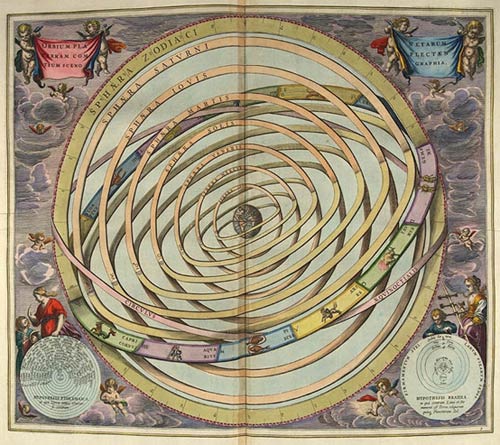
The Ptolemaic Geocentric Model. Source: Wikipedia
The Copernican Revolution
In his
publication De Revolutionibus Orbium Coelestium (On the Revolutions of
the Celestial Spheres) in 1543, Copernicus proposed the replacement of the
geocentric system for a heliocentric model, in which the Earth and the other
planets orbit the Sun, on the basis that heliocentrism could explain the motion
of celestial bodies more simply than the geocentric view. The implication of
this revolutionary idea was that Earth could no longer be seen as being in any
central or specially favoured position, a concept which became known as the
Copernican Principle.
This was
shocking and it was met by one stubbornly resistant force – the Catholic
Church. After all, what would it really mean for civilization and
religion to find that “we live on an insignificant planet of a humdrum star
lost in a galaxy tucked away in some forgotten corner of a universe in which
there are far more galaxies than people," as Carl Sagan succinctly
expressed in the 20th century?
Such a
radical change in world-view could not happen overnight and indeed it was at
least another century before Copernicus’s ideas came to be well
established. In the meantime, numerous scientists came forward to try to
measure the Earth’s orbit around the Sun.
“For two
centuries the greatest scientists in the world tried to come up with an
experiment that would measure that motion of the earth around the sun, that
everyone almost knew was obviously occurring,” explained Delano. “But
paradoxically, for two centuries every one of these experiments that tried to
measure this universally assumed motion of the Earth around the Sun kept
returning a value of zero for the motion of the earth, and this became a really
big issue in science.”
The
Danish astronomer Tycho Brahe (1546-1601), a brilliant experimental scientist
whose measurements of the positions of the stars and planets surpassed any that
were made prior to the invention of the telescope, proposed a model that
attempted to serve as a compromise between the geocentric explanation and the
Copernican theory. In this model, all planets except the Earth
revolve around the Sun. In other words, the planets revolve around the Sun, and
the Sun revolves around the Earth.
“The
remarkable thing is that the Tycho system absolutely duplicates the
observations we see in the sky just as the heliocentric system does. There is
no visual distinction at all between the Tycho system and the Copernican
system,” explained Delano.
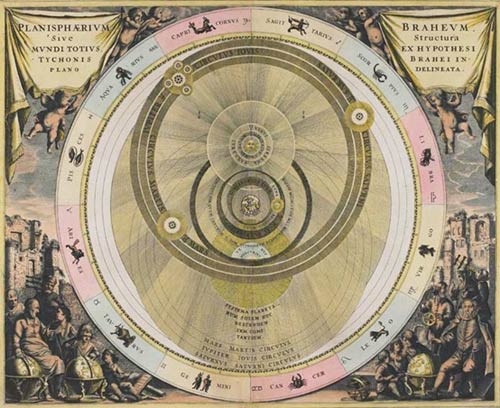
Tycho Brahe's Geo-Heliocentric Model. Image source:
Wikipedia
Throughout
the 16th and 17th centuries, huge advances were made in
the field of astronomy and science through the work of Johannes Kepler, Galileo
Galilei, and Isaac Newton, whose work is far too involved to be able to address
adequately in this article. So we shall jump ahead to the 20th
century and the work of Albert Einstein.
Einstein,
puzzled by the failure of every experiment to measure the universally assumed
motion of the Earth around the Sun, searched for a reason to explain why this
could not be measured. The result? Einstein’s famous Theory of Relativity.
Shockingly, Einstein maintained that absolute motion cannot be detected by any
optical experiment as no particular frame of reference is absolute. In other
words, the physics works just as well to have the Earth at the centre with the
Sun going around, as to have the Sun at the centre with the Earth going around.
Nevertheless,
Einstein maintained that even though it may look like we are at the centre of
the universe with all the galaxies moving away from us (as Edward Hubble
observed through his telescope in the 1920s), this is only an illusion. He maintained
that since space is not flat but curved, and since space is expanding, wherever
one may be located in that space, the movement of the galaxies would appear to
be radiating away from that point. This theory certainly supported the
Copernican Principle that there are no centres, no edges, and no special
positions. According to Delano, here is where the big problem comes in.
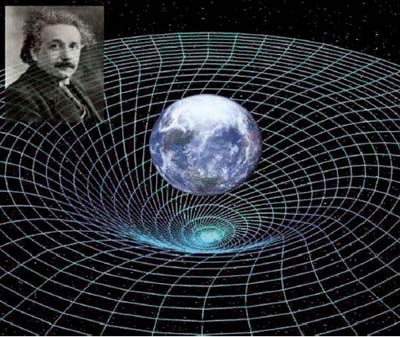
Einstein’s flexible space/time. Image source.
New cosmological observations challenge Copernican
Principle
Over the
last decade, a number of anomalous cosmological observations have emerged which
do not make sense according to the Copernican Principle, the latest being the
Planck satellite results of March 2013. While the science behind the
findings is complex, to put it simply, the Copernican Principle requires that
any variation in the radiation from the Cosmic Microwave Background (thermal
radiation assumed to be left over from the ‘Big Bang’) be more or less randomly
distributed throughout the universe. However, the results of three
separate missions, starting with the WMAP satellite in 2001, has shown
anomalies in the background radiation which are aligned directly with the plane
of our solar system and the equator of the Earth. This never-before-seen alignment
of the Earth results in an axis through the universe, which scientists have
dubbed the ‘Axis of Evil’, owing to the shocking implications for current
models of the cosmos.
Laurence
Krauss, American theoretical physicist and cosmologist, commented in 2005:
When you
look at [the cosmic microwave background] map, you also see that the structure
that is observed, is in fact, in a weird way, correlated with the plane of the
earth around the sun. Is this Copernicus coming back to haunt us? That’s crazy.
We’re looking out at the whole universe. There’s no way there should be a
correlation of structure with our motion of the earth around the sun — the
plane of the earth around the sun — the ecliptic. That would say we are truly
the center of the universe.
Cosmologists,
astrophysicists, and others initially brushed off the strange finding as an
artifact, and dozens of papers and reports followed trying to address the
anomaly. But when the Planck results returned in March 2013, the alignment
showed up in yet even higher resolution and detail, and has now been replicated
across three separate missions, suggesting there is something more than an
‘artifact’ that is going on here.
“The
thing that has really launched the media hysteria about our film, is that we
are pulling the covers off the dirty little secret that not only is there
structure, that structure is related in astonishing ways to one and precisely
one location in the universe, and it happens to be us,” said Delano.
If there
is something fundamentally wrong with the Cosmological and Copernican
Principle, our entire picture of reality is about to change again, and the
irony is that just like the last two great scientific revolutions, both were
centred around this puzzling persistent question about our place in the cosmos.
Whether
The Principle documentary presents a convincing enough argument to seriously
undermine the Copernican Principle and more than four centuries of science remains
to be seen. But one thing is for sure, come the October 10 launch date, we
can’t wait to find out.
Source: http://www.ancient-origins.net/news-evolution-human-origins-human-origins-science/radical-new-documentary-claims-copernicus-and#!bs7lRK


No comments:
Post a Comment