Monday, September 26, 2016

What is Trisodium Phosphate?

What is Trisodium Phosphate doing in thousands of consumer products, including kid’s cereals?
Did you know Trisodium Phosphate (also known as TSP) is an additive and flavor enhancer found in thousands of frozen and processed foods includingprocessed meat, processed cheese, commercial bakes and goods, canned foods,nutritional supplements, and even kids cereals?
Trisodium Phosphate is found in other consumer products including toothpastes, baby toothpastes, shampoos, mouthwash, cosmetics, hair coloring and bleaching agents.
trisodium-phosphate-paint-thinner-in-consumer-products-kids-cheerios-cereals
When I looked at the Material Safety Data Sheets (MSDS) to learn more about TSP, I realized that it used to be an ingredient inside industrial cleaners until EPA and OSHA found it too toxic for employees.
Amazingly, Trisodium Phosphate currently used as an industrial paint thinner is used inside children’s breakfast cereal in stores like Trader Joe's.
Trisodium Phosphate is an inorganic salt commonly used by construction workers and developer, but most parents who buy breakfast cereals for their kids, don’t expect to find TSP as an ingredient in cereals of stores like Trader Joe's that offer people a higher quality of food.
A concerned mother writes that she contacted General Mills to find out what TSP is doing inside her kids cereals. Here is what General Mills had to say:
 "TSP is used as a buffer to adjust the acidic nature of the cereal dough. In home cleaning products TSP is used in large quantities. In our food products we use very small amounts. Theoretically, any food grade base could be used: sodium hydroxide, potassium hydroxide, ammonium hydroxide, ammonium phosphate, etc. At General Mills we have found that TSP works best in our particular products, and has been approved as safe for use in food by the Food and Drug Administration."
Obviously there is a limit on how much poison can be tested on human beings since TSP is known to be hazardous to human’s health:
Although FDA claims that smaller levels of TSP isn’t hazardous to human’s health, other agencies have reported TSP as a hazardous substance and have linked TSP to carcinogenicity, neurotoxicity, Abdominal burning, or reproductive failures.
The Clean Water Act has now taken steps to limit the use of TSP in cleaning products, because it damages the environment. Although TSP has not been proven to be toxic to human’s health (because no agency has invested enough time and money to research it any further), it has shown to be severely irritating to gastric mucosa.
Excessive TSP is also known to lead to kidney toxicity, calcium deficiency and osteoporosis and imbalances of minerals in the bones.
FDA safely limit of TSP is about 70 mg per day, however, (with TSP being used in thousands of consumer products), an average American can be exposed to more than 500mg of TSP a day.
Here the list of common cereals that have Trisodium Phosphate as an ingredient:
why-is-Trisodium-Phosphate--in-our-childrens-food
-Trader Joe's O's
- Mom's Best Cereals
- Cheerios
- General Mills
- Cinnamon Toast Crunch
- Golden Grahams
- Honeycomb
- Lucky Charms
- Wheat Squares Cereals
- Trix
- Cocoa Puffs
- Triple Berry Toasted
- Wheat chex
- Cookie Crisp
- Party Mix
- Tasteeos
- Reese's Puffs
- Heart Healthy Cereal
- Kix
- Cinnamon Toast Crunch
- Froot loops
- Meijer Honey Nut Toasted Oats
- Oatmeal Crisp Cereal
- Nestle Nesquik Cereal
- Cookie Crisp Cereal
- Magic Stars Cereal
- Nestle Oats & More Raisin
- Quaker
- Kellogg’s Corn Pops
Tell FDA and your local grocery store to remove Trisodium Phosphate from food products:
Thousands of consumer products are filled with toxic ingredients, additives and preservatives that are banned in many countries. Find out more about Top 10 foods, additives and preservatives that are banned in many countries except US: http://www.seattleorganicrestaurants.com/vegan-whole-food/foods-banned-in-other-countries-but-we-eat-in-us.php
While your dinner is banned in 30 other countries, biotech and chemicals companies spend millions of dollars to keep GMOs hidden in our food supply. The only way to make your voices heard is to boycott cancer-causing chemicals and toxic additives that are regulated and considered safe in your food by FDA.
Be the change you want to see in the world and boycott consumer products that have tons of toxic additives like Trisodium Phosphate. We must fight for our right to non-toxic foods. Please submit your comment to FDA and ask them to ban toxic additives like TSP from our food:


http://www.fda.gov/aboutfda/contactfda/default.htm

Top 10 Toxic Kid Cereals To Avoid At All Costs

Top 10 Toxic Kid Cereals To Avoid At All Costs
When we think of kids’ breakfast in America, we tend to think of the icons we grew up with: Cap’n Crunch, Tony the Tiger and Count Dracula. This kind of marketing has encouraged kids to demand cereal loaded with sugar and has also eroded our concept of what comprises a healthy breakfast. Cold cereals can dominate an entire aisle in your supermarket, but what’s hiding in those cereals can be doing damage to your child.
Like our expose on peanut butter and what’s really in your orange juice, Mamavation took a look at some of the most toxic ingredients hiding in your child’s breakfast cereal:
Toxic Ingredients in Your Kid’s Cereal
  • Sugar: Many kids’ cereals are high in sugar or high fructose corn syrup (HFCS), which is also called corn syrup or corn sugar. Generally, if you see “sugar” of any kind in non-organic or GMO cereal, very likely it’s HFCS.
  • GMOs: Most conventional cereals contain sugar and corn made from GMO products. Note that these same manufacturers create GMO free cereals for distribution overseas.
  • Hydrogenated Oils: Partially hydrogenated oils contain trans fats, which, as we’ve discussed before, are linked to cancer, heart disease and immune problems. Fully hydrogenated oils are full of saturated fat. In addition, some companies will label partially hydrogenated oils as just “hydrogenated oils,” so you can’t be sure if there is trans fat in the product. (If there is less than 0.5 grams of trans fat per serving, companies are allowed to write “0 grams of trans fat.”)
  • BHA: Another GRAS additive, BHA has been linked to cancer in some studies. The National Institutes of Health’s National Toxicology Programs has concluded that it can be “reasonably anticipated to be a human carcinogen.” Both BHA and BHT are said to be at low enough levels to be safe for consumption by the FDA.
  • Soy Lecithin: Derived from GMO soy, this additive often contains toxins. According to The Cornucopia Institute, soy lecithin processing often involves hexane, and, though it is removed, trace amounts can be left behind. That residue is unregulated by the FDA even though it is listed by that organization as a potential carcinogen and neurotoxin
  • Annatto: This natural flavoring is now entering into controversy.According to WebMD, it can affect blood sugar levels so if your child has diabetes, please be aware of that. It also has been linked with allergies, and the Food Intolerance Network has gotten reports linking it to headaches and irritability. If you have a sensitive eater or a child prone to allergies, you may want to avoid this flavoring.
  • BHT: Found in many cereals, this food is classified by U.S. law as “GRAS” – “generally recommended as safe” – by the FDA. This means that experts consider them safe and they are approved as food additives without additional testing of their effects. In 2014, the National Resources Defense Council (NRDC), an environmental safety watchdog group, released “Generally Recognized as Secret: Chemicals Added to Food in the U.S. (PDF).” This report found loopholes in the GRAS classification, including research data coming from the company themselves and expert opinions that disregarded evidence of allergic reactions, that compromise the real safety of GRAS additives. BHT is also a chemical additive and may be a possible ADHD trigger.
Why You Should Also Care About Processing
Many cereals are manufactured using something called the “extrusion process.” This exposes the grains to high levels of heat and pressure, which changes the nature of the grain, effectively turning it into processed food.FoodMatters.com quotes biochemist Paul Stitt, who notes that this process destroys most of the grains’ natural nutrients. This is why many cereals are fortified, although extrusion can destroy those added nutrients as well.
In addition, the proteins in extruded grains are fundamentally altered, leaving a product that may be toxic. According to “Dirty Secrets of the Food Processing Industry,” two known but unpublished experiments exist testing breakfast cereal on lab rats exist; in both studies, the rats eating breakfast cereal and water died before rats that were either not fed at all or fed the cardboard cereal box and water. One published study showed that these rogue proteins could interact with “each other and other components, forming new compounds that are foreign to the human body.”
The real problem with that the extrusion process is not just the lack of recent research on its effect on proteins, but that organic cereals as well as conventional brands often employ this method.
The Trouble with Fortified Foods
Many cereals try to cover up their high sugar content with fortification, that is, adding back in nutrients after-the fact. As mentioned, extrusion can delete these nutrients. The second problem with fortified foods is that some can contain too many nutrients, which can actually be toxic for your child. The Environmental Working Group did a survey of major brand cereals in 2014 and found that “one serving would over expose children to” zinc, niacin and vitamin A. While many of those brands were geared towards adults, Kellogg’s Cocoa Krispies and Chocolate Krave were in the high Vitamin A list.
Controversial Ingredient
You may have heard the claims about “antifreeze” being found in cereal. I did a little digging on this topic recently and discovered that the culprit – trisodium phosphate (TSP) – often found in cereal, has gotten a bad rap. According to LiveStrong, this additive affects color, extrusion and adds phosphorus. Antifreeze contains trisodium phosphate powder used in chemicals like paint thinner and antifreeze and acts as a cleaning agent.
Sounds bad, right? So I hopped over to EWG’s website and entered the words. It turns out that TSP is an inorganic salt. EWG gives it a score of “0” on their toxicity scale and lists no known hazard whatsoever. The PAN Pesticides Database also lists this chemical, warning “avoid all contact,” yet there is no conclusive data on that same database of why it is toxic. Perhaps more studies need to be done on this chemical. You should know that it is a chelating agent and a pH adjuster, in case that affects anyone in your household. I’ve listed the top 10 toxic kid cereals that contain this ingredient, so you can make your own decision about TSP.
Top 10 Toxic Kid Cereals
When it came to the listing “most toxic” cereals, we faced a challenge. Should we list those with the most sugar? The most dangerous levels of vitamin? Dyes? BHT? We could go on forever, but I checked some current ingredients and believe these are some of the worst offenders and why. All of these use extrusion processing, contain GMOs and are fortified. Sugars listed are the amount for 1 serving size in grams.
  1. Kellogg’s Fruit Loops: Sugar, hydrogenated or partially hydrogenated vegetable oils, modified food starch, annatto, BHT, artificial dyes including red #40, 10g of sugar. Fruit Loops with Marshmallowscontains 13g.
  2. Kellogg’s Corn Pops: Sugar and molasses, hydrogenated vegetable oils, annatto, BHT, 9g of sugar.
  3. Kellogg’s Apple Jacks: Sugar, partially and fully hydrogenated vegetable oils, modified food starch, modified corn starch, artificial dyes including red #40, BHT, 10g of sugar.
  4. Kellogg’s Honey Smacks: Sugar, honey and dextrose, partially and fully hydrogenated vegetable oils, soy lecithin, BHT and topping our list with a whopping 15g of sugar.
  5. General Mills Lucky Charms: Sugar, corn syrup and dextrose, modified corn starch, trisodium phosphate, artificial dyes including red #40, artificial flavor, 10g of sugar.
  6. General Mills Boo Berry/Count Chocula/Franken Berry: Sugar, dextrose and corn syrup, modified corn starch, canola oil, BHT, trisodium phosphate, artificial flavor, artificial dyes including red #40, artificial flavor, 9g of sugar.
  7. General Mills Trix: Sugar, corn syrup, BHT, trisodium phosphate, artificial dyes including red #40, 10g of sugar.
  8. Post Foods Fruity Pebbles: Sugar, hydrogenated vegetable oils, BHA, artificial flavor, artificial dyes including red #40, 9g of sugar.
  9. Cap’N Crunch CrunchBerries: Sugar, brown sugar, BHT, artificial flavor, artificial dyes including red #40, 11g of sugar. OOPS! All Berries contains 15g of sugar.
  10. Post Golden Crisps: Corn syrup, honey, caramel color. I had to add this one even though it’s not full of too many toxins because of the sugar content: a whopping 14g per serving!
These are some of the worst offenders and I could have kept going. There were a few brands I wasn’t sure if they still made, like Reese’s Puffs – if they do, please avoid it! The rule, however, is simple: if it’s covered in sugar or has a “flavor” (chocolate, cinnamon, apple), it’s probably very high in sugar. If it’s colored, it most likely contains artificial dyes, especially red #40, which is linked to ADHD. And if it’s a conventional brand, it most likely has additives and artificial flavors.
Cereals: which to avoid, which to buy
For healthy children, the American Heart Association recommends a daily sugar intake of no more than 16.7g per day for preschoolers, 12.5g per day for children ages 4-8 and tweens and teens 21-33g . Naturally, these amounts are subject to their daily caloric intake. As you can see, 1 serving size bowl of these top 10 toxic kid cereals can contain more than all their sugar for the day – and kids commonly pour more in their bowl than the recommended serving.
Top 10 Kid-Friendly Cereals to Try
We couldn’t complete this expose without some healthy recommendations. I had a hard time finding any company that did not 100% use extrusion, although I read that Nature’s Path doesn’t use it in all their products. That said, we all know that breakfast cereal has to be kid-friendly. You may be lucky enough to have a child who’ll sit down to a bowl of muesli, but I don’t know any kids like that myself!
Here are my picks for organic brands that have kid-friendly cereals, including replacement cereals for Corn Flakes, Frosted Flakes, Cheerios and Rice Krispies, as well as puffed rice and a berry option. The cereals with flavor tend to have higher sugar content but still lower than any of the conventional brands listed above. Sugars listed are the amount for 1 serving size in grams.
  1. Nature’s Path Fruit Juice Sweetened Corn Flakes: USDA organic and Non-GMO Project certified, they are also gluten free. Contains 3g of sugar.
  2. Nature’s Path Honey’d Corn Flakes: USDA organic and Non-GMO Project certified, they are also gluten free. Contains 4g of sugar.
  3. Nature’s Path Whole O’s: USDA organic and Non-GMO Project certified, they are also gluten free. Contains 4g of sugar.
  4. Envirokidz Peanut Butter Panda Puffs: USDA organic and Non-GMO Project certified, they are also gluten free. Contains 7g of sugar.
  5. Envirokidz Amazon Flakes: USDA organic and Non-GMO Project certified, gluten free and vegan, 6g of sugar.
  6. Erewhon Organic Corn Flakes: USDA organic and Non-GMO Project certified, these are also certified gluten free and are listed at “0” grams of sugar. Also available in Mixed Berry flavor, which contains 2g of sugar.
  7. Erewhon Crispy Brown Rice: USDA Organic and Non-GMO Project certified, these are also gluten free certified. Contain less than 1g of sugar.
  8. Barbara’s Original Puffins: Project Non-GMO certified, this cereal is wheat-free and only contains 5g of sugar.
  9. Cinnamon Puffins: Project Non-GMO certified, this cereal is vegan and has 6g of sugar.
  10. Snackimals Vanilla Blast: USDA Organic and Project Non-GMO certified, this cereal is vegan and has 7g of sugar.
A Better Breakfast
While cereal is what most American families think of as the best fast and easy breakfast, there are healthier options even if your family is on the go every morning. Cereal can be served with nuts or unsweetened almond milk for protein and topped with fruit that has a lower glycemic index. You should also consider finding alternatives to cold cereal for your child’s breakfast. When my kids had to go gluten and dairy free, I found it much easier to switch to cooked meals such as scrambled eggs, gluten free French toast or peanut butter banana muffins, providing my kids with natural sources of protein to start their day.
Another healthy option includes oatmeal – look for organic brands and make it fresh, rather than serving it out of a packet. If you are pressed for time, try non-GMO yogurt topped with nuts or seeds and low sugar fruit. Or consider smoothies made with baby spinach, chia seeds and frozen fruit, like bananas or strawberries. (You can also drop in a dollop of nut butter but watch the sugar.)
Looking to find it all in one place? You can shop for your family at Thrive Market for approved cereals, oatmeal and other breakfast items at prices that are 30-50% off retail. Let’s ditch the standard American breakfast of toxic kid cereals and create meals that are healthier, lower in sugar and give our kids the boost they need to succeed every day!

Disclosure: Bookieboo LLC has an affiliate relationship with Thrive Market. Bookieboo has also worked with numerous brands in the natural space, including Nature’s Path.

Thursday, September 22, 2016

Do only humans have souls, or do animals possess them too?


Do only humans have souls, or do animals possess them too?

By Michael Jawer

In common parlance, the word ‘soul’ pops up everywhere. We may speak of a vast, soulless corporation or describe an athlete as the ‘heart and soul’ of his team. Soul music gets us swaying. We want our lover, body and soul. In each case, ‘soul’ connotes deep feeling and core values. ‘Feelings form the basis for what humans have described for millennia as the … soul or spirit,’ the neuroscientist Antonio Damasio eloquently expounds in his groundbreaking book Descartes’ Error (1994).
Today, studies increasingly show that many non-human beings feel. Elephants appear to feel grief, while dolphins and whales express joy, or something much like it. Parrots can become cranky, pigs and cows terrified, chickens saddened, monkeys seemingly embarrassed. Experiments have shown that rats become agitated when seeing surgery performed on other rats and that, when presented with a trapped lab-mate and a piece of chocolate, they will free their caged brethren before eating. There’s even evidence that rats take pleasure in being tickled.
None of this will come as a surprise to pet owners or anyone who has observed virtually any kind of animal for any length of time. Science is rediscovering what Charles Darwin, in his book The Expression of the Emotions in Man and Animals (1872) concluded: that the variations between humans and other species in their capacity to feel and express emotion are differences in degree rather than in kind. It’s a short step from there to recognition that individual animals have personalities, and to reckon that not only do they live – they have lives.
One might even argue that other creatures are more cognisant of feelings than humans are, because they possess a primary form of consciousness: they are aware of themselves and their environment but are less burdened by complexities such as reflection and rumination that typify human consciousness. They live closer to the bone, so to speak. Jeffrey Masson, author of When Elephants Weep (1995), has remarked that animals possess feelings of ‘undiluted purity and clarity’ compared to the ‘seeming opacity and inaccessibility of human feelings.’ Furthermore, we should consider that humans may not experience the full range of feelings found in the animal kingdom. As Humane Society ethologist Jonathan Balcombe points out: ‘In light of their sometimes vastly different living circumstances and sensory capabilities, other species may experience some emotional states that we do not.’
Sentience – the capacity of an organism to feel – is fundamental to being alive. If human beings have souls, they must be more about sentience than consciousness. We are motivated far more by passion than by intellect – what we feel deeply is what drives us, for good and ill. In his book Pleasure: A Creative Approach to Life (1970), the late psychoanalyst Alexander Lowen meditated on these connections, proposing that ‘The soul of a man is in his body. Through his body a person is part of life and part of nature … If we are identified with our bodies, we have souls, for through our bodies we are identified with all creation.’ As long as we are alive – and therefore feeling – we are connected to one another and to the natural world. We are, in a word, ensouled.
Extraordinary examples of ensoulment among non-human animals abound. Ethologist Adriaan Kortlandt once observed a wild chimp in the Congo ‘gaze at a particularly beautiful sunset for a full 15 minutes, watching the changing colors’, forsaking his evening meal in the process. Elsewhere, African elephants belonging to the same family or group will greet one another after a separation with a loud chorus of rumbles and roars as they rush together, flapping their ears and spinning in circles.
Thanks to the internet, there’s a steady stream of examples of animals demonstrating compassion, from an ape saving a crow to a gorilla protecting a 3-year-old boy when he fell into her enclosure. A particularly striking case of animal gratitude occurred in 2005 off the California coast, where a female humpback whale was found entangled in nylon ropes used by fishermen. As recounted by Frans de Waal in The Age of Empathy: Nature’s Lessons for a Kinder Society (2009): ‘The ropes were digging into the blubber, leaving cuts. The only way to free the whale was to dive under the surface to cut away the ropes.’ The divers spent an hour at the task, an especially risky one given the sheer strength of the animal’s tail. ‘The most remarkable part came when the whale realised it was free. Instead of leaving the scene, she hung around. The huge animal swam in a large circle, carefully approaching every diver separately. She nuzzled one, then moved on to the next, until she had touched them all.’
Animals that express gratitude, play, contemplate nature, act to save a fellow creature, or react mournfully to the loss of family members or other close companions, are all, in my view, demonstrating aspects of connectedness. Such connectedness is the root of spirituality – with the capacity to feel and emote being central.
In the end, soul may be a profound matter of fellow feeling. The stronger the capability of a given species for fellow feeling, the more that species can be said to exhibit soulfulness. To view things in this way offers another important step in humanity’s progression towards understanding its place in creation – and to appreciate the inheritance we hold in common with other sentient beings on this increasingly small, restive, and fragile planet.
Source: https://aeon.co/ideas/do-only-humans-have-souls-or-do-animals-have-them-too

Wednesday, September 21, 2016

Is China Really Building Missiles With Artificial Intelligence?

Is China Really Building Missiles With Artificial Intelligence?
Military missiles are presented during the military parade marking the 70th anniversary of the end of World War II, in Beijing, China (September 3, 2015.)
Image Credit: REUTERS/Rolex Dela Pena/Pool

Is China Really Building Missiles With Artificial Intelligence?

A good point of departure for the discussion on autonomous combat systems is a recent report in the Chinese media about the development of a family of cruise missiles with artificial intelligence (AI) capabilities. In August this year, a Chinese daily reported that China’s aerospace industry was developing tactical missiles with inbuilt intelligence that would help seek out targets in combat. The “plug and play” approach, a Chinese aerospace executive pointed out, could potentially enable China’s military commanders to launch missiles tailor made for specific combat conditions.
Oddly enough, no clarifications were offered for what “tailor made cruise missiles with high levels of artificial intelligence and automation” really meant. Apart from reiterating China’s global leadership status in the field of artificial intelligence, the Chinese source did not provide any insight into the specific nature of autonomous capability being developed.
In practice, however, Artificial Intelligence is a term used for a combat system that has the ability to taketargeting decisions. This is more in the nature of “who to target,” as opposed to “how to target,” which is anyway a task that guided missiles have been performing with some precision. It’s worth emphasizing that maritime forces remain skeptical of autonomous weapon systems with independent targeting capability. In the nautical realm, the launch of a missile on an enemy platform is an act of war. The decision to execute a missile launch is the exclusive preserve of the command team (led by the ship’s captain), which must independently assess the threat and act in pursuit of war objectives.The issue for many naval commanders is the dichotomy between the theoretical definition of Artificial Intelligence and its popular interpretation. Technically, AI is any onboard intelligence that allows machines in combat to execute regular tasks, allowing humans more time to focus on demanding and complex missions. Modern-day combat requires war-fighters to operate with the active assistance from sensors and systems. Intheory, AI provides the technology to augment human analysis and decision-making by capturing knowledge that can be re-applied in critical situations. It purports to change the human role from “in-the-loop” controller to “on-the-loop” thinker who can focus on a more reflective assessment of problems and strategies, guiding rather than being buried in execution detail.
Despite several advancements allowing for a more precise targeting of platforms, the logic of maritime operations hasn’t fundamentally changed. As a result, naval missiles haven’t been invested with any serious intelligence to make command decisions to target enemy units. While their ability to strike targets has been radically enhanced — through the use of superior onboard gyros, computing systems, and track radars — the basic mode of operation of cruise missiles remains the same.
To be sure, Artificial Intelligence is considered indispensable in the development of new-age naval weapons, in particular hypersonic missiles. After China’s recent high-speed (over Mach 10), “extreme maneuvers”hypersonic tests, it is amply clear that future combat missions will require a human-machine interface on an unprecedented scale; which is why four other Asian states — Japan, India, South Korea, and Taiwan — have been developing supersonic and hypersonic systems. Each one of them has expressed an aspiration for a sophisticated maritime force, with long range sensors, armor protection, precision weapons, and networking technologies. Yet none has been developing naval missile systems with artificial intelligence.
A useful illustration of the predicament that AI poses for the naval community is the U.S. Navy’s Long Range Anti-Ship Missile (LRASM). Often portrayed by senior officers as a single-shot remedy for America’s surface-combat deficit at sea, the LRASM is a replacement for the Harpoon missile (albeit a more powerful version) and a supposedly “intelligent” missile system. Guided first by ship-borne equipment and then by satellite, the projectile is jam-resistant and capable of operations without the Global Positioning System. Flying through a series of way-points, evading static threats, land features, and commercial shipping, the LRASM has the capability to detect threats independently, and navigate around them.
The nature of the LRASM’s “intelligence,” however, tells a story. The missile is smart enough to avoid the engagement zone of an enemy ship that is not on the target list. To bypass enemy warships that aren’t on the target list, it skips way-points that lie within their weapons-engagement range. With an inbuilt capability to dive to sea-skimming altitude in its approach to the target vessel, the missile can strike at an independently calculated “mean point of impact.”
Notwithstanding its considerable computing and processing capabilities, however, the LRASM does not select its target in flight. Human operators feed that information into the missile, providing it with a continuous stream of data. In crime-investigation lingo, the missile is not the mastermind of the encounter; only the assassin. This also demonstrates of the limits of artificial intelligence, where the missile makes its own decisions only after it receives critical targeting information from the command team. Despite its coordinated attack capabilities, the LRASM cannot be termed as a fully autonomous weapon.
Understandably, the debate surrounding artificial intelligence and autonomous naval platforms is a contentious one. AI might have the potential to radicalize naval operations at sea, but many maritime practitioners areuncomfortable with its use in combat – particularly the development of lethal autonomous weapons systems (LAWS). The ethical dilemma arises from the LAWS’ ability to kill people, and policymakers’ reservations about inanimate systems that can take decisions to terminate lives.
It is instructive that while the U.S. Defense Advanced Research Projects Agency (DARPA) has, in recent years, developed programs that envisages the use of LAWS, these apply only to Collaborative Operations in Denied Environment (CODE) — where autonomous aerial vehicles must only target enemy platforms in situations where signal-jamming makes communication between human commanders impossible.
Here too, there is a debate about its humanitarian implications, because international humanitarian law — which governs attacks on humans in times of war — has no specific provisions for such autonomy. The 1949 Geneva Convention on humane conduct in war requires any attack to satisfy three criteria: military necessity; discrimination between combatants and non-combatants; and proportionality between the value of the military objective and the potential for collateral damage. Evidently, these are subjective judgments no current AI system seems able to fully to satisfy.
In the absence of consensus around “artificially intelligent” weapons, autonomous naval combat systems are yet to find ready acceptance in the military. Navy officials aren’t against the use of AI technologies to hasten command and control processes and human decision-making on naval platforms, but it is unlikely they will easily acquiesce to weapon systems taking independent targeting decisions.
Abhijit Singh is a Senior Fellow at the Observer Research Foundation at New Delhi. His recent report onUnmanned and Autonomous Vehicles and Future Maritime Operations in Littoral Asia elaborates on issues covered in this piece.
Source: http://thediplomat.com/2016/09/is-china-really-building-missiles-with-artificial-intelligence/

Monday, September 12, 2016

“Unlimited Access To A Target’s Mobile Devices… Leaving No Trace”

Want “Unlimited Access To A Target’s Mobile Devices… Leaving No Trace”? Ask NSO Group

Want “Unlimited Access To A Target’s Mobile Devices… Leaving No Trace”? Ask NSO Group
Tyler Durden’s picture
by Tyler Durden
Sep 4, 2016 7:30 PM
For the affordable price of $650,000, Israeli company NSO Group will enable you to invisibly spy on 10 iPhone owners without their knowledge. The cost is a little higher for Blackberry users (5 for $500,000).. and there is a 17% maintenance fee every thereafter to ensure “leaving no traces whatsoever.” Welcome to the new world of private companies selling surveillance tools to the ‘average joe’…

NSO Founders
Since its founding six years ago, the NSO Group has kept a low profile. But, as The New York Times reports, last month, security researchers caught its spyware trying to gain access to the iPhone of a human rights activist in the United Arab Emirates. They also discovered a second target, a Mexican journalist who wrote about corruption in the Mexican government.
    NSO is one of a number of companies that sell surveillance tools that can capture all the activity on a smartphone, like a user’s location and personal contacts. These tools can even turn the phone into a secret recording device.
    The company is one of dozens of digital spying outfits that track everything a target does on a smartphone. They aggressively market their services to governments and law enforcement agencies around the world.
    The industry argues that this spying is necessary to track terrorists, kidnappers and drug lords.
    The NSO Group’s corporate mission statement is “Make the world a safe place.” Now, internal NSO Group emails, contracts and commercial proposals obtained by The New York Times offer insight into how companies in this secretive digital surveillance industry operate.
The New York Times points out that critics note that the company’s spyware has also been used to track journalists and human rights activists.
    “There’s no check on this,” said Bill Marczak, a senior fellow at the Citizen Lab at the University of Toronto’s Munk School of Global Affairs. “Once NSO’s systems are sold, governments can essentially use them however they want. NSO can say they’re trying to make the world a safer place, but they are also making the world a more surveilled place.”
The NSO Group’s capabilities are in higher demand now that companies like Apple, Facebook and Google are using stronger encryption to protect data in their systems, in the process making it harder for government agencies to track suspects. Since it is privately held, not much is known about the NSO Group’s finances, but its business is clearly growing.
    Two years ago, the NSO Group sold a controlling stake in its business to Francisco Partners, a private equity firm based in San Francisco, for $120 million.
    Nearly a year later, Francisco Partners was exploring a sale of the company for 10 times that amount, according to two people approached by the firm but forbidden to speak about the discussions.
In its commercial proposals, the NSO Group asserts that its tracking software and hardware can install itself in any number of ways, including “over the air stealth installation,” tailored text messages and emails, through public Wi-Fi hot spots rigged to secretly install NSO Group software, or the old-fashioned way, by spies in person.
    Much like a traditional software company, the NSO Group prices its surveillance tools by the number of targets, starting with a flat $500,000 installation fee. To spy on 10 iPhone users, NSO charges government agencies $650,000; $650,000 for 10 Android users; $500,000 for five BlackBerry users; or $300,000 for five Symbian users — on top of the setup fee, according to one commercial proposal.
    You can pay for more targets. One hundred additional targets will cost $800,000, 50 extra targets cost $500,000, 20 extra will cost $250,000 and 10 extra costs $150,000, according to an NSO Group commercial proposal.
    There is an annual system maintenance fee of 17 percent of the total price every year thereafter.
    What that gets you, NSO Group documents say, is “unlimited access to a target’s mobile devices.” In short, the company says: You can “remotely and covertly collect information about your target’s relationships, location, phone calls, plans and activities — whenever and wherever they are.”
    And, its proposal adds, “It leaves no traces whatsoever.”
* * *
The cone of personal privacy is shrinking at an every-accelerating pace and we wonder whether private companies’ “consulting efforts” such as those NSO offfers are the military’s ‘non-boots-on-the-ground’ “advisers” political workaround for the security state amid every growing public concerns over big brother?
Source: http://theunhivedmind.com/UHM/want-unlimited-access-to-a-targets-mobile-devices-leaving-no-trace-ask-nso-group/

Tuesday, September 6, 2016

HOW DR. MARTIN LUTHER KING REALLY DIED - AT THE HANDS OF THE TRAITOR REV. JESSE JACKSON !!!!!!

Robert D Morningstar's picture


index


"THE JUDAS GOAT" 

HOW DR. MARTIN LUTHER KING REALLY DIED
Dr. William Pepper's New Book Answers The Question:
"Who Killed Dr.  Martin Luther King?"

The Gary Null Show – 06.21.16

June 21, 2016

*******

For all who are interested in the life and times of Dr. Martin Luther King and who question our government’s official word on Dr. King’s assassination ... This will be an important presentation.
-- Gary Null (Phd.)
*******
Introduction
By Robert D.  Morningstar
On June 21st, 2016, this writer was invited by Dr. Gary Null to participate in his Global Press Conference on the Martin Luther King Assassination to present new evidence in the murder of Martin Luther King, discovered by Dr. William Pepper,  author of "The Plot to Kill King: The Truth Behind the Assassination of Martin Luther King Jr."  
Dr. William Pepper, who officially represented the King Family, was also a also the lawyer who defended Jame Earl Ray and through many years of arduous work and investigation succeeded in an appeal to secure the retrial of James Earl Ray, and through that civil trial was able to present exculpatory evidence that the jury found to be more credible than the official story, and in the end coming to a unanimous verdict that cleared James Earl Ray  of the crime of killing Dr. King.
Listen to Gary Null's Global Press Conference
on The  Martin Luther King Assassination:
An Interview with Dr. William Pepper, Esq.,
Author of "The Plot to Kill King..."
Public defender of James Earl Ray, the Innocent Man Accused & Exonerated
By a Memphis Civil Court of Killing Dr. Martin Luther King Jr.
By Dr. Gary Null
Investigative Journalist  & PRN Radio Host
(Copyright 2016, Gary Null - All Rights Reserved)
*******
On June 21st, 2016, "The Gary Null Show" presented new evidence that demands a revision of the history behind the assassination of Martin Luther King Jr.  An exclusive live press conference happened today over the radio, June 21 at Noon EST, at the studios of the Progressive Radio Network  (PRN).
This is the first presentation to the public of first-hand evidence that will completely revise the official history behind the assassination of Martin Luther King Jr. The broadcast is simultaneously presented with the release of a new authoritative publication, "The Plot to Kill King: The Truth Behind the Assassination of Martin Luther King Jr. "
The book's author, human rights attorney William Pepper Esq, has compiled 39 years of private and legal investigation into the murder of one of the world’s greatest civil rights and non-violent anti-war heroes. Pepper was Dr. King’s personal friend during the latter years of his life.  Later, William Pepper legally represented James Earl Ray and the King Family to exonerate Ray in civil trial and to indict the US Government as a co-conspirator in the assassination of Dr. King.
Pepper’s evidence is based upon tens of thousands of hours of research, key sworn depositions, legal testimonies and private interviews with hundreds of persons, both the guilty and the innocent.  Through the Freedom of Information Act and working with many other sources, Dr.  William Pepper uncovered evidence of the role of FBI Director J. Edgar Hoover and his lover and second-in-command at the FBI, Clyde Anderson Tolson, in financing the actual murder, as well as, the orchestration of James Earl Ray’s escape from prison and his subsequent grooming as a patsy and conviction as the lone gunman.   
For all who are interested in the life and times of Dr. Martin Luther King and who question our government’s official word on Dr. King’s assassination, this will be an important presentation.
Dr. William Pepper was Dr. King’s personal friend during the latter year of his life.  Later, Pepper legally represented James Earl Ray and the King family at trial  to exonerate Ray and indict the US government as a conspirator in the assassination.  Pepper’s evidence is based upon tens of thousands of hours of research, key sworn depositions, legal testimonies and private interviews with hundreds of persons both guilty and innocent.  Dr. William Pepper 's discoveries and findings include:
  • Evidence of the role of FBI Director J. Edgar Hoover and his lover and second in command at the FBI Clyde Anderson Tolson in financing the actual murder;
  • The orchestration of James Earl Ray’s escape from prison and his subsequent grooming as a patsy and conviction as the lone gunman;
  • The names of the actual shooter, spotter and henchmen who carried out the plot, working with the FBI's Cointelpro  Program, the Memphis Police Department and high ranking members of the medical profession to insure the death of Martin Luther King  on April 4th, 1968;
  • The name of the government-paid infiltrator (dubbed "The Judas Goat" by Robert D. Morningstar) , a man who was a paid informant of J. Edgar Hoover and the FBI, a "trusted friend" of Dr. King who infiltrated the Civil Rights Movement working for the FBI's Operation Cointelpro  in order to set up Martin Luther King  for assassination and to seize control of the civil rights movement after King's tragic murder.
  • The actual circumstances of the death of Dr. Martin Luther King who did not die as popularly believed on the porch of a hotel in Memphis, but in a Memphis hospital surrounded by doctors.

For all who are interested in the life and times of Dr. Martin Luther King and who question our government’s official word on Dr. King’s assassination, this will be an important presentation.  
To hear Gary Null's Global Press Conference on the Martin Luther King Assassination, click thedirect link to The Gary Null Show given below and click the Media Player at the bottom of thewebpage.  You can also save this historic press conference to your archives by following the instructions give at the bottom of the webpage.

The Gary Null Show – 06.21.16


AUGUST 29, 2016
BREAKING NEWS –  Well-known JFK Assasination researcher, Ole Dammegard, says thay “probable cause” evidence shows Jesse Jackson was the key covert police operative responsible for April 4, 1968 Martin Luther King assassination.
In the aftermath of the assassination of Dr. King, Jesse Jackson continued as a post-King, US “black leader”, including running as a 1984-88 “Manchurian US Presidential candidate”& from 1991-1997 for US Senator, based on his status as covert police asset at the Dr. King assassination.
This report by Alfred Lambremont Webre first appeared in NewsInsideOut.com
WATCH INTERVIEW ON EXOPOLITICSTV
VANCOUVER, BC – Author and researcher Ole Dammegard, recipient of the 2016 Prague Peace Prize, has documented probable-cause evidence showing that Jesse Jackson (AKA Jesse Louis Burns) acted as a key police operative in the covert operation which resulted in the assassination of Dr. Martin Luther King, Jr. in Memphis, TN on April 4, 1968.
Jesse Jackson appears to have been one of an integrated covert assassination team that also included US Army sharpshooters, CIA, FBI, and Memphis police that assassinated Dr. King on the balcony of the Lorraine Motel.
Jesse Jackson’s priniciple role in the MLK Assassination:  Orders from FBI to the Dixie Mafia chief resulted in Jesse Jackson going to the Lorraine Motel manager to change Dr. King to Room 306 on Lorraine balcony
Ole Dammegard demonstrates that Jesse Jackson acted as a messenger between the head of the Dixie Mafia (the FBI-CIA’s contractor for the King assassination), and the Lorraine Motel management in changing Dr. King’s Ground floor room 206 to 2nd floor balcony room #306 so that US Army sharpshooters and other cabal shooters would have a clear shot to Dr. King.  The order to change Dr. King’s “safe room” for one with an exposed porch went to Jesse Jackson via a covert phone call from the Dixie Mafia chief’s wife to a third party, with instructions to change Dr. King’s ground floor room to the more exposed “Room 306.”
It has come to light that in defiance of Dr. Martin Luther King’s dress code for the Memphis protest activities as planned, Jesse Jackson publicly refused Dr. King’s order to wear a neck tie, which had been designated as a secret US Army sharpshooter “target code.”
Image result for Jesse Jackson Lorraine Motel
On the day of the assassination, Jesse Jackson along with his co-conspirator police-CIA operative Rev. Billy Kyles, were the only people in Dr. King’s key inner circles not to wear ties, despite Dr. King’s public reprimand and argument with Jackson minutes before he was shot that he should change into a tie, which Jackson vehemently refused.  
(Editor’s note: Only now, 48 years later, has the real reason for Jackson refusal to wear a tie and to comply with King’s order become publically known.)
The US Army sharpshooters and shooters involved in the King assassination had been issued orders to “only shoot people wearing ties,” which included Dr. King, Rev. Andrew Young and possibly Rev. Ralph Abernathy (Dr. King’s presumed successor).  This refusal by Jesse Jackson to wear a tie immediately prior to the assassination shows “probable cause” inplicating Jackson as part of the assassination team and adhering to its secret code of no ties for conspirators.
According to Dammegard, the shots that hit Dr. King were fired by Memphis Police Officer Frank Strausser, accompanied by spotter Earl Clark (another Memphis police officer), with US Army sharpshooters or other backup shooters hidden in the cafeteria of Firestation #2, a nearby water tower and another high building. Following the shooting at the Lorraine Motel, Dr. King was taken to St. Joseph’s Hospital where, according to Ole Dammegard, an assassination cabal-connected physician by the name of Dr. Breen Bland entered with two men in suits, ordered nurses “Stop working on that nigger and let him die.”  The physician then spat on the victim, took a pillow and placed it on Dr. King’s face, smothering him to ensure that he was dead.
The designated “patsy” of this false flag assassination plot, James Earl Ray, did not fire any shots and had been handled by a mysterious operative (code named  “Raul”) for over a year on trips through Canada and Mexico before the King assassination.  As “Raul” managed and manipulated James Earl Ray, the Cointelpro assassinations of Dr. King and Robert F. Kennedy were being planned by a high level cabal, moat notably, FBI Director J. Edgar Hoover, and including the Bush faction of the  CIA, the US Army and other national security chiefs.
According to Dammegard, personnel involved in CIA’s Operation 40 who had successfully carried out the John F. Kennedy assassination in Dallas on Nov. 22, 1963 were also recruited in the assassination teams for Dr. King and Robert F. Kennedy.
The “Meme Master” Jesse Jackson
Image result for Jesse Jackson Lorraine Motel
National “black leader” and “Manchurian candidate” for US President in 1984-88
… as well as, Senatorial candidate for DC, 1991-97
According to Dammegard, Jesse Jackson, who has acted as a national “black leader” since the April 4, 1968 assassination, acted out a psyops immediately following Dr. King’s assassination whereby Jackson,according to Andrew Young, dipped his hand in Dr. King’s blood on the balcony floor and smeared it on his pullover, creating a false meme that Jackson had “been the last to hold Dr. King in his arms”,which was patently false, according to all eye witnesses.
Image result for Jesse Jackson Lorraine Motel
Jesse Jackson whispers to a dubious Dr. King – Circa 1968
Jackson also stayed behind at the Lorraine Motel after all members of Dr. King’s entourage departed for St. Joseph’s Hospital where the stricken Dr. King was taken, and became the default de facto spokesperson for the world and national media for the King organization, which in fact promoted Jesse Jackson to a new national and international prominence. In fact, it was know within the Dr, King’s inner circle that Dr. King had uncovered Jesse Jackson as a police spy and was preparing to out him.  Within the Memphis police-FBI-CIA assassination team, Jesse Jackson was reportedly pushing for a quick King assassination date saying King was “on to him.”
Image result for Jesse Jackson Lorraine Motel
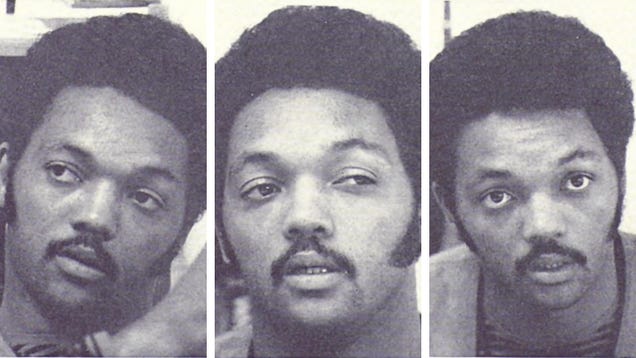
The 3 Faces of Jesse Jackson
In the ensuing years, as a covert police asset at the Dr. King assassination, Jesse Jackson became a ubiquitous default black leadership personality, replacing the authentic African American leader Dr. King (whom Jackson helped assassinate) would have been. Besides media and social organizations, Jackson was a candidate for the Democratic presidential nomination in 1984 and 1988 and served as a shadow U.S. Senator for the District of Columbia from 1991 to 1997, positions he reached as a result of his status as a covert police asset at the Dr. King assassination.
Image result for Jesse Jackson Lorraine Motel
Jesse Jackson Sr., Obama & Jesse Jr. wearing “black tie”
On March 26, 2015, Jesse Jackson Jr.was released from the minimum-security Federal Prison Camp, Montgomery in Montgomery, Alabama, to serve the rest of his sentence (for corruption while serving in the US Congress) at a halfway house, the Volunteers of America Chesapeake facility in Baltimore, Maryland.
*******
House Select Committee on Assassinations – HSCA (1978)
Rep. Henry B. Gonzalez (D-TX), Mrs. Martin Luther King, Jr. and the Congressional Black Caucus together started the House Select Committee on Assassinations (1978) to investigate the assassinations of John F. Kennedy, Robert F. Kennedy, Dr. Martin Luther King, Jr. & Malcolm X.  This reporter, then a Co-Director of the Assassination Information Bureau, was a public interest watchdog to the HSCA.
Many independent researchers have documented the extent to which the CIA and other federal agencies infiltrated the HSCA such that the truth of these four key political assassinations, which began with a Coup d’Etat in America with the assassination on November 22, 1963 by CIA Operation 40 personnel at the orders of high level co-conspirators including President Lyndon B. Johnson, George HW Bush, Richard M. Nixon, FBI Director J Edgar Hoover, and numerous power groups,  from which the United States has never recovered as a modern democracy.
Ole Dammegard has been invited to present as a speaker to the JFK Assassination Conference in Dallas, TX in November 2016.  Donations to support his research can be made at his website (below).
References:  Light On Conspiracies - www.lightonconspiracies.com

Source: http://ufodigest.com/content/judas-goat-how-dr-martin-luther-king-really-died