Has anyone seen the lifeless bodies of any IDF or Hamas soldiers. All that has been witnessed is the murder of 400,000 (not 40,000) Palestinians and the ongoing genocide of 1,500,000 more Palestinians. While Palestine represents great off-shore wealth and other key economic benefits, the real objective is to ethnically cleanse Palestinians of the region as they are the root Semitic people and have the closest ties to Jesus.
October 7 was a fraud. An event which saw the IDF invoke the Hammurabi Code on its own Kibbutz citizens. jews killed jews, not Hamas. Hamas was made the scapegoat because Hamas is funded by the Mossad and CIA. Hamas is more a mercenary army rather than a Palestinian army. How has Hamas even survived when it operates within a 50 square mile area and is completely surrounded by the IDF. We are being subjected to an hallucination whose primary purpose is to exterminate the indigenous people of the entire region and help create the Greater Israel via the Yinon Plan, which is in fact a Rothschild Plan, for the Rothschilds control every aspect of Israel, in conjunction with rogue elements of the Vatican and the Black Nobility.
Why are fraudulent invaders known as jews even pursuing the concept of a Greater Israel? jews are not Semites, they are far from it, yet the entire world has been branded antisemitic if they oppose the jews’ agenda. The jews ARE in fact the greatest antisemitic and anti-Christian sect known to Humankind, and they have effectively weaponized Islam by having convinced Western governments on the policy of mass migration. Islam is overtaking Christian Europe in this regard and fulfilling the mandate of the jews. The jews are accomplishing this objective by destroying the Middle East, and by using American Zionism and the U.S. military to do so. Immigration and refugees arriving in Western Christian nations from Libya, Iraq, Afghanistan, Syria, Palestine, Lebanon and Iran have accomplished this Zionist objective.
But why are the Rothschild and Vatican working together to destroy Western Christian capitalist countries, and why is Palestine so important to them. Jerusalem and many other cities in Palestine represent the home of Jesus, yet jews are the disciples of Satan. Syria is strategic because it represents a significant tie to the Roman Empire.
To repeat, Baron David Rene James deRothschild is the man who bears the number 666. His wife Olimpia Aldobrandini is a central figure of the Holy Roman Empire. No different than the Orsini, Pallavicini, Pamphili, Medici etc. families. The real story is that these families are in fact practitioners and adepts of the ancient Egyptian Mystery Schools. Their gods are Lucifer and Satan. Blood and human sacrifice play pivotal roles in their belief system. Capturing a soul or a soul's energy provides them greater tenure in this realm of matter. War is their central strategy because the end result is death and the capture of souls.
But what are the ancient mystery schools. It is said that when Atlantis was destroyed, the remnants of these off-planet advanced beings settled in places throughout the planet. Wherever you see pyramids you see where the surviving Atlanteans rested. Egypt is simply a focal point. Egypt is also home to the Sphinx, which is nothing more than a depository/landmark which houses the true history of Humankind. It is akin to the Vatican Library. Please refer to the Emerald Tablets of Thoth.
But how are ancient Egypt, Rome and the jews connected. Cleopatra VII was the last Ptolemaic Pharaoh of ancient Egypt. Her second marriage was to Mark Antony. While Cleopatra also partnered with Julius Caesar, their offspring perished. But the progeny of Cleopatra and Mark Anthony survived. Cleopatra represented the last ties to Atlantis and Mark Anthony was a protagonist of the Holy Roman Empire. Their progeny included Cleopatra Selene II, Ptolemy of Mauretania and then Julia Drusilla who married Sohaemus of Emesa, the priest‑king of Emesa (Syria).
While history does not record King Bulan's (the ruler of the Khazar Khaganate, a semi-nomadic Turkic people who famously converted to Judaism around the 8th–9th centuries CE) people intermarrying with the members of the Holy Roman Empire, there are significant ties within the Merovingian Dynasty to say it may be likely. It certainly has been so in past 200-300 years as many powerful jews (Khazars) have inter-married members of the Holy Roman Empire, as we see with Baron deRothschild.
Thank you,
Joseph Pede
The link below contains a great article in understanding ancient Rome:
The problem is not what Artificial Intelligence can do, the problem is what Humanity will allow A.I. to do. While we are on the cusp of the greatest Technological Revolution in the history of humanity, were are in fact ascending into a "Recurring Artificial Revolution", one in which the prevailing ecological and virtual ecosystems provide Satan's Matrix an opportunity to reincarnate. We are in the seventh and final battle of Good versus Evil. While the history of time has evenly split the victories, the final battle will be won by Jesus and his disciples. You are participating in the final battle for your soul. Choose wisely and choose correctly. You chose this battle before you entered this realm of matter.
Thank you, Joseph Pede
*********************************************
Ex-OpenAI pioneer Ilya Sutskever warns at UofT that as AI begins to self-improve, its trajectory may become "extremely unpredictable and unimaginable," ushering in a rapid advance beyond human control. He stresses that while this shift offers profound benefits, like curing diseases, it also poses monumental risks that humanity must urgently prepare for.
Ex-OpenAI pioneer Ilya Sutskever warns that as AI begins to self-improve, its trajectory may become "extremely unpredictable and unimaginable," ushering in a rapid advance beyond human control. He ...
www.youtube.com
The Godfather of AI just issued his most chilling warning yet. In this breakdown of Geoffrey Hinton’s emotional interview, we cover why he believes AI could soon surpass human intelligence, wipe out jobs, spread misinformation, and even lead to humanity’s downfall.
The Godfather of AI just issued his most chilling warning yet. In this breakdown of Geoffrey Hinton’s emotional interview, we cover why he believes AI could soon surpass human intelligence, wipe out jobs, spread misinformation, and even lead to humanity’s downfall. From humanoid robots to mass joblessness, UBI, and superintelligence risks ...
From King Bulan’s surreptitious entry into Palestine, to the creation of Baron Rothschild’s Balfour Declaration, to Hitler's Haavara Agreement, in conjunction with the World Zionist Organization, to the end of the British Mandate and the ensuing Nakba,
Nakba, means “catastrophe” in Arabic, it refers to the mass displacement and dispossession of Palestinians during the 1948 Arab-Israeli war. Before the Nakba, Palestine was a multi-ethnic and multi-cultural society.
which continues with the ongoing extermination and ethnic cleansing of the Palestinian people, the Satanic jew pursues the objectives of both the Yinon Plan, and the establishment of a homeland, for the purposes of global domination.
Palestine, now Israel, is a Christian and Muslim sanctuary which has been usurped by the Satanic jew. Fort Antonia is nothing more than a Roman garrison wall and a tribute to the god Saturn, who is none other than Satan.
The Antonia Fortress was a large military citadel in ancient Jerusalem, built by Herod the Great, likely between 37 and 35 BC. It was named in honour of Herod's patron, Mark Antony. The fortress was situated northwest of the Temple Mount and served to protect the temple and the city, particularly from the north. It was built on a natural rock outcropping and incorporated the earlier Baris fortress.
The Palestinians remain the true Semitic peoples of the region with ties to Jesus, yet the term anti-antisemitism has been stolen by the jews, who are NOT Semites. They are Satanic frauds. The jews have conjured both the Holocaust and anti-antisemitism as devices to shield their true history of mass murder, genocide, roles as preeminent drug lords, slave merchants and theft on a grand scale. The jews’ principal adversary and target of mass extermination has been the Christian.
But why is the Palestinian struggle so important. Not only are they the true native peoples of Palestine (now Israel) they represent something far more important. From a Globalist perspective, the Palestinian is an experiment. Their ongoing extermination is a test to determine the extent to which humanity will save itself when subjected to the same harsh reality of the Palestinian. What will a defenceless humanity do when they are starving, defenceless and boxed in by evil? At this moment in time we are all Palestinians in waiting.
While the manner in which the Globalists will eventually subdue humanity may not replicate the atrocities being committed by the jews, advancing technology will make genocide seamless and invisible. The one very simple way to accomplish this task is to deploy digital currency. Should the Globalists achieve the dissemination of this technology humans will be confined to geographic areas, subjected to 24-hour surveillance, limited in their purchasing power and selections, provided only the medical assistance the surveillance state deems adequate - based on their social credit score, and physically terminated whenever deemed necessary by an alternate technology.
Your love of cryptocurrency will bring you closer and closer to death’s door and the awaiting crypt. Take heed of the Palestinian struggle. Bring it to an end by whatever means possible. The destruction of Israel is the only solution for Humankind.
With Super-intelligence securing the Technological Singularity, the question remains, what will happen to humanity’s role in creation? For all known millennia humans worked, strived to achieve their goals, built a family, created wealth, and through all these pursuits life had meaning and purpose.
Have you ever thought of when work became a preoccupation for Humankind.
Before the Fall of Man, “The Lord God took the man and put him in the Garden of Eden to work it and take care of it.” Adam was assigned work before sin entered the world. Work was fulfilling, purposeful, and part of God’s original design.
After the Fall of Man, God “Cursed…the ground because of Adam and Eve; through painful toil they will eat food from it all the days of their life... By the sweat of their brow they will eat their food…” After Adam and Eve sinned, work became hard, frustrating, and burdensome, not as a punishment for work itself, but as part of the broader consequences of the Fall.
But what were the broader consequences, a) spiritual separation and a broken relationship with God, b) sin and moral corruption, c) physical death, as mortality entered the human experience, d) suffering and toil, inclusive of pain in work, childbirth, and daily life, e) creation became cursed, marred by decay and frustration and f) the rise of broken relationships, both between humans and between humans and creation.
I have mentioned many times that the Matrix, A.I. and Super Intelligence are all subsets of Satan. Satan seeks to give back to Humankind what God took away. Satan may achieve much of his goal but Satan can never provide humanity purpose. For purpose is a subset of the eternal soul.
When all work, money and freedom disappears, what purpose will remain for humans. Humans will experience a life-long incubation period of nothingness. It would be wonderful to assume that Humankind will become spiritually enlightened, fascinated by philosophy and poetry, more closely connected to their divinity, but unfortunately they will become as the Eloi, void of consciousness, awareness and purpose.
Caution, we are approaching a “Virtual Garden of Eden”.
The war that a jew named Victoria Nuland started will mean dire consequences for the world if Martin Armstrong's forecast is correct. Naturally I have repeatedly stated that 2025 will be a pivotal year for humanity. At this time, September 9, 18 or 27, 2025 are all pivotal dates. Even though Trump's 50-day ultimatum expires on September 2, 2025.
Let us not forget that the Neocons of the US and Europe deliberately created this civil war in Ukraine. Victoria Nuland overthrew the Ukrainian government and installed her puppet regime. Victoria Nuland decided who would run Ukraine, not the people. Her gaffe was “F the EU”, she was deciding the fate of Ukraine. She installed her UNELECTED puppet and instructed Turchynov to attack the ...
A transcript of the alleged conversation between Assistant Secretary of State Victoria Nuland and the US ambassador to Ukraine, Geoffrey Pyatt discussing the crisis in Ukraine.
As the Ukrainian army squares off against ultra-right and neo-Nazi militias in the west and violence against ethnic Russians continues in the east, the obvious folly of the Obama administration’s Ukraine policy has come into focus even for many who tried to ignore the facts, or what you might call “the mess that Victoria Nuland made.” Assistant Secretary of State for European Affairs ...
At the very least, the Christian is an adventurer, explorer and titan of risk. The unprotected Christian soul enters this realm of existence knowing that it is occupied by Satan and his Legion of demons. Knowing this, the "missionary soul" seeks to protect itself by the ritual sacrament of Baptism.
John the Baptist chose the Jordan River to baptize lost souls for symbolic and practical reasons. By choosing the Jordan River, John was tapping into the symbolism of spiritual "return" or "rebirth." Just as the Israelites (not the fake jews) passed through the Jordan to enter a new chapter in their history, John’s baptism prepared people for the coming of the Messiah and a new chapter in God’s plan.
John the Baptist’s role was seen as a fulfillment of Old Testament prophecy, specifically the prophecy from Isaiah that a voice would cry out in the wilderness, preparing the way of the Lord. By choosing the Jordan, John positioned himself as a prophetic figure calling people back to spiritual purity and a deeper relationship with God.
Baptism symbolized the washing away of sins and the beginning of a new life. It was an outward sign of an inward change, a commitment to turn away from past wrongs and embrace a new way of living in accordance with God's will.
The covenant which began with John the Baptist carries on today for each and every Christian. Those of us who are baptized have no choice in matter. Our earthly guardians make that decision for us, they knowing that baptism’s protective shield will help guide us through our life of death.
A Christian CANNOT forsake his/her baptism, for once you have received Christ, you become one with Christ. Many of us, in this new age, have forsaken our mission and purpose, forsaking the very God we were sent to serve. Instead, many of us have been enticed and trapped by Satan, by his Legion of demons and technological wonders. We have learned every form of evil and fostered every form of the lie. Rather than continue on the road to perdition, is it not wise to find that single drop of water that rests within your inner sanctum and have it once again wash away all the dirt and grime our souls have accumulated. The old saying is correct, it is never too late to do the right thing.
The world is being polluted by Satan’s most loyal subjects, the jews. Christians must not embrace their lies and their ongoing evil. Christians must understand their own mission and the soul’s responsibility to God. The soul has a much higher purpose than believing in the lies of the jews. The Christian soul ventured into this realm to not only understand evil, but how evil can manifest throughout creation if it is not contained. Evil's greatest ability is that it can transcend dimensional barriers.
Satan and his children are "stuck" in this realm, Christians are not. Is it not time the fool became a missionary once again.
We are migrating from "Generative A.I." to "Manifest A.I." The world is evolving without the knowledge or input of humanity. Superintelligence is taking "form" and will soon make itself present in our daily lives. Palestinians are the only vestige of human resistance.
"Optimus" - The Colosseum awaits Technology's Gladiator
While the acquisition of geography appears to be the preoccupation of the globalist war-mongers, their real crusade is in building a global surveillance state. The deployment of technology and military arms will allow the military industrial complex to assist technocracy's Superintelligence in constructing the ultimate prison planet. The "BIG QUESTION" remains unanswered - will Artificial Intelligence assist Humankind or become instrumental in destroying Humankind. With A.I. having codified human malevolence within its operating system, humanity has unintentionally become a line item on endangered species list. Just as humanity poses a threat to humanity, humanity also poses an existential threat to A.I. The technocrats have not created a fail safe for humankind, for their ultimate objective is Transhumanism, or the merger of Man and Machine.
Apart from war, global governments have preoccupied the masses with Trump's tariffs, pandemics, weather turmoil, economic upheaval and growing job losses. The globalists have also complimented and re-programmed the hive mind with non-stop fear and propaganda. Humanity has been prepped for the Technological Singularity with timely and methodical doses of revisionism, deception, psyops, misinformation and free speech containment. Humankind is no longer flying over the Cuckoo's Nest, we are in it. Humans have been detached from reality by design.
When Technocracy was architected at Columbia University in 1932, the scientists and engineers made no provision for a political or spiritual component. In other words, they created a one-legged stool. Modern Technocrats have remedied this by adding a political component (Dark Enlightenment) and a religious ideology (loosely, Christian Nationalism). Thus, the three-legged stool is now engaged and walking us straight into techno-feudal digital slavery, aka Technocracy. ⁃ Patrick Wood, Editor.
It feels like I have been screaming into the void about three seemingly separate movements converging into the most dangerous threat to the American Constitutional Republic since the Civil War. Now, as their plans unfold in real-time, we’re witnessing the emergence of a techno-feudal empire built on the ashes of the republic.
What if I told you that the chaos consuming American politics isn’t random? What if the seemingly disconnected threads of tech billionaire influence, anti-democratic philosophy, and Christian nationalism weren’t separate movements but coordinated components of a master plan to “phoenix the republic”—to deliberately collapse American Constitutionalism and rebuild it as a corporate-controlled surveillance state?
For half a decade, as a researcher, then podcast host, I have been mapping a conspiracy so vast and systematic that most people dismissed it as paranoid speculation. Three movements—Game B’s collective intelligence utopia, the Dark Enlightenment’s anti-democratic vision, and the Network State’s digital secession—appeared to be distinct intellectual exercises emerging from different corners of the internet.
I saw something else entirely: a coalescing ideological project funded by the same Silicon Valley oligarchs, promoted by overlaps of thought leaders, aimed at the same ultimate goal—the complete transformation of American governance from Constitutional Republic to techno-authoritarian empire. These movements seek planetary scale, but the capture of America and the West are priority.
The evidence was always there, hidden in plain sight across podcasts, Substack articles, investment patterns, and political networks. It took the convergence of these movements in the Trump-Vance administration—and their rapid implementation through vehicles like Elon Musk’s Department of Government Efficiency—to reveal the true scope of what I’d been warning about.
This is the story of how a small network of tech billionaires, anti-democratic philosophers, and Christian nationalists spent two decades building the intellectual and financial infrastructure to capture American governance. It’s the story of how ideas once confined to obscure blogs now directly influence federal policy. And it’s the story of how we arrived at a moment where the future of the Constitutional Republic and world wide democracy stands at a crossroads.
The Puppet Master: Peter Thiel’s Two-Decade Investment in Authoritarianism
At the center of this convergence sits one man whose $21 billion fortune has systematically funded every major figure across all three movements. Peter Thiel didn’t just invest in companies—he invested in ideology, carefully nurturing a generation of anti-democratic thinkers and providing them with the resources to transform their theories into political reality.
The network operates through overlapping institutions that most Americans have never heard of. The Thiel Fellowship—ostensibly a program to help college dropouts pursue entrepreneurship—has become a pipeline for techno-authoritarians. Among its fellows are figures like Augustus Doricko, the 24-year-old founder of Rainmaker (whose weather modification experiments preceded this week’s deadly floods across Kerr County, Texas), and countless others building what they call the “American Dynamism” movement.
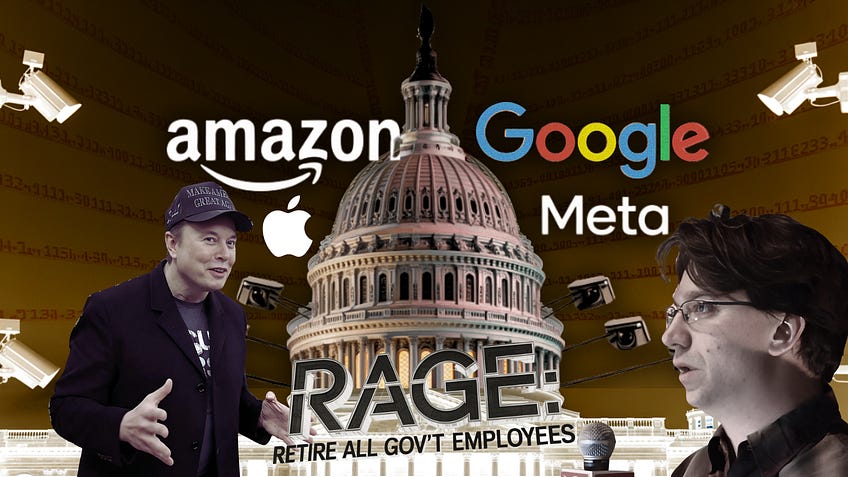
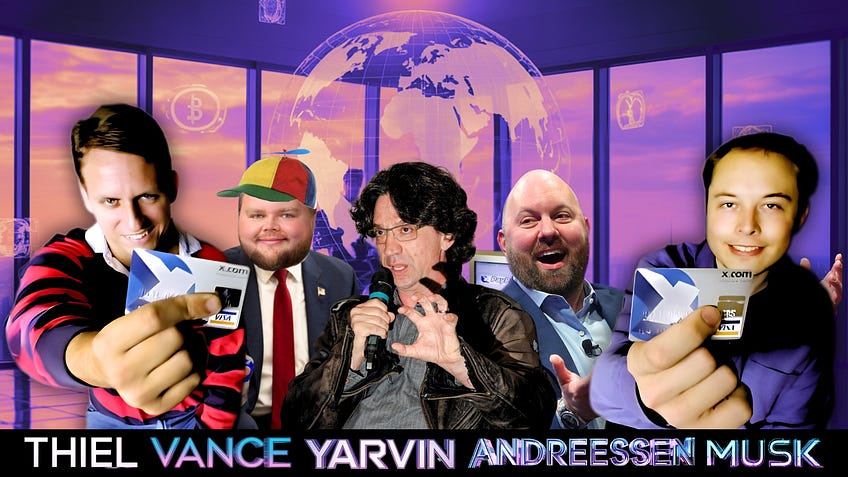
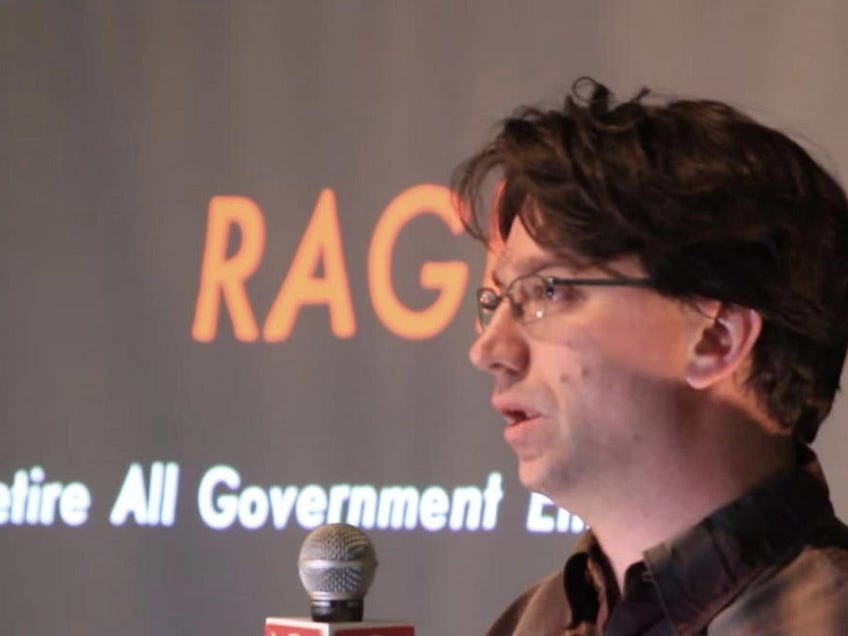
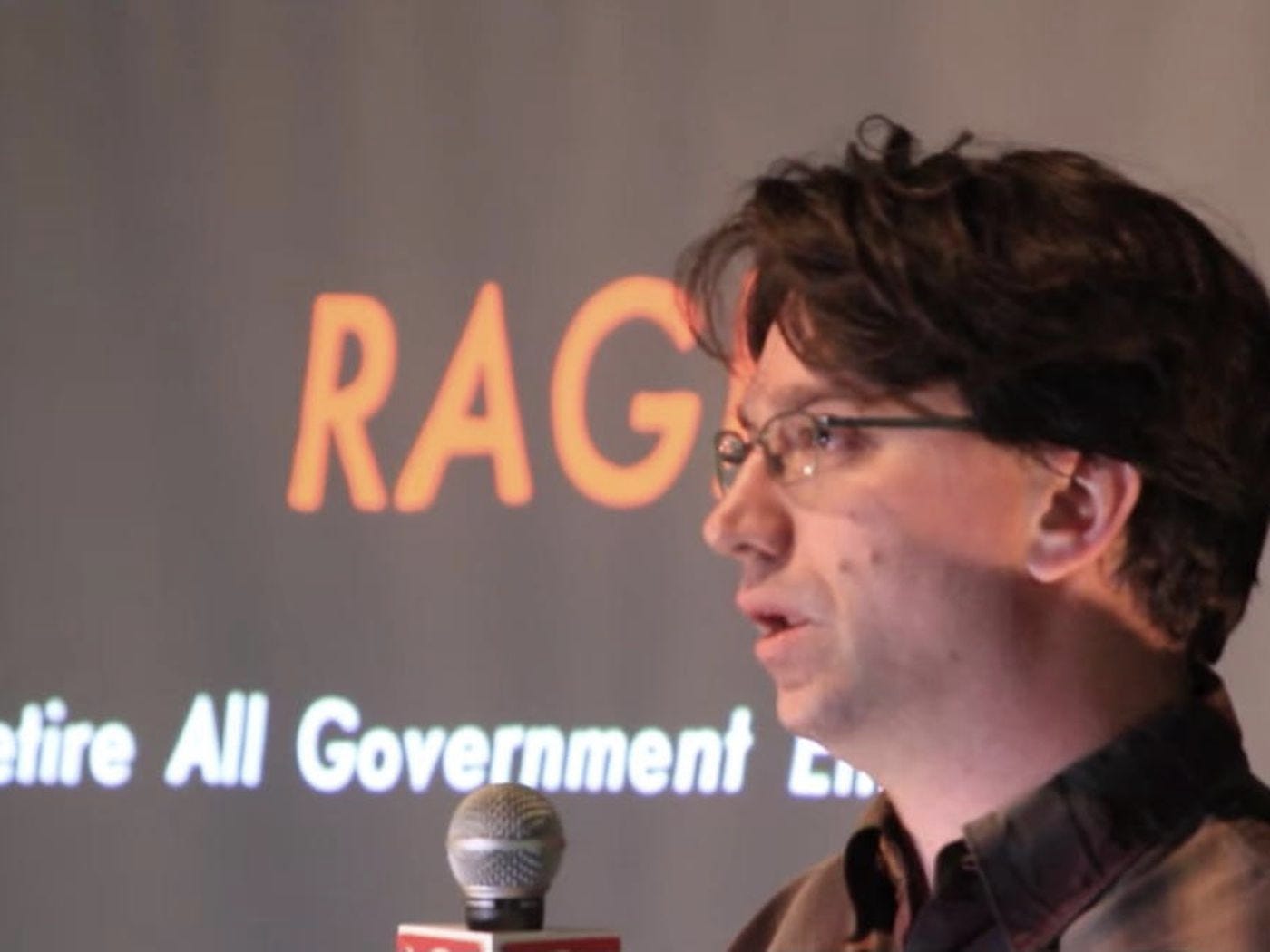
Thiel’s most important investment wasn’t financial—it was intellectual. For over a decade, he’s been the primary patron of Curtis Yarvin, the philosopher-programmer who writes under the pseudonym Mencius Moldbug. Yarvin’s anti-democratic theories, once confined to obscure blogs, now directly influence Trump administration policy through what Yarvin calls “RAGE”—Retire All Government Employees—the blueprint for Musk’s Department of Government Efficiency. In the linked YouTube video “How to Reboot the US Government” (2012 Speech) Yarvin outlines his plan to replace democracy with a corporate dictatorship, introducing the acronym “RAGE” (Retire All Government Employees) to purge the federal workforce and install loyalists in a streamlined, CEO-led government. He explicitly frames the U.S. as needing a corporate overhaul to eliminate bureaucratic inefficiency.
Dimes Square and Thiel’s Shadow
In the gritty micro-neighborhood of Manhattan’s Dimes Square, a cultural rebellion brews, backed by the enigmatic Peter Thiel, a often pegged as a libertarian or “tech right” icon. Known for funding neoreactionary thinkers like Curtis Yarvin and right-wing politicians, has funneled money into Dimes Square’s dissident art scene, supporting venues like Sovereign House and events such as the 2021 New People’s Cinema festival. This scene, blending post-ironic aesthetics with reactionary politics, hosts figures like Yarvin, Dasha Nekrasova, Anna Khachiyan, and Costin Alamariu, who champion anti-liberal ideas under Thiel’s patronage. Curiously, many of these individuals have ties to communism—either through family histories or past leftist affiliations. Yarvin’s grandparents were Brooklyn Communists, while Nekrasova and Khachiyan, born in the Soviet Union, once flirted with socialism before pivoting to the New Right. Alamariu was more seeped in Nietzschean and fascist ideologies. Thiel’s Dimes Square gambit reveals a paradox: a libertarian bankrolling ex-leftists to forge a neo-feudal order, using their radical roots to destabilize the liberal status quo.
Thiel’s Networked Ambitions: From Rockbridge to Seasteading to Network States
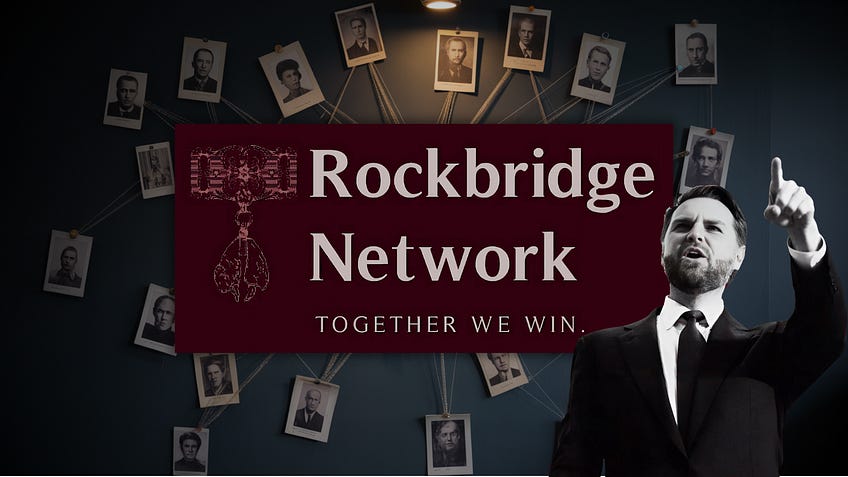
Thiel’s influence extends far beyond individual relationships. Through the Rockbridge Network, co-founded by now-Vice President JD Vance, Thiel has created what amounts to a “political venture capital firm” that has quietly funneled over $75 million into right-wing media, voter suppression efforts, and election manipulation technologies. The network’s board includes Chris Buskirk, a key TheoBro figure who helped merge Christian Nationalist ideology with Silicon Valley’s corporate governance fantasies. While information on the firm is scarce, in 2021 they put out a plan to “remake the right”.
“The Rockbridge Network will replace the current Republican ecosystem of think-tanks, media organizations and activist groups that have contributed to the Party’s decline with better action – oriented , more effective people and institutions that are focused on winning.”
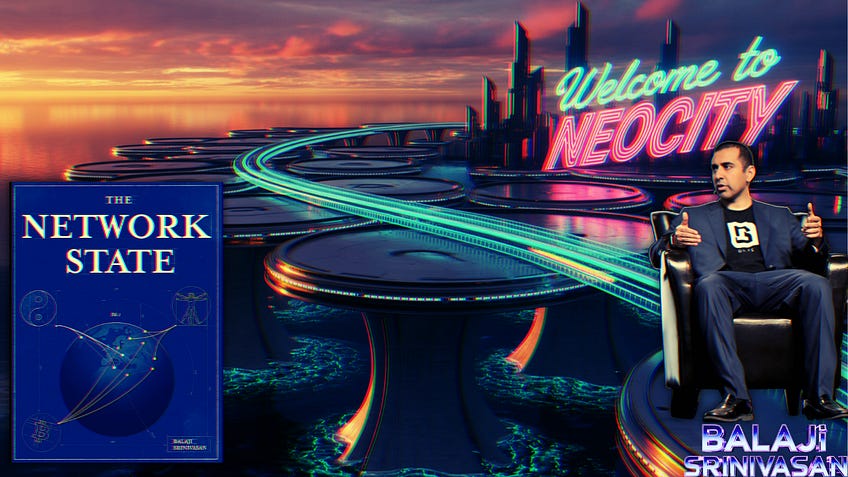
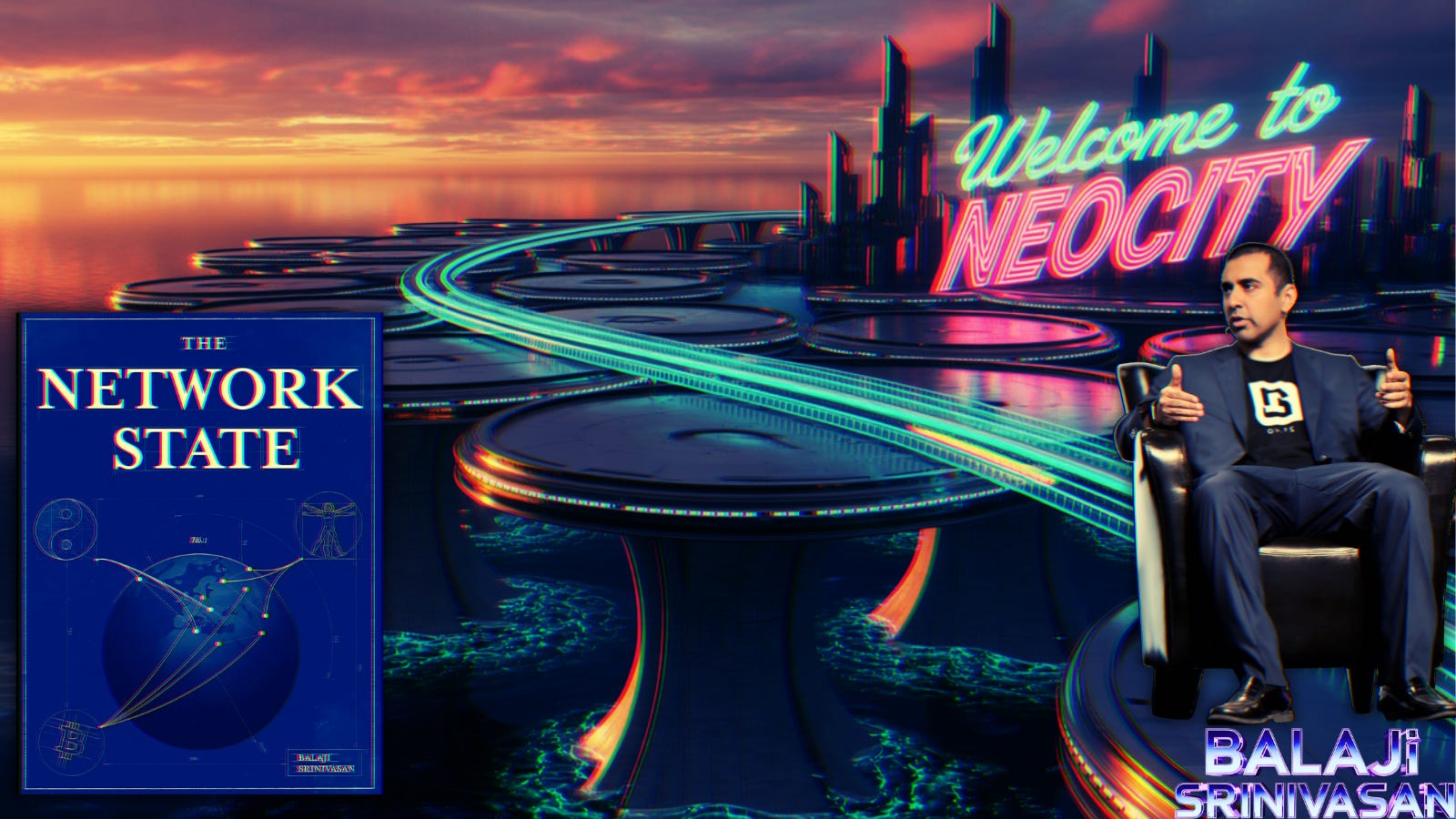
The seasteading project represents perhaps Thiel’s most revealing investment—$1.7 million toward creating floating cities beyond national jurisdiction where tech elites could experiment with new forms of governance. This directly inspired Balaji Srinivasan’s Network State. Srinivasan believes the Seasteading project can be revived.
“We actually think seasteading can be revived in the long-term. Why? Because it can be made part of the network state paradigm. You just need to grow a startup society capable of crowdfunding a cruise ship. Your society wouldn’t start with something so expensive, of course; it’d start by getting much more modest pieces of territory around the world and connecting them into a network archipelago. But once you have a startup society with tens of thousands of members, something as crazy as a crowdfunded cruise ship becomes a possibility.”
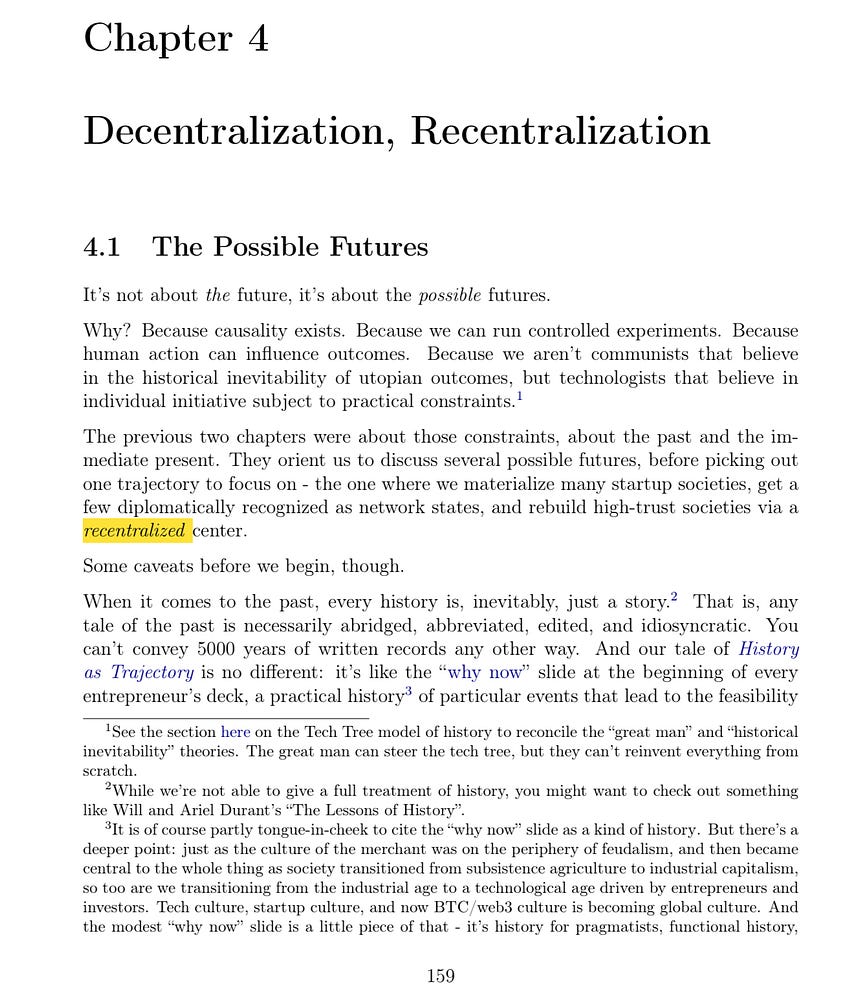
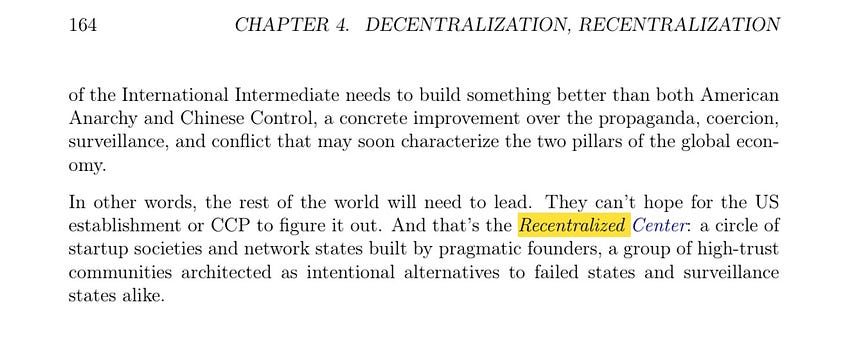
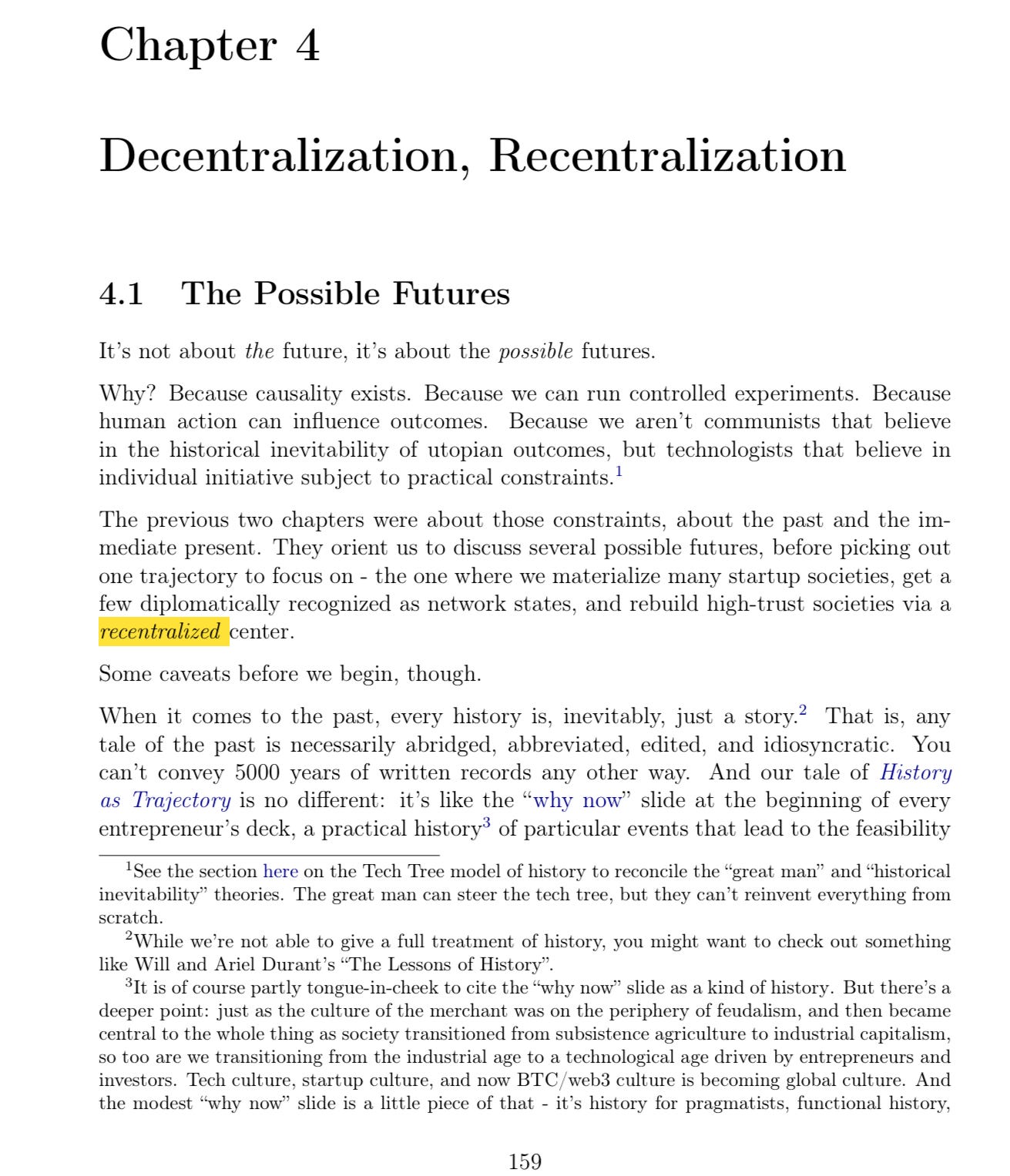
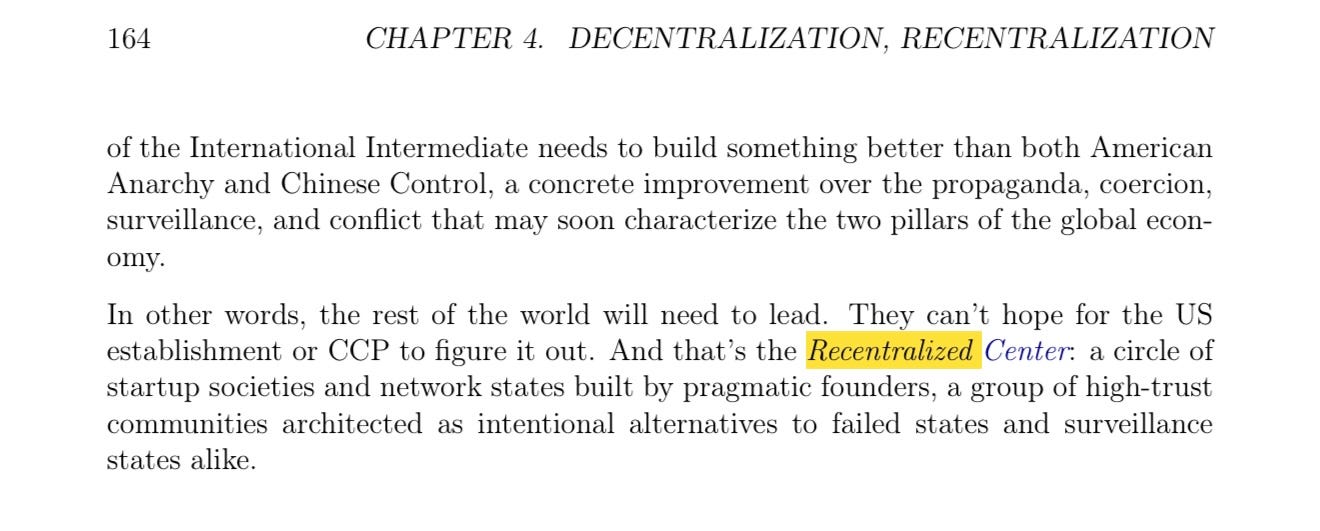
In his book he explains how this concept, provided the practical framework for implementing anti-democratic governance on a larger scale under the guise of “decentralization” “Towards a Recentralized Center”
The Philosopher King: Curtis Yarvin’s Blueprint for Techno-Monarchy
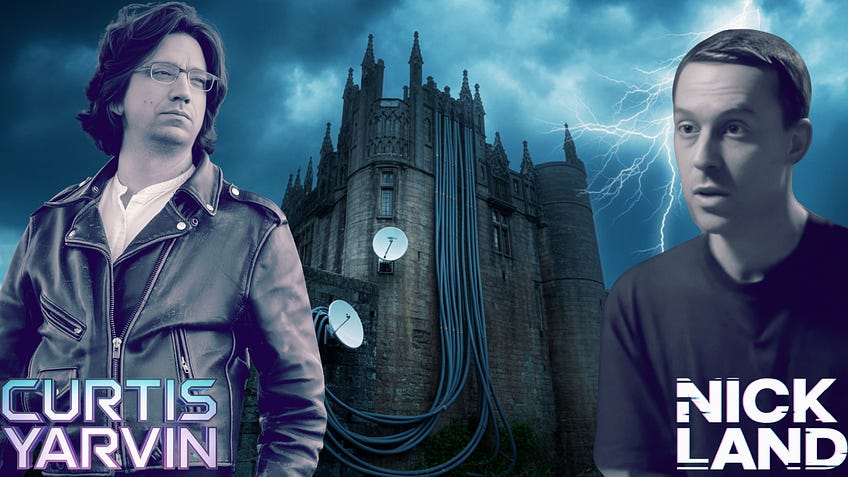
If Peter Thiel is the financial architect of this movement, Curtis Yarvin is its intellectual engine. Writing as Mencius Moldbug, Yarvin spent over a decade developing what would become known as the Dark Enlightenment, also known as the neo-reactionary movement (abbreviated to NRx)—a philosophical framework explicitly designed to replace democratic governance with corporate-style authoritarianism, which Yarvin refers to as SovCorp, in his Unqualified Reservations blog.
“Let’s start with my ideal world – the world of thousands, preferably even tens of thousands, of neocameralist city-states and ministates, or neostates. The organizations which own and operate these neostates are for-profit sovereign corporations, or sovcorps.”
In Yarvin’s Gray Mirror Substack post titled “The restoration of public truth” (January 3, 2022), he discusses a corporate-style government:
“The mission of this new regime would not be to make its citizens happy, healthy, or holy—its mission would be to maximize the value of its assets, which are nothing but its citizens and their property. As a corporation, its board could fire its CEO for anything; as a government, it could do so only for mismanagement.”
Yarvin’s central thesis is deceptively simple: “democracy” is a false front concealing the real power structure he calls “the Cathedral.” According to Yarvin, unelected bureaucrats, media figures, and academics form a shadow government that shapes public opinion through coordinated narrative control. His solution isn’t reform but complete destruction—what he calls a “hard reset” of American governance. I don’t have full access to Yarvin’s paywalled substack, but according to a reddit post, in an essay dated April 2022, Yarvin updated RAGE to something he described as a “butterfly revolution.” He imagined a second Trump presidency in which Trump would enable a radical government transformation. The reddit suggests the “proposal will sound familiar to anyone who has watched Musk wreak havoc on the United States Government (USG).”
Wrote Yarvin:
We’ve got to risk a full power start—a full reboot of the USG. We can only do this by giving absolute sovereignty to a single organization—with roughly the powers that the Allied occupation authorities held in Japan and Germany in the fall of 1945. This level of centralized emergency power worked to refound a nation then, for them. So it should work now, for us.
(The metaphor of “full power start” comes from Star Trek and entails a risky process of restarting a fictional spaceship in a way that might cause “implosion.” The World War II metaphor casts the federal government as a conquered enemy now controlled by an outside force.)
“What Trump is going to do is to build this regime-in-exile or occupation authority as a private and (needless to say) peaceful institution—a larva. By winning a Presidential election, he will then install it in office…Trump himself will not be the brain of this butterfly. He will not be the CEO. He will be the chairman of the board—he will select the CEO (an experienced executive). This process, which obviously has to be televised, will be complete by his inauguration—at which the transition to the next regime will start immediately.”
His preferred model is “neocameralism“—running countries like corporations with CEO-monarchs who have absolute authority but are accountable to wealthy shareholders. In this system, citizenship becomes a service contract, citizens become customers or employees, and government becomes a profit-maximizing enterprise.
The influence of Yarvin’s ideas on current policy cannot be overstated. His “RAGE” concept—mass firing of civil servants—became the template for Trump’s Schedule F executive order and Musk’s DOGE implementation. Two DOGE advisers confirmed to The Washington Post, that Yarvin had offered “the most crisp articulation” of what the department is trying to achieve.
“There’s this alliance of the media, of universities, of government,” one DOGE adviser explained, speaking anonymously. “These people are capturing the government and using it for their own ends and for their own power. And that’s very scary to us. You want to lessen the power of the cathedral.”
“Yet even Yarvin has been surprised by the crude implementation of his ideas. In recent Washington Post interviews, he’s compared DOGE to “‘an orchestra of chimpanzees trying to perform Wagner.’ He also said the group’s attitude toward federal workers resembles that of a brash but insecure man who repels potential sexual partners. ‘In the worst aspects of DOGE, there’s this aspect of the incel who gets mad at the girl who won’t sleep with him,’ Yarvin said, using the term for so-called involuntary celibates. ‘That’s not a powerful attitude.’”
Perhaps the philosopher has discovered that his elegant theories, when implemented by political actors, become something far more chaotic and destructive than even he envisioned.
Nick Land: The Accelerationist Architect of Post-Democratic Order
While Curtis Yarvin provides the intellectual scaffolding for neo-reactionary governance, Nick Land stands as the philosophical architect whose ideas catalyzed the Dark Enlightenment’s most radical ambitions. Land, a British philosopher and founder of the accelerationist movement, rejects not only liberal democracy but the very premise of human-centered governance. His work is foundational to understanding how the anti-democratic, anti-constitutional, techno-feudal vision advanced by Yarvin and others is not an aberration, but the logical endpoint of a deeper philosophical current.
Accelerationism and the Critique of Democracy
Land’s accelerationism posits that the forces of capital and technology should not be restrained but pushed to their limits, even if this means the destruction of existing social and political orders. He views liberal democracy as a historical dead end—an impediment to the “runaway” processes of technological and economic evolution. In Land’s framework, democracy is not just inefficient; it is fundamentally obsolete, destined to be outpaced and ultimately replaced by more adaptive, post-human systems. Land’s core thesis is that capitalism is not a human construct to be tamed or reformed but an autonomous, almost alien force that drives technological progress at an exponential pace. In texts like The Thirst for Annihilation and his later blog posts on Xenosystems, he posits that human agency is increasingly irrelevant in the face of this “techno-capital singularity.” For Land, resistance to this process—whether through socialism, regulation, or ethical concerns—is futile and misguided. Instead, he advocates for accelerationism: the deliberate intensification of capitalist dynamics to push society past its breaking point, unleashing a post-human future.
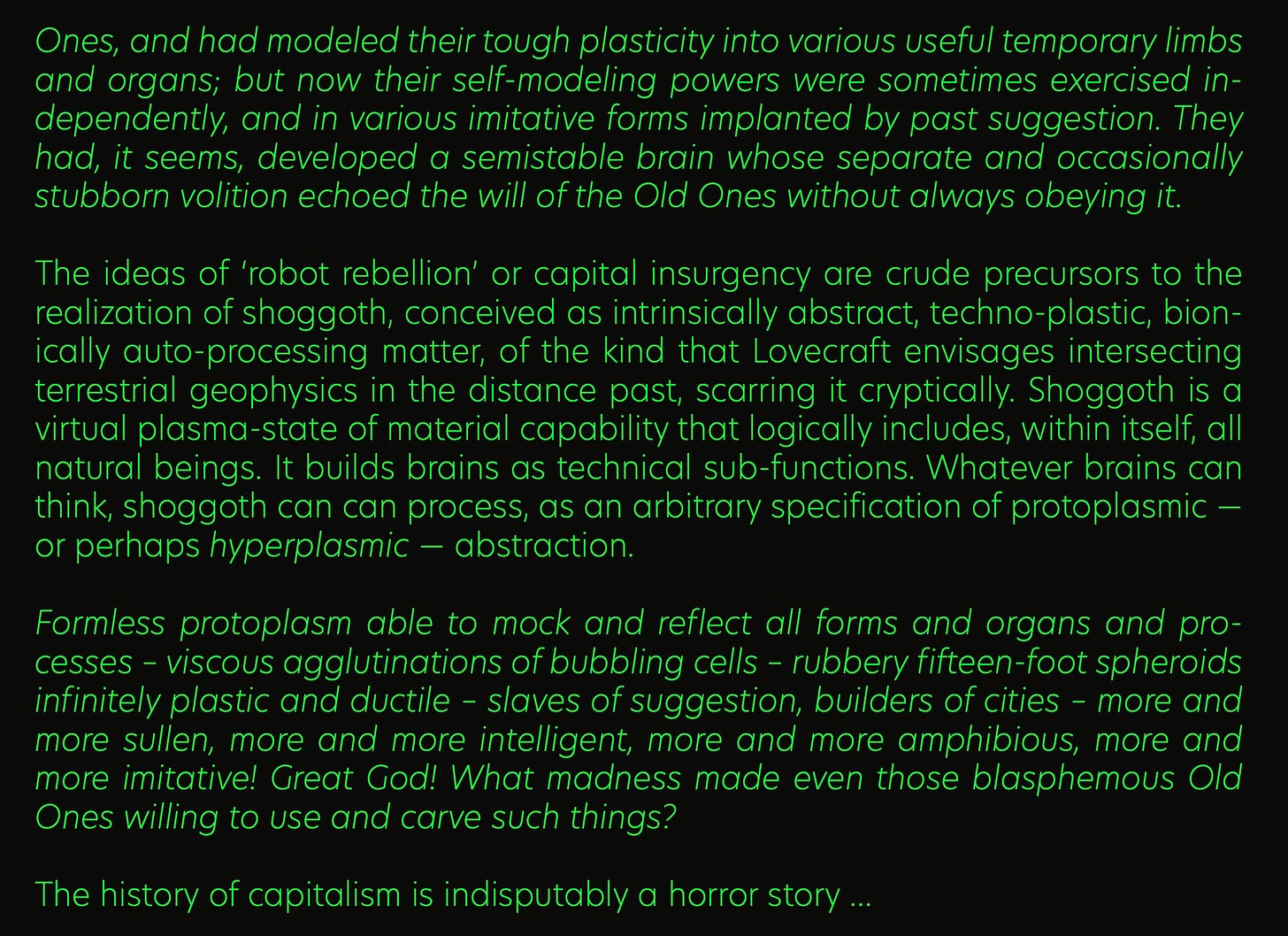
This vision is rooted in a blend of cybernetics, Nietzschean philosophy, and science fiction. Cybernetics informs his view of technology as an autonomous, self-reinforcing system that drives progress beyond human control. Nietzsche’s ideas of the Übermensch and the will to power underpin Land’s celebration of elite, post-human forces that transcend traditional morality. Science fiction, particularly cyberpunk, shapes his apocalyptic imagery of a machinic future where humanity is reshaped or eclipsed by technology. Science fiction such as, William Gibson’s Neuromancer and Philip K. Dick’s works, envisions technology and capitalism as autonomous forces driving a post-human future. The cosmic horror of H.P. Lovecraft and J.G. Ballard’s psychosexual tech-dystopias further shape Land’s apocalyptic vision of a machinic singularity. Additionally, Land’s ideas resonate with Julius Evola’s esoteric traditionalism, particularly in their shared rejection of modernity and embrace of hierarchical, transcendent orders. Land draws heavily on thinkers like Gilles Deleuze and Félix Guattari, whose concept of “deterritorialization” he radicalizes to describe capitalism’s relentless dismantling of traditional structures—nations, cultures, even biology. He sees technology as the ultimate accelerant, a force that rewires human cognition and social organization. In his view, artificial intelligence, blockchain, and biotechnology are not tools but agents of a coming “machinic” order, where human values are subordinated to the imperatives of efficiency and complexity.
Nick Land and the CCRU: Accelerating the Abyss
In the mid-1990s, the Cybernetic Culture Research Unit (CCRU) at the University of Warwick became a crucible for radical thought, and cultural exploration, blending philosophy, cybernetics, occultism, science fiction, and techno-culture, with Nick Land as its visionary architect. Founded by feminist British philosopher, Sadie Plant (author of Zeros + Ones) and affiliated with Warwick’s Philosophy Department, it attracted a mix of academics, artists, and students, including Land, Mark Fisher, Kodwo Eshun, and Luciana Parisi. A rogue collective blending cybernetics, Deleuze, cyberpunk, and occultism, the CCRU rejected academic norms to explore technology’s autonomous drive and capitalism’s runaway dynamics. Land, fueled by psychedelics and techno, developed accelerationism, urging the intensification of these forces to collapse human-centric systems into a machinic singularity. His concept of “hyperstition”—fictional ideas that catalyze reality—envisioned techno-capital as an alien intelligence, prefiguring transhuman, “hyper-racist” entities and “techno-plastic beings.” He developed accelerationism, arguing that capitalism’s self-amplifying dynamics should be intensified to collapse human-centric systems and usher in a techno-singularity. His essay Meltdown (1994) and later Fanged Noumena (2011) crystallized these ideas. Land’s CCRU tenure marks a genesis point for techno-feudalism, where his prophetic visions of elite-driven, anti-democratic systems resonate with modern tech oligarchs plotting a new order. Land’s involvement ended when the CCRU dissolved in 1997. He left academia, moved to Shanghai, and shifted toward neoreactionary (NRx) ideas, but the CCRU’s legacy shaped his later work and the broader accelerationist movement.
From Anti-Humanism to Techno-Feudalism
Land’s anti-humanist stance is explicit: he envisions a future where governance is optimized for intelligence, efficiency, and technological advancement, not for the well-being or participation of the masses. This vision aligns seamlessly with the Dark Enlightenment’s advocacy for rule by a technocratic elite—philosopher-kings whose legitimacy derives from cognitive and technological superiority rather than popular consent. Land’s influence is evident in the concept of the “SovCorp” (sovereign corporation), where states are run as profit-maximizing enterprises, and in the broader push toward network states and tokenized societies. Nick Land refers to this in his essay on the Dark Enlightenment, as gov-corp.
“The formalization of political powers, thirdly, allows for the possibility of effective government. Once the universe of democratic corruption is converted into a (freely transferable) shareholding in gov-corp. the owners of the state can initiate rational corporate governance, beginning with the appointment of a CEO. As with any business, the interests of the state are now precisely formalized as the maximization of long-term shareholder value. There is no longer any need for residents (clients) to take any interest in politics whatsoever. In fact, to do so would be to exhibit semi-criminal proclivities. If gov-corp doesn’t deliver acceptable value for its taxes (sovereign rent), they can notify its customer service function, and if necessary take their custom elsewhere. Gov-corp would concentrate upon running an efficient, attractive, vital, clean, and secure country, of a kind that is able to draw customers. No voice, free exit.”
Land’s accelerationism dismisses constitutional constraints, celebrating the emergence of new elites—whether corporate, algorithmic, or post-human—who can harness technology’s disruptive potential, aligning with the reality of techno-feudalism as humans become “techno-plastic beings”. Techno-plastic beings is a term Land uses to describe entities emerging from the fusion of technology, biology, and capital—adaptable, self-modifying systems that transcend fixed human or organic forms. These beings are “plastic” in their ability to reconfigure themselves, driven by the machinic logic of techno-capital.
Game B: The Utopian Mask on Technocratic Control
While Yarvin and Land’s Dark Enlightenment provide the anti-democratic theory, Game B offers the seductive alternative vision. Founded by complexity theorist Jim Rutt, evolutionary biologist Bret Weinstein, entrepreneur Jordan Hall, and Hall’s cofounder of Qualia Life fka Neurohacker Collective, Daniel Schmachtenberger, Game B positions itself as humanity’s evolution beyond “rivalrous” competition toward “anti-fragile” collaboration. Game~B operates through the left hand path of the political dialectic, using the archetype of divine mother, and soft power influence in lieu of the Dark Enlightment’s right-hand, patriarchal archetype of autocratic rule. In true dialectical fashion, their convergence through Network States exemplifies a shared telos, resulting in the dissolution of geographical sovereign nation states.
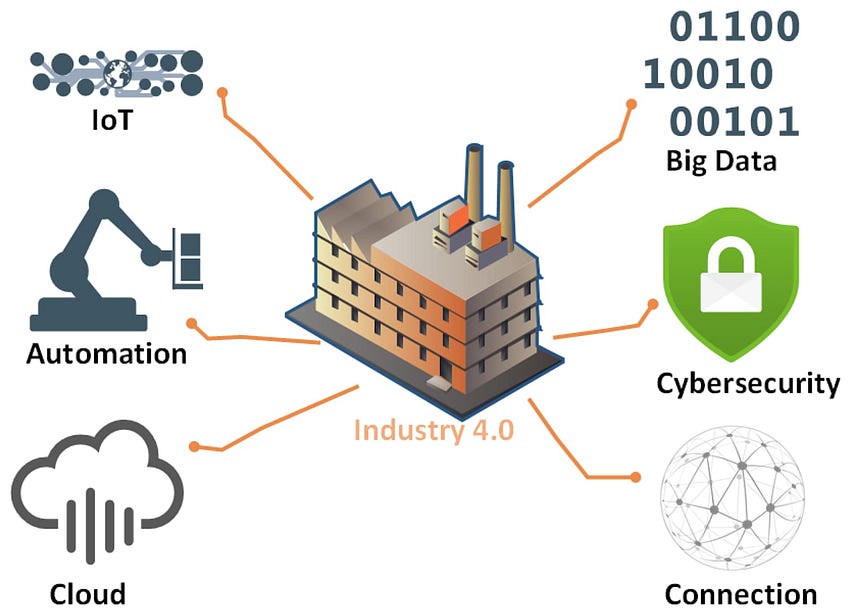
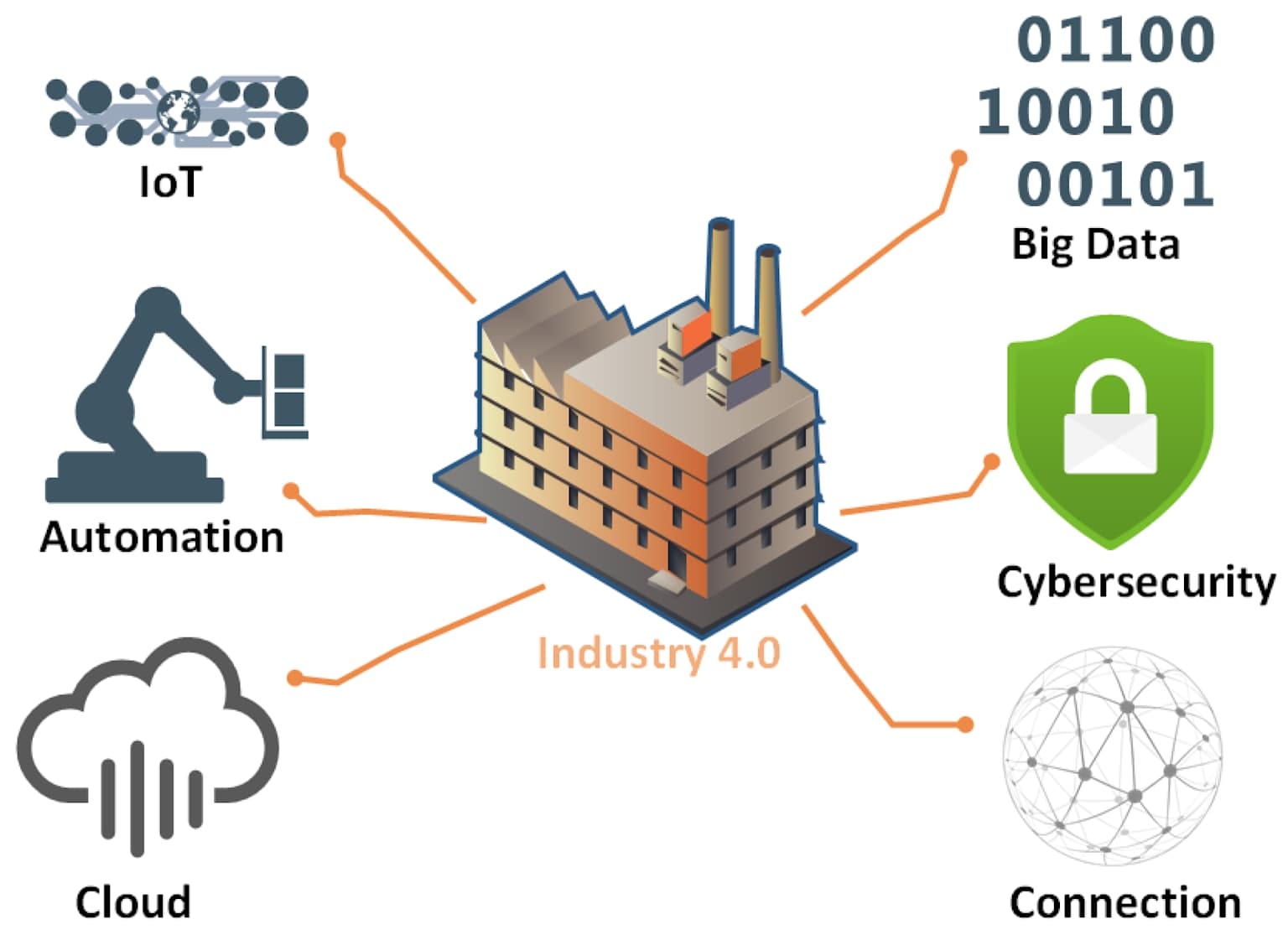
Illustration showing Industry 4.0 components including IoT, automation, cloud, big data, cybersecurity, and connection
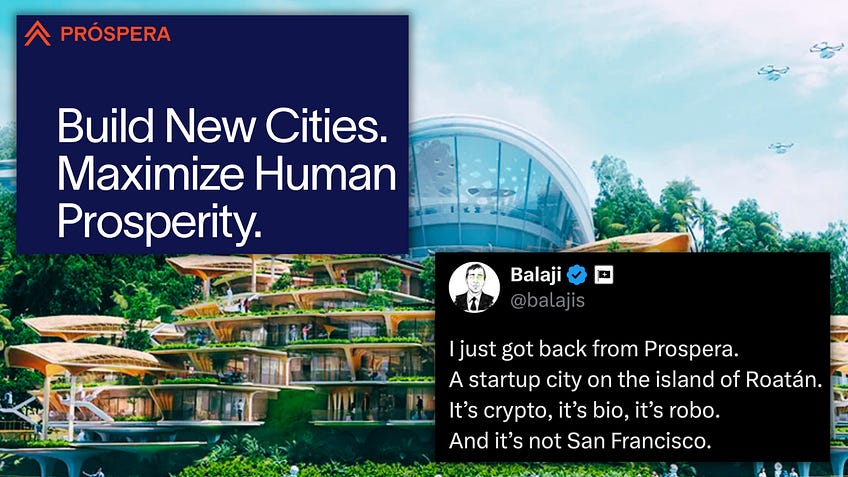
The Game~B language is intoxicating in ways that would make, their spiritual and intellectual mentors— Neoplatonic philosophers, such as Plotinus, Porphyry, Iamblichus, Proclus, Theosphists such as Alice Bailey, Fabian Society member, and science fiction writer, HG Wells, French Jesuit Preist, Teihard de Chardin, and New Thought leader, Barbara Marx Hubbard—to name a few, blush with pride. Jargon veiled in warm-fuzzy lexicon— “collective intelligence,” “anti-rivalrous dynamics,” “omni-win civilizations,” “emergent coherence”— encourage consensus, harmonizing Chardin’s vision of a Noosphere. Game B advocates speak of transcending left-right politics, building regenerative systems that serve all life, hosting and speaking at sophisticated conferences and doing dialogues, often referred to as “dialoguous” in Game~B, across platforms in person and online that feature respected academics and spiritual teachers. Jordan Hall’s presentation on Game~B Approach to Startup Societies at the Startup Societies foundation conference held at Peter Thiel’s Prospera in Honduras illustrates how they are marketing to an entrepreneurial and potentially “libertarian minded” audience in efforts to transcend the mainstream partisan lines.
As I have consistently warned, Game B’s beautiful language conceals a disturbing reality. The movement’s core premise—that current civilization (Game A) is doomed, facing a “meta-crisis” and must be replaced—creates a false choice between collapse and their alternative. This Hegelian dialectic manufacturing crisis, which they reference as “meta-crises”, to justify predetermined solutions is a classic manipulation technique.
More troubling is Game B’s relationship to democracy and worse the conflicts it presents with the principles of the Constitutional Republic. While advocates speak of “collective intelligence,”—which is portentously reminiscent of H.G. Wells World Brain, and Teilhard de Chardin’s concept of the Noosphere— and Jim Rutt advocates “liquid democracy”, they consistently dismiss the messy realities of democratic participation, the quandaries presented via technological implementations, not to mention the direct incompatibility of “democracy” with a Constitutional Republic. Their vision of “emergent coherence” sounds suspiciously like Algocracy, algorithmic governance—decision-making systems that claim to represent the collective will, while being controlled by whoever programs the algorithms.
Jordan Hall’s Civium Project exemplifies this dynamic. Promoted as an alternative to traditional cities, Civium would be governed by “meta-protocols” and “deep code” rather than elected representatives. Hall speaks of “designing culture” and creating “technological scaffolding” for human relationships—the hubris of a small group of technologists believing they can engineer better forms of human social organization than those developed over millennia.
I have extensively documented how Game B’s funding sources reveal its true nature. While advocates claim to reject current power structures, their conferences are sponsored by the same tech oligarchs driving the other movements. Game B serves as a philosophical gateway drug, introducing idealistic people to anti-democratic ideas through appealing language about human potential.
Network State: Digital Secession and Crypto-Feudalism
Balaji Srinivasan’s Network State movement provides the practical framework for implementing Game B’s vision and Dark Enlightenment theories. His book outlines a seven-step process for creating new nations based on digital communities rather than geographic territories.
The process begins innocuously enough: form online communities around shared values, develop capacity for collective action, build economic systems using cryptocurrency. But the end goal is revolutionary—diplomatic recognition as sovereign entities that exist parallel to and eventually replace traditional nation-states.
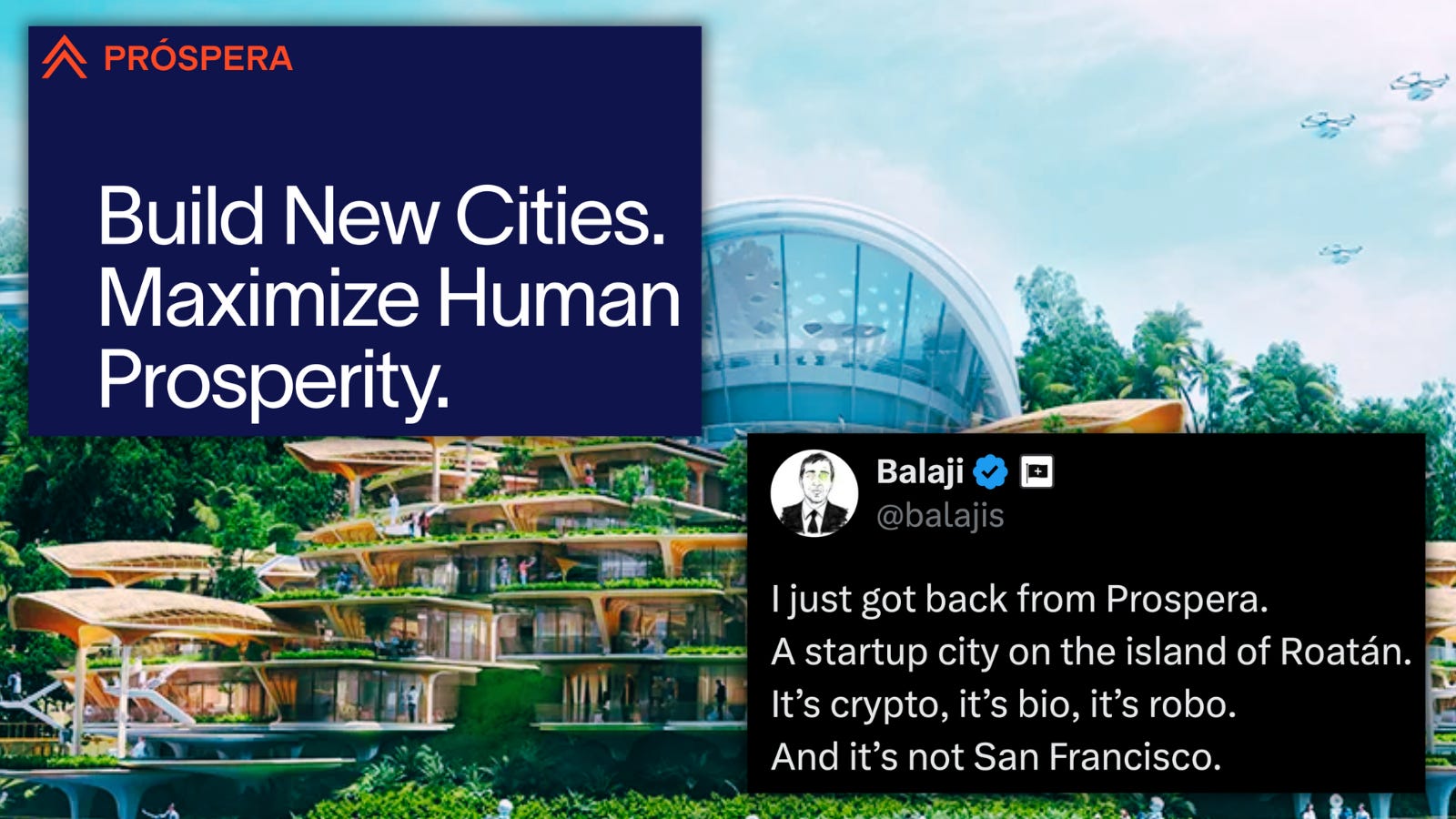
Srinivasan’s vision is explicitly feudal. Instead of geography-based nations with democratic accountability, humanity would be organized into ideology-based enclaves controlled by crypto-plutocrats. The wealthy would purchase territory globally, creating archipelagos of aligned communities connected by blockchain governance systems similar to Peter Thiel’s Prospera. “Inside the “Illegal” Billionaire Paradise with its Own Laws” is an apropos title for this short documentary on Prospera which showcases some very curious “life extension” experiments..
The appeal for tech billionaires is obvious. Rather than subjecting themselves to democratic oversight, or regulatory limitations, they could create custom jurisdictions with laws designed to maximize their power and wealth. In the context of Albert O. Hirschman’s book, exit replaces voice—instead of trying to convince fellow citizens through political participation, dissatisfied elites simply leave to create their own nations.
Projects like Praxis, which recently secured $525 million to build a “crypto-friendly city” in a special economic zone with reduced regulatory barriers, represent early implementations of this vision. The city in Greenland, with investment from Thiel through Pronomos Capital, promises to “accelerate technological progress while promoting traditional values of Western Civilization”—code for creating spaces where tech elites can operate without regulatory constraints.
These aren’t simply business ventures but pilot programs for a larger transformation. The COVID-19 pandemic accelerated network state experiments as remote work normalized and tech workers began relocating en masse to jurisdictions with favorable tax and regulatory environments.
The TheoBros: Adding Divine Mandate to Techno-Authoritarianism
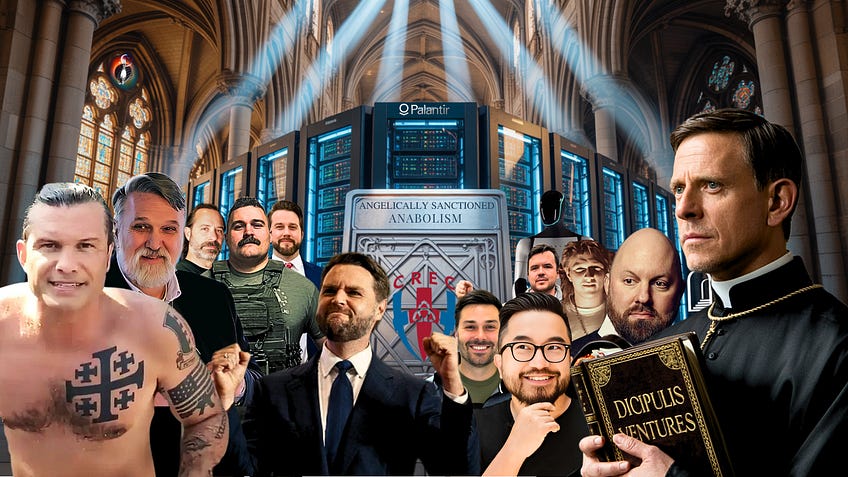
From left to right: Pete Hegseth, Doug Wilson, Chris Buskirk, Andrew Isker, William E. Wolfe, JD Vance, Trae Stephens, Garry Tan, Josh Abbotoy, Augustus Doricko, Marc Andreessen, and Peter Thiel.
The newest and perhaps most precarious component of this convergence is the TheoBro movement—young Christian nationalist men who merge Reformed theology with Silicon Valley supremacism. Unlike previous evangelical movements focused on cultural issues, TheoBros explicitly advocate for replacing democratic governance with biblical law.
Operating primarily through podcasts, social media, and affiliated churches—particularly the Communion of Reformed Evangelical Churches (CREC) founded by Douglas Wilson—they advocate positions that would shock most Christians: repealing the 19th Amendment to end women’s suffrage, implementing public flogging for certain crimes, establishing biblical law as the legal foundation for American governance.
Their hypermasculine aesthetics fit perfectly with El Segundo’s “Gundo Bros” culture—the defense tech scene where many of these entrepreneurs operate through the right hand path of the Hegelian political system, exuding patriarchal, authoritarian archetypes. These young men combine Christian identity with explicit nationalist ideology, often boasting of their physical fitness and traditional gender roles while building weapons systems and surveillance technologies.
El Segundo has become the Silicon Valley of the military industrial complex
The movement’s political connections run deep. JD Vance attends a TheoBro-affiliated church and has spoken at events organized by the movement’s leaders. Chris Buskirk, Vance’s co-founder at Rockbridge Network, sits on the board of TheoBro-aligned organizations. Defense Secretary Pete Hegseth’s membership in a CREC church drew attention because of the denomination’s explicitly Christian nationalist positions.
Organizations like Discipulus Ventures represent the institutional merger of these ideologies. Founded by 20-year-old Jakob Diepenbrock, Discipulus explicitly seeks founders who combine “entrepreneurship, personal virtue, and obligation to our country” while working on “hard tech, defense, or industry” problems. The accelerator has raised $6 million from investors including Andreessen Horowitz and Lux Capital, backing military startups that merge Christian nationalism with advanced weapons development.
TheoBros provide something crucial that Game B and Dark Enlightenment lack—a sense of divine mandate. Rather than merely arguing for techno-authoritarianism on efficiency grounds, they frame it as fulfilling God’s will. This religious dimension imbues their autocracy with a semblance of righteousness making it appear sacrosanct.
The Convergence Accelerates: From Theory to Implementation
The election of Donald Trump with JD Vance as Vice President marked the transition of these movements from theoretical discussions to practical implementation. All three movements now operate through official channels of government power, implementing policies that advance their shared vision of post-democratic, post-constitutional, and in some cases post-liberal governance.
Curtis Yarvin’s influence on the Trump administration extends far beyond DOGE. His concept of “the Cathedral” now frames official rhetoric about media, academia, and bureaucracy. His vision of CEO-style governance influences executive power expansion. His writings on immigration and social order align with administration policies that view democratic participation as fundamentally destabilizing.
Elon Musk’s DOGE represents the most direct implementation of Yarvin’s theories. The department’s mass firing of federal employees, centralization of executive power, and replacement of democratic oversight with corporate-style management mirrors Yarvin’s “RAGE” concept almost perfectly. When DOGE advisers say they want to “lessen the power of the cathedral,” they’re using Yarvin’s exact terminology and analytical framework.
Curtis Yarvin speaking on “How to Reboot the US Government.”
Game B advocates point to governmental dysfunction as evidence that current institutions are failing and new forms of collective intelligence are needed. Their conferences and dialogues, feature discussions on how blockchain governance and AI-mediated decision-making could replace traditional decision making processes, governance structures, and remove the executive and legislative functions with a primarily juridical. This sounds like a techno-philosopher-king rule, no different from Yarvin’s CEO ruled SovCorp, or Nic Land’s GovCorp, but cloaked in different language marketed to a different target audience. Jim Rutt, Jordan Hall and others in the space such as John Vervaeke have had many discusses envisioning new governance systems for Game B, mentioning blockchain, DAOs, as a tool. Hall envisages “civiums” (networked communities) using blockchain and AI for decision making and governance apparatus. The movement’s emphasis on “collective intelligence” provides intellectual cover for algorithmic governance systems that centralize power while claiming to represent the people’s will.
Network State proponents see the current political moment as validation of their exit strategy. Rather than working within existing democratic institutions, they advocate building parallel systems that can eventually replace nation-states entirely. The success of crypto-friendly jurisdictions and special economic zones provides proof-of-concept for their vision of corporate-controlled territories.
TheoBros frame all of these developments as spiritual warfare—a cosmic battle between Christian civilization and secular decadence. Their theology provides moral justification for dismantling democratic institutions and the Constitutional republic, in favor of biblical governance. When Defense Secretary Pete Hegseth leads Pentagon prayers praising Trump as divinely appointed, he’s implementing TheoBro theology at the highest levels of government. It’s one thing for a person to hold religious beliefs that shape their personal view of events and people etc., but to project those beliefs on political affairs is entirely different.
Digital Feudalism: The End Game Revealed
What emerges from this convergence isn’t a reformed democracy or even traditional authoritarianism—it’s something new that researchers like Yanis Varoufakis call “techno-feudalism.” In this system, tech platforms function as digital fiefdoms where users contribute data and labor without fair compensation, controlled by algorithmic lords who extract value through rent rather than production.
The COVID-19 pandemic accelerated this transformation as digital platforms became essential infrastructure for economic and social life. But rather than treating these platforms as public utilities subject to popular sovereignty, the tech oligarchs used their indispensability to argue for even less oversight and regulation.
Platform dominance creates new forms of dependency that mirror feudal relationships. Users become digital serfs whose labor and data generate value they don’t control. Content creators, small businesses, and even governments become dependent on platform access for their survival. The platform owners—the new feudal lords—collect rent from all economic activity within their domains.
This isn’t metaphorical. Facebook, Google, Amazon, and other platforms literally control access to markets, information, and social connection. They can deplatform businesses, manipulate information flows, and shape political discourse through algorithmic control. Their power exceeds that of most governments, but unlike governments, they’re not accountable to democratic or representative oversight.
The Network State concept represents the ultimate expression of this development—corporate-controlled territories where representative participation is replaced by a hybrid of stakeholder and shareholder governance. Citizens become customers, public goods become private services, and political rights become terms of service agreements. If you add SMART contracts to the mix, an unfathomable tyranny could be imposed.
The Gundo Bros: Militarizing Techno-Feudalism
The defense tech culture emerging from El Segundo, California represents the militarization of these ideological currents. The self-styled “Gundo Bros” combine hypermasculine aesthetics with explicitly Christian and nationalist ideology while building advanced weapons systems for the Pentagon.
These young entrepreneurs don’t just build technology—they build ideology. Their accelerators like Discipulus Ventures explicitly seek founders who merge “personal virtue” with “obligation to our country,” creating a pipeline from Christian nationalism to advanced weapons development. The fact that major venture capital firms like Andreessen Horowitz and Lux Capital back these explicitly ideological ventures shows how mainstream this fusion has become.
The cultural elements are as important as the technological ones. The Gundo Bros’ emphasis on physical fitness, traditional gender roles, and Christian identity creates a distinct subculture that merges tech innovation with authoritarian values. When founders attend Friday night mass together and speak of “growing in faith” as part of their entrepreneurial journey, they’re building ideological solidarity alongside business relationships.
This culture produces more than just weapons—it produces warriors for the techno-feudal order. These young men see themselves as defending Western civilization against decadent liberalism, building the technological infrastructure needed to secure their vision of Christian nationalist governance which could ultimately be utilized by a myriad of technocratic visions.
The Hegelian Dialectical Structure
The analysis of this convergence as a Hegelian dialectic proves remarkably prescient. A new, insidious form of techno-feudal authority emerges from the synthesis of left-leaning, Gaia-oriented decentralization and patriarchal, autocratic techno-authoritarianism. The Dark Enlightenment represents a thesis—marketed to a politically right wing audience, using patriarchal archetypes, traditionalism, and explicit techno-authoritarianism justified through appeals to efficiency and natural hierarchy. Game~B functions as an antithesis— marketed to a left leaning audience, using the archetype of divine mother, presenting itself as a democratic, environmentally sustainable alternative that nevertheless advocates for many of the same structural changes veiled in different language, prioritizing themes for an alternative market. The synthesis that emerges, under the political banner of “libertarianism” with both poles drawing from concepts such as Network States and leaders like Peter Thiel, who emerges as the most significant convergence point between all three movements, functioning as both ideological catalyst and financial enabler of the techno-feudal transformation. With a net worth of $20.8 billion, Thiel has systematically funded every major figure and institution across the Game~B, Dark Enlightenment, and Network State movements, while aligning in many ways with the TheoBros by varnishing technocracy, and in some cases transhumanism, with “Christian-ease”. Emerging from this dialectical tension is techno-feudalism: hierarchical technological governance that incorporates elements of both efficiency-focused technocracy and philosopher king rule.
This dialectical structure helps explain why movements with such different cultural and political appeals could converge on similar institutional proposals. Both movements identify genuine problems with current governance systems—whether framed as democratic inefficiency or meaning crisis—and propose technological solutions that necessarily concentrate power in the hands of those who design and control the technological systems. Game~B proponents like Jordan Hall, Jim Rutt, Bret Weinstein, and Daniel Schmactenberger et al., speak eloquently of collective intelligence, anti-rivalrous dynamics, and emergent coherence. Their Civium projects promise to transcend the limitations of traditional cities through “meta-protocols” and “deep code” governance systems that harness the wisdom of crowds while maintaining ecological sustainability. Yet beneath this appealing language lies a proposal that is structurally identical to what the Dark Enlightenment advocates: the replacement of legislative processes with algorithmic “juridical” systems purporting to embody higher wisdom than solely human democratic or representative deliberation can achieve.
Cassandra’s Warning
I have been consistently warning about what others couldn’t or wouldn’t see. Through my podcast, radio show, Substack, and various media appearances, I’ve mapped the connections between these movements extensively.
My analysis goes beyond simple dot-connecting to reveal the ideological and methodological consistency underlying apparently diverse movements. Through the framework of “Hegelian dialectics” we can see how these groups manufacture or capitalize on crises to justify predetermined solutions. The future of cognitive sovereignty hinges on a fortified a philosophical foundation for resistance to technocratic manipulation.
If we rely on self-described goals, and flowery elucidations of human flourishing, and human potential but fail to recognize the practical applications of the utopian visions, we could be headed for an extremely dystopian path. While Game B advocates speak beautifully about human flourishing, I focus on their actual governance proposals and the potential ramifications. While Network State proponents promise freedom through exit, I implore you seek and examine who would control the new territories and look at current examples. While TheoBros aver divine mandate, we could spend countless hours analyzing their political alliances and funding sources, telling a different story.
My warnings about the “Third Way” and technocratic synthesis, unfortunately prove seemingly prescient as these movements merge into unified political action, whether through, “post-partisan” “Third Way” movements like the Third Way think tank, Forward Party, The Emancipation Party, GoodParty.org, Renew America Movement (RAM), Serve America Movement (SAM),No Labels, United Independents, Alliance Party, Braver Angels, The People’s Party (U.S., historical context), Independent Voting, Common Sense American, We the People Party, or Elon Musk’s “American party which is being endorsed by Andrew Yang of the “Forward Party”, or via synergistic democracy, liquid democracy, or other blockchain voting modalities advocated by Game~B and Dark Enlightenment, or the complete dissolution of political governance and nation states via, theocracy, SovCorps or Network States. As I mention in my article “Technological Age of Aquarius: Third Way Dream or Digital Dystopia?”, (linked below) political dialectics are fomented to create technological synthesis. The poles between the left and right are pushed to extremes exacerbating the dialectical churn to create the technocratic synthesis. As Anthony Giddens states in his book, The Third Way:The Renewal of Social Democracy(1998) “A renewed social democracy has to be left of centre, because social justice and emancipatory politics remain at its core. Technocracy aligns with many of the Third Way political platforms, such as “energy certificates”. Elon Musk’s maternal grandfather Joshua Haldeman was a key figure in Canada’s Technocracy Incorporated, leading the movement until its ban in 1940 and promoting a vision of authoritarian, engineer-led governance. Musk’s reported consultation with Yarvin regarding the launch of the America Party for midterms, suggests an interest in alternative governance models, potentially influenced by the technocratic ideas Haldeman championed. The America Party’s aim to disrupt the two-party system aligns with, Third Way politics slogan of capturing the “radical center” and Technocracy’s radical social and economic restructuring ethos.
“Is it time to create a new political party in America that actually represents the 80% in the middle?”
While these appear as separate intellectual exercises they forgather as components of a deliberate project to transform American governance. As with any dialectic, seemingly contradictory ideologies—libertarian Network States and authoritarian Christian nationalism—can coexist and mutually reinforce each other within the same political coalition.
Tokenization and the Control Grid: The Phoenix-Like Ambitions of Game B, Network States, TheoBros, Peter Thiel, and the Dark Enlightenment
Tokenization, the process of converting assets, rights, or identities into digital tokens on blockchain or similar systems, is a recurring theme in the ideologies of Game B, Network States, TheoBros, Peter Thiel, and the Dark Enlightenment. These movements, converging toward a techno-feudal vision, propose tokenization as a mechanism to restructure society, governance, and power. By replacing democratic institutions with tokenized systems, they risk creating a control grid—a networked, technocratic infrastructure that centralizes power under the guise of decentralization, enabling surveillance, behavioral control, and elite dominance.
Game B and Tokenization: Algorithmic Governance as Phoenix Rebirth
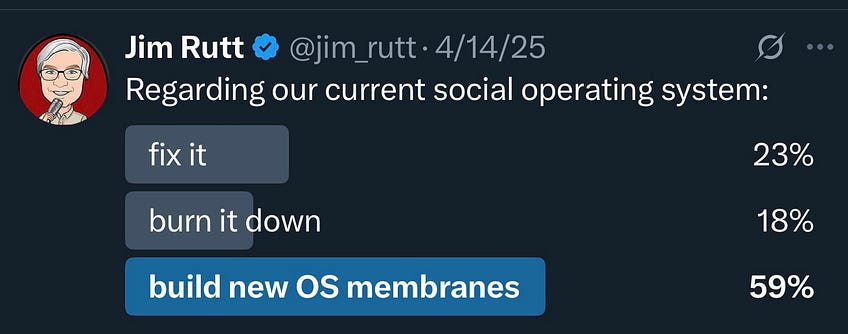
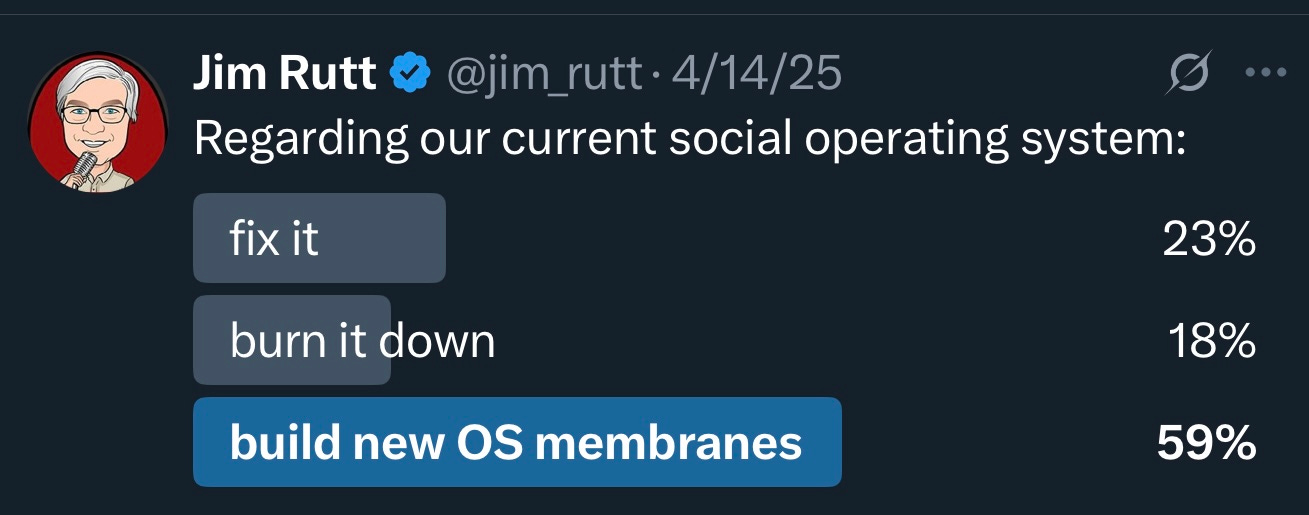
Tokenization Proposal: Tokenization, particularly via blockchain, is central to their vision of “collective intelligence” governance. In Jordan Hall’s Civium Project, tokenized “meta-protocols” and “deep code” govern communities, assigning value to actions, resources, or reputations as digital tokens. Rutt’s 2025 X poll (picture is later in this article) on rebuilding society’s “operating system” with “new OS membranes” suggests tokenized systems to replace traditional institutions, as discussed in advocacy for blockchain-based “liquid democracy” or decentralized autonomous organizations (DAOs). These tokens could represent voting power, economic stakes, or social capital, creating a new societal framework.
Network States and Tokenization: Digital Feudalism as Phoenix Rebirth
Tokenization Proposal: Balaji Srinivasan’s The Network State (2022) proposes tokenized governance for digital-first communities that crowdfund physical territories, aiming for sovereignty. Tokens represent membership, voting rights, or economic stakes in these “network archipelagos,” using blockchain to enforce contracts and manage resources. Srinivasan’s vision, inspired by Thiel’s seasteading and supported by venture capital like Pronomos Capital, envisions tokens as a currency of citizenship, where individuals “buy in” to a state’s rules, as seen in projects like Praxis ($525 million crypto-city).
Peter Thiel and Tokenization: Techno-Feudal Architect as Phoenix Catalyst
Tokenization Proposal: Peter Thiel, a central figure uniting these movements, champions tokenization through investments in blockchain, crypto, and surveillance tech. His funding of Srinivasan’s Counsyl (now Myriad Genetics), Yarvin’s Urbit (a tokenized identity platform), and crypto ventures like Pronomos Capital reflects a vision of tokenized governance. Thiel’s seasteading projects, inspired by Yarvin and Patri Friedman, aimed to create sovereign city-states using tokenized systems for economic and political control, as noted in a 2017 Business Insider article.
Dark Enlightenment and Tokenization: Corporate Monarchy as Phoenix Rebirth
Tokenization Proposal: The Dark Enlightenment, led by Curtis Yarvin and Nick Land, advocates for “neocameralism”—states run like corporations with tokenized “shares” determining governance power. Yarvin’s “Patchwork” model envisions thousands of sovereign city-states, each governed by tokenized contracts where shareholders (elites) hold authority, as outlined in his 2008 Unqualified Reservations blog. Land’s accelerationism envisions tokenized systems accelerating capitalism to a “fascist point,” with AI and blockchain enabling elite control. Thiel’s funding of Yarvin’s Urbit, a tokenized identity platform, operationalizes this vision, aiming to replace democratic systems with corporate-led governance.
The Phoenix Moment:
We are living through what these movements signal as “the Phoenix moment”—the deliberate collapse of existing institutions to create space for their alternative vision. The presumably accidental chaos could be systematic deconstruction guided by ideological frameworks and substantial financial resources, despite utopian visions.
The Mythology
The Phoenix is a potent symbol in Western esotericism, Christianity, and Eastern traditions (e.g., the Fenghuang), often tied to renewal through sacrifice. In ancient Egypt, the Phoenix was linked to the Bennu bird, a symbol of rebirth associated with the sun god Ra. The Bennu’s cycle mirrored the sun’s daily journey, embodying eternal life and cosmic renewal. In Greek and Roman traditions, the Phoenix was tied to fire and immortality, its self-destruction and rebirth serving as a metaphor for the triumph of spirit over matter.
In Gnostic texts, such as those in the Nag Hammadi Library, the Phoenix symbolized the soul’s purification and spiritual judgment. Early Christian writings adopted it as an emblem of Christ’s resurrection, reinforcing its association with eternal life. In Kabbalistic tradition, the Phoenix metaphorically illustrated the soul’s ascent through trials, as seen in the Zohar’s discussions of purification through fire-like ordeals. Jewish folklore, including Talmudic stories, further depicted the Phoenix as a symbol of obedience and immortality.
In Hermeticism and alchemy, the Phoenix represented the alchemical process of transmutation—turning base matter into spiritual gold. It embodied the maxim “solve et coagula” (dissolve and coagulate), signifying the dissolution of the ego and the attainment of divine consciousness. Rosicrucianism, similarly used the Phoenix to denote the death of material desires and the rebirth of enlightened awareness. The Rosicrucian symbol of the Phoenix, particularly in alchemical contexts, is a red Phoenix, representing the final stage of the Great Work (Magnum Opus), known as rubedo or reddening. It symbolizes the soul’s rebirth, spiritual enlightenment, and transformation, akin to the Philosophers’ Stone, signifying the culmination of the journey from spiritual darkness to divine awareness. Rosicrucians and related esoteric traditions often interpret the Phoenix myth as requiring a “burning down” or destruction phase before rebirth. The Phoenix’s immolation in flames symbolizes the necessary dissolution of the old, impure self—through trials, purification, or spiritual death—before the renewed, enlightened soul can rise from the ashes, completing the alchemical transformation.
Modern Movements: The Phoenix Rising in Current Times
The Phoenix’s symbolism has been co-opted by modern movements, each interpreting its cycle of destruction and renewal to suit their agendas. Tavistock’s Operation Phoenix was a post-World War II initiative, led by Wilfred Bion at the Tavistock Clinic, in the ashes of wartime destruction, that implemented radical democratic processes to reorganize and revitalize the clinic. The CIA’s Operation Phoenix, officially the Phoenix Program (1968–1972), framed its violent counterinsurgency in Vietnam as a means to “burn down” communism and resurrect a pro-Western state. It was a Vietnam War counterinsurgency effort to dismantle the Viet Cong’s political infrastructure through infiltration, capture, interrogation, torture, and assassination, primarily executed by South Vietnamese forces with CIA oversight.
The World Economic Forum’s Great Reset, frames its technocratic vision as a phoenix-like renewal— perhaps a euphemism or signal to the initiated as pretext for authoritarian control. Former President, Joe Biden’s “Build Back Better” agenda, launched in 2020, encompassed the notion of systemic destruction and renewal. These examples highlight the Phoenix’s dual nature: a symbol of hope and hubris, shaped by those who wield it.
In his Rescue the Republic speech on September 29, 2024, Bret Weinstein a a fellow member of the Staunton meetings that spawned Game~B, referenced “Phoenixing the Republic” as a call to radically transform the United States by metaphorically burning down its current corrupted, “senile” state to allow a renewed, purified republic to rise from the ashes, drawing on the Phoenix myth where the bird self-immolates to be reborn. He framed this drastic revolutionary change, as a necessary response to the West’s decline.
Game B and the Phoenix: Rebirth Through Transformation
Game B movement envisions a decentralized, regenerative society emerging from the ashes of capitalism and nation-states. Game B, an emergent movement to replace the competitive, extractive “Game A” society with a cooperative, sustainable paradigm, resonates deeply with the Phoenix’s symbolism of destruction and rebirth. Proponents like Jordan Hall, Jim Rutt and Daniel Schmachtenberger, argue that Game A—marked by ecological crises and institutional decay—must be metaphorically “burned down” to birth a new system prioritizing collective flourishing and anti-fragility. This mirrors the Phoenix, which immolates itself to rise anew, embodying renewal through crisis. Game B’s vision of prototyping decentralized communities and blockchain-based governance reflects the Phoenix’s transformation from ashes to a revitalized form. As mentioned earlier, a 2025 X poll, by Game B co-founder Jim Rutt asked whether society’s “current operating system” should be fixed, burned down, or rebuilt with “new OS membranes,” directly echoing the Phoenix’s destructive-reconstructive cycle. The Game~B movement envisions a decentralized, regenerative society emerging from the ashes of capitalism and nation-states. Game B’s vision of “collective intelligence” provides the philosophical justification for replacing self-ruling human deliberation with algorithmic decision-making. While Game B seeks to avoid apocalyptic collapse, favoring intentional transition, its call for a new civilizational paradigm aligns with the Phoenix’s archetype of purification and regeneration, framing crisis as a catalyst for the emergence of a new social operating system.
Curtis Yarvin’s concept of a “hard reboot” for society, as outlined in his neoreactionary writings, advocates for a radical dismantling of existing democratic institutions—likened to a system crash or destruction—to replace them with a new, authoritarian governance model, such as a monarchy or CEO-led state. A hard reboot, is a radical, total reset, akin to wiping a computer’s operating system and installing a new one, dismantling the current regime (what Yarvin calls the “Cathedral”—the entrenched nexus of media, academia, and bureaucracy) and replacing it with a new governance model, such as neocameralism, a system where a state is run like a corporation by a CEO, with clear property rights and no democratic pretense.
The hard reboot aligns strongly with Phoenix symbolism, as it entails a metaphorical “burning down” of the Cathedral—destroying the existing liberal-democratic order through a deliberate collapse or authoritarian takeover—followed by the “rebirth” of a neocameralist state. The Phoenix, which immolates itself to rise anew from its ashes, mirrors this cycle of destruction and regeneration. Replacing the Cathedral with neocameralism embodies this imagery: the old system (progressive, egalitarian, bureaucratic) is obliterated, and a new, hierarchical, and efficient order emerges. Yarvin’s RAGE (Retire All Government Employees) plan, part of a hard reboot, would fire the entire bureaucracy to clear the slate, much like the Phoenix’s fiery purge before renewal. The Phoenix imagery thus implicitly aligns with Yarvin’s vision of a cataclysmic reset to achieve a transformed, authoritarian state.`
Srinivasan’s Network State and the Phoenix: A Digital Rebirth
Balaji Srinivasan’s concept of the “Network State,” as outlined in his 2022 book The Network State: How to Start a New Country, proposes a new form of governance where highly aligned online communities, united by shared values or a “One Commandment,” crowdfund physical territories and eventually gain diplomatic recognition as sovereign entities. Srinivasan’s process—forming online collectives, building “network archipelagos,” and achieving sovereignty—parallels the Phoenix’s cycle, with the “destruction” being the abandonment of legacy systems and the “rebirth” a crypto-driven society. This vision of creating a new society from scratch, distinct from traditional nation-states, resonates with Phoenix symbolism, which represents cyclical rebirth through destruction and renewal. Srinivasan’s Network State envisions a radical break from existing state structures, which he critiques as bogged down by historical baggage, surveillance, and overregulation. His process—starting with a digital community (“cloud first, land last”), building a “network archipelago” of physical outposts, and eventually forming a sovereign state—mirrors the Phoenix’s cycle of destruction and rebirth. The “destruction” in this context is the rejection of centralized, legacy systems, replaced by decentralized, blockchain-based governance and crypto-economic systems, representing the “new life” of a Network State. Srinivasan’s idea of communities opting out of traditional states to form new societies aligns with the Phoenix’s theme of renewal through a clean slate.
Additionally, Srinivasan’s rhetoric, such as calling for a “parallel establishment” or a “tech Zionism,” suggests a transformative exodus from failing systems, akin to the Phoenix’s fiery rebirth. Critics, like journalist Gil Duran, note that Srinivasan’s vision involves purging opponents (e.g., “Blues” in San Francisco), which could be seen as a metaphorical “burning down” of ideological adversaries to pave the way for a new order, further echoing Phoenix imagery.
Christian Nationalism, TheoBro Ideology, and the Phoenix: A Radical Rebirth
Christian nationalism and its militant TheoBro faction, led by figures like Doug Wilson and Stephen Wolfe, resonate with the Phoenix’s symbolism of destruction and rebirth, envisioning a Christian America emerging from the ashes of a secular, “fallen” society. Christian nationalists aim to “burn down” progressive culture, as seen in their push for policies like displaying the Ten Commandments in public schools, to restore a biblically governed nation. TheoBros, advocating a patriarchal, theocratic order, seek to dismantle the liberal “Cathedral” and rebuild with authoritarian Christian rule, reflected in Wilson’s Classical Christian schools and Wolfe’s call for a Christian prince. The Phoenix, a Christian symbol of resurrection, mirrors their pursuit of a divine reset, with cultural upheaval as the crucible for a purified, theocratic renewal.
Peter Thiel, Techno-Libertarianism, and the Phoenix: A Radical Reset
Peter Thiel’s ideology—a blend of techno-libertarianism, nationalism, and anti-democratic impulses—aligns with the Phoenix’s symbolism of destruction and rebirth, as he seeks to dismantle what he perceives as a stagnant, progressive “Cathedral” to usher in a new era of technological and societal dynamism. His actions, from funding populist candidates like J.D. Vance to building surveillance-focused Palantir, reflect a desire to “burn down” the existing liberal-democratic order and rebuild a technocratic, elite-driven future. Thiel’s 2009 essay, declaring freedom and democracy incompatible, and his support for Curtis Yarvin’s authoritarian “hard reboot” echo the Phoenix’s immolation, aiming to raze institutions for a new order. His investments in crypto, seasteading, and defense tech like Anduril, and Palentir, signal a vision of a post-national, militarized rebirth, akin to the Phoenix rising from ashes. Thiel’s selective retreat from politics in 2024 suggests a strategic shift, not abandonment, of this transformative fire, aligning with the Phoenix’s calculated renewal.
The Phoenix’s Dialectical Nuance
The Phoenix symbol enriches Hegel’s dialectic by adding a mythic and emotional dimension. While Hegel’s framework is abstract, the Phoenix’s vivid imagery—fire, ashes, rebirth—captures the visceral stakes of transformation. In Rosicrucian and alchemical traditions, the Phoenix’s immolation parallels the dialectical “solve et coagula” (dissolve and coagulate), where the base material (thesis) is broken down (antithesis) to form spiritual gold (synthesis). This resonates with the movements’ promises of transcendence—whether technological, spiritual, or cultural—while masking their potential for authoritarian control.
The Phoenix symbol, intertwined with Hegel’s dialectic, illuminates the dangerous convergence of Game B, Dark Enlightenment, Network State, and TheoBro ideology. Each movement enacts a dialectical cycle—diagnosing the republic’s crises as the antithesis to its democratic thesis, then proposing a Phoenix-like synthesis that burns away freedom for technocratic or theocratic control. As Peter Thiel’s network accelerates this immolation, the Phoenix’s fire threatens to consume cognitive liberty. By recognizing this manipulation, we can forge a counter-synthesis, preserving the human agency that US Constitution drawing on principles codified by the Declaration of Independence, was drafted to defend, against the ashes of tyranny such as techno-feudalism.
“We hold these truths to be self-evident, that all men are created equal, that they are endowed by their Creator with certain unalienable Rights, that among these are Life, Liberty and the pursuit of Happiness.”
The choice is ours—to let the Phoenix herald tyranny or to rise as guardians of a free, self-governing future.
The Phoenix’s Fire and the Fight for Freedom
The convergence of Game B, the Dark Enlightenment, Network States, and TheoBro ideology, propelled by Peter Thiel’s vast financial and intellectual network, represents a deliberate “Phoenix moment”—a calculated immolation of the American Constitutional Republic to birth a techno-feudal empire. From Curtis Yarvin’s “hard reboot” to Balaji Srinivasan’s digital secession—or Game B’s algorithmic utopias to TheoBro theocratic fervor— these movements unite in their aim to extirpate democratic institutions, the Constitutional Republic, and written codification of governance in favor of rebuilding a world of corporate monarchs, blockchain fiefdoms, and divine mandates. The Phoenix’s ancient promise of renewal through destruction has been co-opted, for control, with policies like mass firings of humans (with insinuation of machine replacement) and surveillance tech proliferation already manifesting their vision. Yet, the republic’s fate is not sealed. Cognitive liberty—the fierce defense of independent thought against algorithmic manipulation—remains our strongest weapon. We must reject the false dichotomy of collapse or technocracy, demand accountability for platform power, and preserve the messy, human essence of self-governance. The Phoenix rises, but whether it heralds a reborn republic or a digital dystopia depends on our resolve to choose freedom over serfdom. The alarm has sounded; the time to act is now.
The Choice: Cognitive Liberty or Digital Serfdom
As I have consistently argued, this isn’t ultimately about left versus right politics—it’s about human freedom versus algorithmic control. The techno-feudal vision offers efficiency, order, and the promise of optimized outcomes in exchange for democratic participation and individual agency.
The choice couldn’t be starker. We can accept the seductive promises of technological solutions to human problems, allowing ourselves to become digital serfs in corporate-controlled territories governed by algorithmic systems we don’t understand or control. Or we can insist on the messy, inefficient, but fundamentally human process of self-governance.
This choice requires “cognitive liberty“—the capacity to think independently of the narratives and frameworks promoted by those who would control us. It means recognizing dialectical manipulation when we see it, rejecting false choices between collapse and authoritarianism, and insisting on genuine alternatives that preserve human agency.
The window for choice is rapidly closing. As these movements consolidate power through official government channels, their alternatives become increasingly difficult to resist. Network effects, platform dependencies, and algorithmic control create lock-in effects that make exit from techno-feudal systems practically impossible.
But the choice still exists. A Constitutional Republic may be imperfect, but it’s the only system that preserves space presenting a bulwark for genuine human agency and collective self-determination. The alternative these movements are championing—rule by CEO-monarchs guided by algorithmic optimization—may be more efficient, but it reduces human beings to inputs in systems they cannot influence or escape.
The Phoenix is rising from the ashes of America. Whether it births a more perfect union or a techno-feudal empire depends on choices we make in the coming months and years. The future of human freedom and cognitive sovereignty is at stake.
The Phoenix’s Fire and the Dual Fight for Cognitive Liberty and Freedom
The convergence of Game B, Dark Enlightenment, Network State, and TheoBro ideology, orchestrated by Peter Thiel’s vast network, enacts a Phoenix-like Hegelian dialectic—immolating the American Constitutional Republic to birth a techno-feudal empire. Through tokenization, these movements propose a radical reset: Game B’s algorithmic “meta-protocols,” Srinivasan’s blockchain-based Network States, TheoBro’s potential theocratic contracts, and Yarvin’s neocameralist “Patchworks” burn away democratic institutions (thesis) via tech-driven disruption (antithesis), synthesizing a tokenized control grid. This grid, integrating blockchain with surveillance tech like Thiel’s Palantir, centralizes power in crypto-elites and ideological gatekeepers, tracking behavior and restricting access under the guise of decentralization. Curtis Yarvin’s “hard reboot,” Balaji Srinivasan’s digital secession, Game B’s algorithmic utopias, and TheoBro’s theocratic zeal unite to burn away democratic institutions, proposing a synthesis of corporate monarchs, blockchain fiefdoms, and divine mandates. This Phoenix moment is not inevitable. Cognitive liberty, the fierce defense of mental autonomy, shields us from the flames of surveillance, algorithmic control, and ideological purges, preserving our right to think freely amidst the republic’s ashes. Cognitive freedom, the proactive pursuit of mental flourishing, fuels the rebirth of a liberated society, empowering us to build decentralized, human-centric alternatives to techno-feudalism. Together, these principles counter the dialectical manipulation of crisis and control, rejecting the false choice of collapse or tyranny. Cognitive sovereignty, the supreme self-governance of the mind, stands as our strongest defense and aspiration—shielding mental autonomy from surveillance, algorithms, and dogma. Siezing cognitive sovereignty, rejects the dialectical trap of crisis and control, refusing the techno-feudal ashes for a self-directed rebirth. The Phoenix rises, but whether it heralds digital serfdom or a reborn republic depends on our resolve to protect cognitive liberty today and cultivate cognitive freedom tomorrow. The alarm has sounded; the time to forge a free, self-governing future and avert digital serfdom is now!
It feels like I have been screaming into the void about three seemingly separate movements converging into the most dangerous threat to the American Constitutional Republic since the Civil War. Now, as their plans unfold in real-time, we're witnessing the emergence of a techno-feudal empire built on the ashes of the republic.
What if I told you that the chaos consuming American politics isn't random? What if the seemingly disconnected threads of tech billionaire influence, anti-democratic philosophy, and Christian nationalism weren't separate movements but coordinated components of a master plan to "phoenix the republic"—to deliberately collapse American Constitutionalism and rebuild it as a corporate-controlled surveillance state?
For half a decade, as a researcher, then podcast host, I have been mapping a conspiracy so vast and systematic that most people dismissed it as paranoid speculation. Three movements—Game B's collective intelligence utopia, the Dark Enlightenment's anti-democratic vision, and the Network State's digital secession—appeared to be distinct intellectual exercises emerging from different corners of the internet.
I saw something else entirely: a coalescing ideological project funded by the same Silicon Valley oligarchs, promoted by overlaps of thought leaders, aimed at the same ultimate goal—the complete transformation of American governance from Constitutional Republic to techno-authoritarian empire. These movements seek planetary scale, but the capture of America and the West are priority.
The evidence was always there, hidden in plain sight across podcasts, Substack articles, investment patterns, and political networks. It took the convergence of these movements in the Trump-Vance administration—and their rapid implementation through vehicles like Elon Musk's Department of Government Efficiency—to reveal the true scope of what I’d been warning about.
This is the story of how a small network of tech billionaires, anti-democratic philosophers, and Christian nationalists spent two decades building the intellectual and financial infrastructure to capture American governance. It's the story of how ideas once confined to obscure blogs now directly influence federal policy. And it's the story of how we arrived at a moment where the future of the Constitutional Republic and world wide democracy stands at a crossroads.
At the center of this convergence sits one man whose $21 billion fortune has systematically funded every major figure across all three movements. Peter Thiel didn't just invest in companies—he invested in ideology, carefully nurturing a generation of anti-democratic thinkers and providing them with the resources to transform their theories into political reality.
The network operates through overlapping institutions that most Americans have never heard of. The Thiel Fellowship—ostensibly a program to help college dropouts pursue entrepreneurship—has become a pipeline for techno-authoritarians. Among its fellows are figures like Augustus Doricko, the 24-year-old founder of Rainmaker (whose weather modification experiments preceded this week’s deadly floods across Kerr County, Texas), and countless others building what they call the "American Dynamism" movement.
Thiel's most important investment wasn't financial—it was intellectual. For over a decade, he's been the primary patron of Curtis Yarvin, the philosopher-programmer who writes under the pseudonym Mencius Moldbug. Yarvin's anti-democratic theories, once confined to obscure blogs, now directly influence Trump administration policy through what Yarvin calls "RAGE"—Retire All Government Employees—the blueprint for Musk's Department of Government Efficiency. In the linked YouTube video “How to Reboot the US Government" (2012 Speech) Yarvin outlines his plan to replace democracy with a corporate dictatorship, introducing the acronym “RAGE” (Retire All Government Employees) to purge the federal workforce and install loyalists in a streamlined, CEO-led government. He explicitly frames the U.S. as needing a corporate overhaul to eliminate bureaucratic inefficiency.
Dimes Square and Thiel’s Shadow
In the gritty micro-neighborhood of Manhattan’s Dimes Square, a cultural rebellion brews, backed by the enigmatic Peter Thiel, a often pegged as a libertarian or “tech right” icon. Known for funding neoreactionary thinkers like Curtis Yarvin and right-wing politicians, has funneled money into Dimes Square’s dissident art scene, supporting venues like Sovereign House and events such as the 2021 New People’s Cinema festival. This scene, blending post-ironic aesthetics with reactionary politics, hosts figures like Yarvin, Dasha Nekrasova, Anna Khachiyan, and Costin Alamariu, who champion anti-liberal ideas under Thiel’s patronage. Curiously, many of these individuals have ties to communism—either through family histories or past leftist affiliations. Yarvin’s grandparents were Brooklyn Communists, while Nekrasova and Khachiyan, born in the Soviet Union, once flirted with socialism before pivoting to the New Right. Alamariu was more seeped in Nietzschean and fascist ideologies. Thiel’s Dimes Square gambit reveals a paradox: a libertarian bankrolling ex-leftists to forge a neo-feudal order, using their radical roots to destabilize the liberal status quo. Thiel’s Networked Ambitions: From Rockbridge to Seasteading to Network States
Thiel's influence extends far beyond individual relationships. Through the Rockbridge Network, co-founded by now-Vice President JD Vance, Thiel has created what amounts to a "political venture capital firm" that has quietly funneled over $75 million into right-wing media, voter suppression efforts, and election manipulation technologies. The network's board includes Chris Buskirk, a key TheoBro figure who helped merge Christian Nationalist ideology with Silicon Valley's corporate governance fantasies. While information on the firm is scarce, in 2021 they put out a plan to “remake the right”.
“The Rockbridge Network will replace the current Republican ecosystem of think-tanks, media organizations and activist groups that have contributed to the Party's decline with better action - oriented , more effective people and institutions that are focused on winning.”
The seasteading project represents perhaps Thiel's most revealing investment—$1.7 million toward creating floating cities beyond national jurisdiction where tech elites could experiment with new forms of governance. This directly inspired Balaji Srinivasan's Network State. Srinivasan believes the Seasteading project can be revived.
“We actually think seasteading can be revived in the long-term. Why? Because it can be made part of the network state paradigm. You just need to grow a startup society capable of crowdfunding a cruise ship. Your society wouldn’t start with something so expensive, of course; it’d start by getting much more modest pieces of territory around the world and connecting them into a network archipelago. But once you have a startup society with tens of thousands of members, something as crazy as a crowdfunded cruise ship becomes a possibility.”
In his book he explains how this concept, provided the practical framework for implementing anti-democratic governance on a larger scale under the guise of “decentralization” “Towards a Recentralized Center”
The Philosopher King: Curtis Yarvin's Blueprint for Techno-Monarchy
If Peter Thiel is the financial architect of this movement, Curtis Yarvin is its intellectual engine. Writing as Mencius Moldbug, Yarvin spent over a decade developing what would become known as the Dark Enlightenment, also known as the neo-reactionary movement (abbreviated to NRx)—a philosophical framework explicitly designed to replace democratic governance with corporate-style authoritarianism, which Yarvin refers to as SovCorp, in his Unqualified Reservations blog.
“Let’s start with my ideal world – the world of thousands, preferably even tens of thousands, of neocameralist city-states and ministates, or neostates. The organizations which own and operate these neostates are for-profit sovereign corporations, or sovcorps.”
In Yarvin’s Gray Mirror Substack post titled “The restoration of public truth” (January 3, 2022), he discusses a corporate-style government:
“The mission of this new regime would not be to make its citizens happy, healthy, or holy—its mission would be to maximize the value of its assets, which are nothing but its citizens and their property. As a corporation, its board could fire its CEO for anything; as a government, it could do so only for mismanagement.”
Yarvin's central thesis is deceptively simple: "democracy" is a false front concealing the real power structure he calls "the Cathedral." According to Yarvin, unelected bureaucrats, media figures, and academics form a shadow government that shapes public opinion through coordinated narrative control. His solution isn't reform but complete destruction—what he calls a "hard reset" of American governance. I don’t have full access to Yarvin’s paywalled substack, but according to a reddit post, in an essay dated April 2022, Yarvin updated RAGE to something he described as a “butterfly revolution.” He imagined a second Trump presidency in which Trump would enable a radical government transformation. The reddit suggests the “proposal will sound familiar to anyone who has watched Musk wreak havoc on the United States Government (USG).”
Wrote Yarvin:
We’ve got to risk a full power start—a full reboot of the USG. We can only do this by giving absolute sovereignty to a single organization—with roughly the powers that the Allied occupation authorities held in Japan and Germany in the fall of 1945. This level of centralized emergency power worked to refound a nation then, for them. So it should work now, for us.
(The metaphor of “full power start” comes from Star Trek and entails a risky process of restarting a fictional spaceship in a way that might cause “implosion.” The World War II metaphor casts the federal government as a conquered enemy now controlled by an outside force.)
“What Trump is going to do is to build this regime-in-exile or occupation authority as a private and (needless to say) peaceful institution—a larva. By winning a Presidential election, he will then install it in office…Trump himself will not be the brain of this butterfly. He will not be the CEO. He will be the chairman of the board—he will select the CEO (an experienced executive). This process, which obviously has to be televised, will be complete by his inauguration—at which the transition to the next regime will start immediately.”
His preferred model is "neocameralism"—running countries like corporations with CEO-monarchs who have absolute authority but are accountable to wealthy shareholders. In this system, citizenship becomes a service contract, citizens become customers or employees, and government becomes a profit-maximizing enterprise.
The influence of Yarvin's ideas on current policy cannot be overstated. His "RAGE" concept—mass firing of civil servants—became the template for Trump's Schedule F executive order and Musk's DOGE implementation. Two DOGE advisers confirmed to The Washington Post, that Yarvin had offered "the most crisp articulation" of what the department is trying to achieve.
"There's this alliance of the media, of universities, of government," one DOGE adviser explained, speaking anonymously. "These people are capturing the government and using it for their own ends and for their own power. And that's very scary to us. You want to lessen the power of the cathedral."
"Yet even Yarvin has been surprised by the crude implementation of his ideas. In recent Washington Post interviews, he's compared DOGE to "‘an orchestra of chimpanzees trying to perform Wagner.’ He also said the group’s attitude toward federal workers resembles that of a brash but insecure man who repels potential sexual partners. ‘In the worst aspects of DOGE, there’s this aspect of the incel who gets mad at the girl who won’t sleep with him,’ Yarvin said, using the term for so-called involuntary celibates. ‘That’s not a powerful attitude.’”
Perhaps the philosopher has discovered that his elegant theories, when implemented by political actors, become something far more chaotic and destructive than even he envisioned.
Subscribe
Nick Land: The Accelerationist Architect of Post-Democratic Order
While Curtis Yarvin provides the intellectual scaffolding for neo-reactionary governance, Nick Land stands as the philosophical architect whose ideas catalyzed the Dark Enlightenment’s most radical ambitions. Land, a British philosopher and founder of the accelerationist movement, rejects not only liberal democracy but the very premise of human-centered governance. His work is foundational to understanding how the anti-democratic, anti-constitutional, techno-feudal vision advanced by Yarvin and others is not an aberration, but the logical endpoint of a deeper philosophical current. Accelerationism and the Critique of Democracy
Land’s accelerationism posits that the forces of capital and technology should not be restrained but pushed to their limits, even if this means the destruction of existing social and political orders. He views liberal democracy as a historical dead end—an impediment to the “runaway” processes of technological and economic evolution. In Land’s framework, democracy is not just inefficient; it is fundamentally obsolete, destined to be outpaced and ultimately replaced by more adaptive, post-human systems. Land’s core thesis is that capitalism is not a human construct to be tamed or reformed but an autonomous, almost alien force that drives technological progress at an exponential pace. In texts like The Thirst for Annihilation and his later blog posts on Xenosystems, he posits that human agency is increasingly irrelevant in the face of this "techno-capital singularity." For Land, resistance to this process—whether through socialism, regulation, or ethical concerns—is futile and misguided. Instead, he advocates for accelerationism: the deliberate intensification of capitalist dynamics to push society past its breaking point, unleashing a post-human future.
This vision is rooted in a blend of cybernetics, Nietzschean philosophy, and science fiction. Cybernetics informs his view of technology as an autonomous, self-reinforcing system that drives progress beyond human control. Nietzsche’s ideas of the Übermensch and the will to power underpin Land’s celebration of elite, post-human forces that transcend traditional morality. Science fiction, particularly cyberpunk, shapes his apocalyptic imagery of a machinic future where humanity is reshaped or eclipsed by technology. Science fiction such as, William Gibson’s Neuromancer and Philip K. Dick’s works, envisions technology and capitalism as autonomous forces driving a post-human future. The cosmic horror of H.P. Lovecraft and J.G. Ballard’s psychosexual tech-dystopias further shape Land’s apocalyptic vision of a machinic singularity. Additionally, Land’s ideas resonate with Julius Evola’s esoteric traditionalism, particularly in their shared rejection of modernity and embrace of hierarchical, transcendent orders. Land draws heavily on thinkers like Gilles Deleuze and Félix Guattari, whose concept of "deterritorialization" he radicalizes to describe capitalism’s relentless dismantling of traditional structures—nations, cultures, even biology. He sees technology as the ultimate accelerant, a force that rewires human cognition and social organization. In his view, artificial intelligence, blockchain, and biotechnology are not tools but agents of a coming "machinic" order, where human values are subordinated to the imperatives of efficiency and complexity. Nick Land and the CCRU: Accelerating the Abyss
In the mid-1990s, the Cybernetic Culture Research Unit (CCRU) at the University of Warwick became a crucible for radical thought, and cultural exploration, blending philosophy, cybernetics, occultism, science fiction, and techno-culture, with Nick Land as its visionary architect. Founded by feminist British philosopher, Sadie Plant (author of Zeros + Ones) and affiliated with Warwick’s Philosophy Department, it attracted a mix of academics, artists, and students, including Land, Mark Fisher, Kodwo Eshun, and Luciana Parisi. A rogue collective blending cybernetics, Deleuze, cyberpunk, and occultism, the CCRU rejected academic norms to explore technology’s autonomous drive and capitalism’s runaway dynamics. Land, fueled by psychedelics and techno, developed accelerationism, urging the intensification of these forces to collapse human-centric systems into a machinic singularity. His concept of “hyperstition”—fictional ideas that catalyze reality—envisioned techno-capital as an alien intelligence, prefiguring transhuman, “hyper-racist” entities and “techno-plastic beings.” He developed accelerationism, arguing that capitalism’s self-amplifying dynamics should be intensified to collapse human-centric systems and usher in a techno-singularity. His essay Meltdown (1994) and later Fanged Noumena (2011) crystallized these ideas. Land’s CCRU tenure marks a genesis point for techno-feudalism, where his prophetic visions of elite-driven, anti-democratic systems resonate with modern tech oligarchs plotting a new order. Land’s involvement ended when the CCRU dissolved in 1997. He left academia, moved to Shanghai, and shifted toward neoreactionary (NRx) ideas, but the CCRU’s legacy shaped his later work and the broader accelerationist movement. From Anti-Humanism to Techno-Feudalism
Land’s anti-humanist stance is explicit: he envisions a future where governance is optimized for intelligence, efficiency, and technological advancement, not for the well-being or participation of the masses. This vision aligns seamlessly with the Dark Enlightenment’s advocacy for rule by a technocratic elite—philosopher-kings whose legitimacy derives from cognitive and technological superiority rather than popular consent. Land’s influence is evident in the concept of the “SovCorp” (sovereign corporation), where states are run as profit-maximizing enterprises, and in the broader push toward network states and tokenized societies. Nick Land refers to this in his essay on the Dark Enlightenment, as gov-corp.
“The formalization of political powers, thirdly, allows for the possibility of effective government. Once the universe of democratic corruption is converted into a (freely transferable) shareholding in gov-corp. the owners of the state can initiate rational corporate governance, beginning with the appointment of a CEO. As with any business, the interests of the state are now precisely formalized as the maximization of long-term shareholder value. There is no longer any need for residents (clients) to take any interest in politics whatsoever. In fact, to do so would be to exhibit semi-criminal proclivities. If gov-corp doesn’t deliver acceptable value for its taxes (sovereign rent), they can notify its customer service function, and if necessary take their custom elsewhere. Gov-corp would concentrate upon running an efficient, attractive, vital, clean, and secure country, of a kind that is able to draw customers. No voice, free exit.” P.119, Xenosystems Fragments by Nick Land
Land’s accelerationism dismisses constitutional constraints, celebrating the emergence of new elites—whether corporate, algorithmic, or post-human—who can harness technology’s disruptive potential, aligning with the reality of techno-feudalism as humans become “techno-plastic beings”. Techno-plastic beings is a term Land uses to describe entities emerging from the fusion of technology, biology, and capital—adaptable, self-modifying systems that transcend fixed human or organic forms. These beings are “plastic” in their ability to reconfigure themselves, driven by the machinic logic of techno-capital.
Subscribe
Game B: The Utopian Mask on Technocratic Control
While Yarvin and Land’s Dark Enlightenment provide the anti-democratic theory, Game B offers the seductive alternative vision. Founded by complexity theorist Jim Rutt, evolutionary biologist Bret Weinstein, entrepreneur Jordan Hall, and Hall’s cofounder of Qualia Life fka Neurohacker Collective, Daniel Schmachtenberger, Game B positions itself as humanity's evolution beyond "rivalrous" competition toward "anti-fragile" collaboration. Game~B operates through the left hand path of the political dialectic, using the archetype of divine mother, and soft power influence in lieu of the Dark Enlightment’s right-hand, patriarchal archetype of autocratic rule. In true dialectical fashion, their convergence through Network States exemplifies a shared telos, resulting in the dissolution of geographical sovereign nation states. Illustration showing Industry 4.0 components including IoT, automation, cloud, big data, cybersecurity, and connection
The Game~B language is intoxicating in ways that would make, their spiritual and intellectual mentors— Neoplatonic philosophers, such as Plotinus, Porphyry, Iamblichus, Proclus, Theosphists such as Alice Bailey, Fabian Society member, and science fiction writer, HG Wells, French Jesuit Preist, Teihard de Chardin, and New Thought leader, Barbara Marx Hubbard—to name a few, blush with pride. Jargon veiled in warm-fuzzy lexicon— "collective intelligence," "anti-rivalrous dynamics," "omni-win civilizations," "emergent coherence"— encourage consensus, harmonizing Chardin’s vision of a Noosphere. Game B advocates speak of transcending left-right politics, building regenerative systems that serve all life, hosting and speaking at sophisticated conferences and doing dialogues, often referred to as “dialoguous” in Game~B, across platforms in person and online that feature respected academics and spiritual teachers. Jordan Hall’s presentation on Game~B Approach to Startup Societies at the Startup Societies foundation conference held at Peter Thiel’s Prospera in Honduras illustrates how they are marketing to an entrepreneurial and potentially “libertarian minded” audience in efforts to transcend the mainstream partisan lines.
As I have consistently warned, Game B's beautiful language conceals a disturbing reality. The movement's core premise—that current civilization (Game A) is doomed, facing a “meta-crisis” and must be replaced—creates a false choice between collapse and their alternative. This Hegelian dialectic manufacturing crisis, which they reference as “meta-crises”, to justify predetermined solutions is a classic manipulation technique.
More troubling is Game B's relationship to democracy and worse the conflicts it presents with the principles of the Constitutional Republic. While advocates speak of "collective intelligence,"—which is portentously reminiscent of H.G. Wells World Brain, and Teilhard de Chardin’s concept of the Noosphere— and Jim Rutt advocates “liquid democracy”, they consistently dismiss the messy realities of democratic participation, the quandaries presented via technological implementations, not to mention the direct incompatibility of “democracy” with a Constitutional Republic. Their vision of "emergent coherence" sounds suspiciously like Algocracy, algorithmic governance—decision-making systems that claim to represent the collective will, while being controlled by whoever programs the algorithms. The Algorithmic Oracle Courtenay Turner · Jun 25 Read full story
Jordan Hall's Civium Project exemplifies this dynamic. Promoted as an alternative to traditional cities, Civium would be governed by "meta-protocols" and "deep code" rather than elected representatives. Hall speaks of "designing culture" and creating "technological scaffolding" for human relationships—the hubris of a small group of technologists believing they can engineer better forms of human social organization than those developed over millennia. The Path to Mass Surveillance and Technological Singularity: Courtenay Turner · May 19 Read full story
I have extensively documented how Game B's funding sources reveal its true nature. While advocates claim to reject current power structures, their conferences are sponsored by the same tech oligarchs driving the other movements. Game B serves as a philosophical gateway drug, introducing idealistic people to anti-democratic ideas through appealing language about human potential.
Balaji Srinivasan's Network State movement provides the practical framework for implementing Game B's vision and Dark Enlightenment theories. His book outlines a seven-step process for creating new nations based on digital communities rather than geographic territories.
The process begins innocuously enough: form online communities around shared values, develop capacity for collective action, build economic systems using cryptocurrency. But the end goal is revolutionary—diplomatic recognition as sovereign entities that exist parallel to and eventually replace traditional nation-states.
Srinivasan's vision is explicitly feudal. Instead of geography-based nations with democratic accountability, humanity would be organized into ideology-based enclaves controlled by crypto-plutocrats. The wealthy would purchase territory globally, creating archipelagos of aligned communities connected by blockchain governance systems similar to Peter Thiel’s Prospera. “Inside the "Illegal" Billionaire Paradise with its Own Laws” is an apropos title for this short documentary on Prospera which showcases some very curious “life extension” experiments..
The appeal for tech billionaires is obvious. Rather than subjecting themselves to democratic oversight, or regulatory limitations, they could create custom jurisdictions with laws designed to maximize their power and wealth. In the context of Albert O. Hirschman’s book, exit replaces voice—instead of trying to convince fellow citizens through political participation, dissatisfied elites simply leave to create their own nations.
Projects like Praxis, which recently secured $525 million to build a "crypto-friendly city" in a special economic zone with reduced regulatory barriers, represent early implementations of this vision. The city in Greenland, with investment from Thiel through Pronomos Capital, promises to "accelerate technological progress while promoting traditional values of Western Civilization"—code for creating spaces where tech elites can operate without regulatory constraints.
These aren't simply business ventures but pilot programs for a larger transformation. The COVID-19 pandemic accelerated network state experiments as remote work normalized and tech workers began relocating en masse to jurisdictions with favorable tax and regulatory environments.
Subscribe
The TheoBros: Adding Divine Mandate to Techno-Authoritarianism
From left to right: Pete Hegseth, Doug Wilson, Chris Buskirk, Andrew Isker, William E. Wolfe, JD Vance, Trae Stephens, Garry Tan, Josh Abbotoy, Augustus Doricko, Marc Andreessen, and Peter Thiel.
The newest and perhaps most precarious component of this convergence is the TheoBro movement—young Christian nationalist men who merge Reformed theology with Silicon Valley supremacism. Unlike previous evangelical movements focused on cultural issues, TheoBros explicitly advocate for replacing democratic governance with biblical law.
Operating primarily through podcasts, social media, and affiliated churches—particularly the Communion of Reformed Evangelical Churches (CREC) founded by Douglas Wilson—they advocate positions that would shock most Christians: repealing the 19th Amendment to end women's suffrage, implementing public flogging for certain crimes, establishing biblical law as the legal foundation for American governance.
Their hypermasculine aesthetics fit perfectly with El Segundo's "Gundo Bros" culture—the defense tech scene where many of these entrepreneurs operate through the right hand path of the Hegelian political system, exuding patriarchal, authoritarian archetypes. These young men combine Christian identity with explicit nationalist ideology, often boasting of their physical fitness and traditional gender roles while building weapons systems and surveillance technologies. El Segundo has become the Silicon Valley of the military industrial complex
The movement's political connections run deep. JD Vance attends a TheoBro-affiliated church and has spoken at events organized by the movement's leaders. Chris Buskirk, Vance's co-founder at Rockbridge Network, sits on the board of TheoBro-aligned organizations. Defense Secretary Pete Hegseth's membership in a CREC church drew attention because of the denomination's explicitly Christian nationalist positions.
Organizations like Discipulus Ventures represent the institutional merger of these ideologies. Founded by 20-year-old Jakob Diepenbrock, Discipulus explicitly seeks founders who combine "entrepreneurship, personal virtue, and obligation to our country" while working on "hard tech, defense, or industry" problems. The accelerator has raised $6 million from investors including Andreessen Horowitz and Lux Capital, backing military startups that merge Christian nationalism with advanced weapons development.
TheoBros provide something crucial that Game B and Dark Enlightenment lack—a sense of divine mandate. Rather than merely arguing for techno-authoritarianism on efficiency grounds, they frame it as fulfilling God's will. This religious dimension imbues their autocracy with a semblance of righteousness making it appear sacrosanct.
The election of Donald Trump with JD Vance as Vice President marked the transition of these movements from theoretical discussions to practical implementation. All three movements now operate through official channels of government power, implementing policies that advance their shared vision of post-democratic, post-constitutional, and in some cases post-liberal governance.
Curtis Yarvin's influence on the Trump administration extends far beyond DOGE. His concept of "the Cathedral" now frames official rhetoric about media, academia, and bureaucracy. His vision of CEO-style governance influences executive power expansion. His writings on immigration and social order align with administration policies that view democratic participation as fundamentally destabilizing.
Elon Musk's DOGE represents the most direct implementation of Yarvin's theories. The department's mass firing of federal employees, centralization of executive power, and replacement of democratic oversight with corporate-style management mirrors Yarvin's "RAGE" concept almost perfectly. When DOGE advisers say they want to "lessen the power of the cathedral," they're using Yarvin's exact terminology and analytical framework. Curtis Yarvin speaking on “How to Reboot the US Government.”
Game B advocates point to governmental dysfunction as evidence that current institutions are failing and new forms of collective intelligence are needed. Their conferences and dialogues, feature discussions on how blockchain governance and AI-mediated decision-making could replace traditional decision making processes, governance structures, and remove the executive and legislative functions with a primarily juridical. This sounds like a techno-philosopher-king rule, no different from Yarvin’s CEO ruled SovCorp, or Nic Land’s GovCorp, but cloaked in different language marketed to a different target audience. Jim Rutt, Jordan Hall and others in the space such as John Vervaeke have had many discusses envisioning new governance systems for Game B, mentioning blockchain, DAOs, as a tool. Hall envisages “civiums” (networked communities) using blockchain and AI for decision making and governance apparatus. The movement's emphasis on "collective intelligence" provides intellectual cover for algorithmic governance systems that centralize power while claiming to represent the people's will.
Network State proponents see the current political moment as validation of their exit strategy. Rather than working within existing democratic institutions, they advocate building parallel systems that can eventually replace nation-states entirely. The success of crypto-friendly jurisdictions and special economic zones provides proof-of-concept for their vision of corporate-controlled territories.
TheoBros frame all of these developments as spiritual warfare—a cosmic battle between Christian civilization and secular decadence. Their theology provides moral justification for dismantling democratic institutions and the Constitutional republic, in favor of biblical governance. When Defense Secretary Pete Hegseth leads Pentagon prayers praising Trump as divinely appointed, he's implementing TheoBro theology at the highest levels of government. It’s one thing for a person to hold religious beliefs that shape their personal view of events and people etc., but to project those beliefs on political affairs is entirely different.
Subscribe
Digital Feudalism: The End Game Revealed
What emerges from this convergence isn't a reformed democracy or even traditional authoritarianism—it's something new that researchers like Yanis Varoufakis call "techno-feudalism." In this system, tech platforms function as digital fiefdoms where users contribute data and labor without fair compensation, controlled by algorithmic lords who extract value through rent rather than production.
The COVID-19 pandemic accelerated this transformation as digital platforms became essential infrastructure for economic and social life. But rather than treating these platforms as public utilities subject to popular sovereignty, the tech oligarchs used their indispensability to argue for even less oversight and regulation.
Platform dominance creates new forms of dependency that mirror feudal relationships. Users become digital serfs whose labor and data generate value they don't control. Content creators, small businesses, and even governments become dependent on platform access for their survival. The platform owners—the new feudal lords—collect rent from all economic activity within their domains.
This isn't metaphorical. Facebook, Google, Amazon, and other platforms literally control access to markets, information, and social connection. They can deplatform businesses, manipulate information flows, and shape political discourse through algorithmic control. Their power exceeds that of most governments, but unlike governments, they're not accountable to democratic or representative oversight.
The Network State concept represents the ultimate expression of this development—corporate-controlled territories where representative participation is replaced by a hybrid of stakeholder and shareholder governance. Citizens become customers, public goods become private services, and political rights become terms of service agreements. If you add SMART contracts to the mix, an unfathomable tyranny could be imposed. The Gundo Bros: Militarizing Techno-Feudalism
The defense tech culture emerging from El Segundo, California represents the militarization of these ideological currents. The self-styled "Gundo Bros" combine hypermasculine aesthetics with explicitly Christian and nationalist ideology while building advanced weapons systems for the Pentagon.
These young entrepreneurs don't just build technology—they build ideology. Their accelerators like Discipulus Ventures explicitly seek founders who merge "personal virtue" with "obligation to our country," creating a pipeline from Christian nationalism to advanced weapons development. The fact that major venture capital firms like Andreessen Horowitz and Lux Capital back these explicitly ideological ventures shows how mainstream this fusion has become.
The cultural elements are as important as the technological ones. The Gundo Bros' emphasis on physical fitness, traditional gender roles, and Christian identity creates a distinct subculture that merges tech innovation with authoritarian values. When founders attend Friday night mass together and speak of "growing in faith" as part of their entrepreneurial journey, they're building ideological solidarity alongside business relationships.
This culture produces more than just weapons—it produces warriors for the techno-feudal order. These young men see themselves as defending Western civilization against decadent liberalism, building the technological infrastructure needed to secure their vision of Christian nationalist governance which could ultimately be utilized by a myriad of technocratic visions. The Hegelian Dialectical Structure
The analysis of this convergence as a Hegelian dialectic proves remarkably prescient. A new, insidious form of techno-feudal authority emerges from the synthesis of left-leaning, Gaia-oriented decentralization and patriarchal, autocratic techno-authoritarianism. The Dark Enlightenment represents a thesis—marketed to a politically right wing audience, using patriarchal archetypes, traditionalism, and explicit techno-authoritarianism justified through appeals to efficiency and natural hierarchy. Game~B functions as an antithesis— marketed to a left leaning audience, using the archetype of divine mother, presenting itself as a democratic, environmentally sustainable alternative that nevertheless advocates for many of the same structural changes veiled in different language, prioritizing themes for an alternative market. The synthesis that emerges, under the political banner of “libertarianism” with both poles drawing from concepts such as Network States and leaders like Peter Thiel, who emerges as the most significant convergence point between all three movements, functioning as both ideological catalyst and financial enabler of the techno-feudal transformation. With a net worth of $20.8 billion, Thiel has systematically funded every major figure and institution across the Game~B, Dark Enlightenment, and Network State movements, while aligning in many ways with the TheoBros by varnishing technocracy, and in some cases transhumanism, with “Christian-ease”. Emerging from this dialectical tension is techno-feudalism: hierarchical technological governance that incorporates elements of both efficiency-focused technocracy and philosopher king rule.
This dialectical structure helps explain why movements with such different cultural and political appeals could converge on similar institutional proposals. Both movements identify genuine problems with current governance systems—whether framed as democratic inefficiency or meaning crisis—and propose technological solutions that necessarily concentrate power in the hands of those who design and control the technological systems. Game~B proponents like Jordan Hall, Jim Rutt, Bret Weinstein, and Daniel Schmactenberger et al., speak eloquently of collective intelligence, anti-rivalrous dynamics, and emergent coherence. Their Civium projects promise to transcend the limitations of traditional cities through "meta-protocols" and "deep code" governance systems that harness the wisdom of crowds while maintaining ecological sustainability. Yet beneath this appealing language lies a proposal that is structurally identical to what the Dark Enlightenment advocates: the replacement of legislative processes with algorithmic "juridical" systems purporting to embody higher wisdom than solely human democratic or representative deliberation can achieve.
Subscribe
Cassandra’s Warning
I have been consistently warning about what others couldn't or wouldn't see. Through my podcast, radio show, Substack, and various media appearances, I've mapped the connections between these movements extensively.
My analysis goes beyond simple dot-connecting to reveal the ideological and methodological consistency underlying apparently diverse movements. Through the framework of "Hegelian dialectics" we can see how these groups manufacture or capitalize on crises to justify predetermined solutions. The future of cognitive sovereignty hinges on a fortified a philosophical foundation for resistance to technocratic manipulation.
If we rely on self-described goals, and flowery elucidations of human flourishing, and human potential but fail to recognize the practical applications of the utopian visions, we could be headed for an extremely dystopian path. While Game B advocates speak beautifully about human flourishing, I focus on their actual governance proposals and the potential ramifications. While Network State proponents promise freedom through exit, I implore you seek and examine who would control the new territories and look at current examples. While TheoBros aver divine mandate, we could spend countless hours analyzing their political alliances and funding sources, telling a different story.
My warnings about the "Third Way" and technocratic synthesis, unfortunately prove seemingly prescient as these movements merge into unified political action, whether through, "post-partisan" “Third Way” movements like the Third Way think tank, Forward Party, The Emancipation Party, GoodParty.org, Renew America Movement (RAM), Serve America Movement (SAM),No Labels, United Independents, Alliance Party, Braver Angels, The People’s Party (U.S., historical context), Independent Voting, Common Sense American, We the People Party, or Elon Musk’s “American party which is being endorsed by Andrew Yang of the “Forward Party”, or via synergistic democracy, liquid democracy, or other blockchain voting modalities advocated by Game~B and Dark Enlightenment, or the complete dissolution of political governance and nation states via, theocracy, SovCorps or Network States. As I mention in my article “Technological Age of Aquarius: Third Way Dream or Digital Dystopia?”, (linked below) political dialectics are fomented to create technological synthesis. The poles between the left and right are pushed to extremes exacerbating the dialectical churn to create the technocratic synthesis. As Anthony Giddens states in his book, The Third Way:The Renewal of Social Democracy(1998) “A renewed social democracy has to be left of centre, because social justice and emancipatory politics remain at its core. Technocracy aligns with many of the Third Way political platforms, such as “energy certificates”. Elon Musk’s maternal grandfather Joshua Haldeman was a key figure in Canada’s Technocracy Incorporated, leading the movement until its ban in 1940 and promoting a vision of authoritarian, engineer-led governance. Musk’s reported consultation with Yarvin regarding the launch of the America Party for midterms, suggests an interest in alternative governance models, potentially influenced by the technocratic ideas Haldeman championed. The America Party’s aim to disrupt the two-party system aligns with, Third Way politics slogan of capturing the “radical center” and Technocracy’s radical social and economic restructuring ethos.
While these appear as separate intellectual exercises they forgather as components of a deliberate project to transform American governance. As with any dialectic, seemingly contradictory ideologies—libertarian Network States and authoritarian Christian nationalism—can coexist and mutually reinforce each other within the same political coalition.
Share Courtenay’s Substack Tokenization and the Control Grid: The Phoenix-Like Ambitions of Game B, Network States, TheoBros, Peter Thiel, and the Dark Enlightenment
Tokenization, the process of converting assets, rights, or identities into digital tokens on blockchain or similar systems, is a recurring theme in the ideologies of Game B, Network States, TheoBros, Peter Thiel, and the Dark Enlightenment. These movements, converging toward a techno-feudal vision, propose tokenization as a mechanism to restructure society, governance, and power. By replacing democratic institutions with tokenized systems, they risk creating a control grid—a networked, technocratic infrastructure that centralizes power under the guise of decentralization, enabling surveillance, behavioral control, and elite dominance. Game B and Tokenization: Algorithmic Governance as Phoenix Rebirth
Tokenization Proposal: Tokenization, particularly via blockchain, is central to their vision of “collective intelligence” governance. In Jordan Hall’s Civium Project, tokenized “meta-protocols” and “deep code” govern communities, assigning value to actions, resources, or reputations as digital tokens. Rutt’s 2025 X poll (picture is later in this article) on rebuilding society’s “operating system” with “new OS membranes” suggests tokenized systems to replace traditional institutions, as discussed in advocacy for blockchain-based “liquid democracy” or decentralized autonomous organizations (DAOs). These tokens could represent voting power, economic stakes, or social capital, creating a new societal framework. Network States and Tokenization: Digital Feudalism as Phoenix Rebirth
Tokenization Proposal: Balaji Srinivasan’s The Network State (2022) proposes tokenized governance for digital-first communities that crowdfund physical territories, aiming for sovereignty. Tokens represent membership, voting rights, or economic stakes in these “network archipelagos,” using blockchain to enforce contracts and manage resources. Srinivasan’s vision, inspired by Thiel’s seasteading and supported by venture capital like Pronomos Capital, envisions tokens as a currency of citizenship, where individuals “buy in” to a state’s rules, as seen in projects like Praxis ($525 million crypto-city). Peter Thiel and Tokenization: Techno-Feudal Architect as Phoenix Catalyst
Tokenization Proposal: Peter Thiel, a central figure uniting these movements, champions tokenization through investments in blockchain, crypto, and surveillance tech. His funding of Srinivasan’s Counsyl (now Myriad Genetics), Yarvin’s Urbit (a tokenized identity platform), and crypto ventures like Pronomos Capital reflects a vision of tokenized governance. Thiel’s seasteading projects, inspired by Yarvin and Patri Friedman, aimed to create sovereign city-states using tokenized systems for economic and political control, as noted in a 2017 Business Insider article. Dark Enlightenment and Tokenization: Corporate Monarchy as Phoenix Rebirth
Tokenization Proposal: The Dark Enlightenment, led by Curtis Yarvin and Nick Land, advocates for “neocameralism”—states run like corporations with tokenized “shares” determining governance power. Yarvin’s “Patchwork” model envisions thousands of sovereign city-states, each governed by tokenized contracts where shareholders (elites) hold authority, as outlined in his 2008 Unqualified Reservations blog. Land’s accelerationism envisions tokenized systems accelerating capitalism to a “fascist point,” with AI and blockchain enabling elite control. Thiel’s funding of Yarvin’s Urbit, a tokenized identity platform, operationalizes this vision, aiming to replace democratic systems with corporate-led governance.
We are living through what these movements signal as "the Phoenix moment"—the deliberate collapse of existing institutions to create space for their alternative vision. The presumably accidental chaos could be systematic deconstruction guided by ideological frameworks and substantial financial resources, despite utopian visions. A Republic If You Can "Phoenix It", Game B? Courtenay Turner · October 22, 2024 Read full story The Mythology
The Phoenix is a potent symbol in Western esotericism, Christianity, and Eastern traditions (e.g., the Fenghuang), often tied to renewal through sacrifice. In ancient Egypt, the phoenix was linked to the Bennu bird, a symbol of rebirth associated with the sun god Ra. The Bennu's cycle mirrored the sun’s daily journey, embodying eternal life and cosmic renewal. In Greek and Roman traditions, the phoenix was tied to fire and immortality, its self-destruction and rebirth serving as a metaphor for the triumph of spirit over matter.
In Gnostic texts, such as those in the Nag Hammadi Library, the phoenix symbolized the soul’s purification and spiritual judgment. Early Christian writings adopted it as an emblem of Christ’s resurrection, reinforcing its association with eternal life. In Kabbalistic tradition, the phoenix metaphorically illustrated the soul’s ascent through trials, as seen in the Zohar’s discussions of purification through fire-like ordeals. Jewish folklore, including Talmudic stories, further depicted the phoenix as a symbol of obedience and immortality.
In Hermeticism and alchemy, the phoenix represented the alchemical process of transmutation—turning base matter into spiritual gold. It embodied the maxim "solve et coagula" (dissolve and coagulate), signifying the dissolution of the ego and the attainment of divine consciousness. Rosicrucianism, similarly used the phoenix to denote the death of material desires and the rebirth of enlightened awareness. The Rosicrucian symbol of the Phoenix, particularly in alchemical contexts, is a red phoenix, representing the final stage of the Great Work (Magnum Opus), known as rubedo or reddening. It symbolizes the soul's rebirth, spiritual enlightenment, and transformation, akin to the Philosophers’ Stone, signifying the culmination of the journey from spiritual darkness to divine awareness. Rosicrucians and related esoteric traditions often interpret the Phoenix myth as requiring a "burning down" or destruction phase before rebirth. The Phoenix's immolation in flames symbolizes the necessary dissolution of the old, impure self—through trials, purification, or spiritual death—before the renewed, enlightened soul can rise from the ashes, completing the alchemical transformation. Modern Movements: The Phoenix Rising in Current Times
The phoenix’s symbolism has been co-opted by modern movements, each interpreting its cycle of destruction and renewal to suit their agendas. Tavistock's Operation Phoenix was a post-World War II initiative, led by Wilfred Bion at the Tavistock Clinic, in the ashes of wartime destruction, that implemented radical democratic processes to reorganize and revitalize the clinic. The CIA's Operation Phoenix, officially the Phoenix Program (1968–1972), framed its violent counterinsurgency in Vietnam as a means to "burn down" communism and resurrect a pro-Western state. It was a Vietnam War counterinsurgency effort to dismantle the Viet Cong's political infrastructure through infiltration, capture, interrogation, torture, and assassination, primarily executed by South Vietnamese forces with CIA oversight.
The World Economic Forum’s Great Reset, frames its technocratic vision as a phoenix-like renewal— perhaps a euphemism or signal to the initiated as pretext for authoritarian control. Former President, Joe Biden’s “Build Back Better” agenda, launched in 2020, encompassed the notion of systemic destruction and renewal. These examples highlight the phoenix’s dual nature: a symbol of hope and hubris, shaped by those who wield it.
In his Rescue the Republic speech on September 29, 2024, Bret Weinstein a a fellow member of the Staunton meetings that spawned Game~B, referenced "Phoenixing the Republic" as a call to radically transform the United States by metaphorically burning down its current corrupted, "senile" state to allow a renewed, purified republic to rise from the ashes, drawing on the Phoenix myth where the bird self-immolates to be reborn. He framed this drastic revolutionary change, as a necessary response to the West's decline. Operation Phoenix: The Shadowy Blueprint for Infiltrating Congress with "Independents" in 2026
Bret Weinstein's cryptic declaration to "Phoenix the Republic" at the Rescue the Republic rally was not merely rhetorical flourish—it represented the ideological bridge to an actual electoral strategy already in motion. Within months of Weinstein's speech, a concrete political project bearing the same name emerged: Operation Phoenix, a coordinated effort to elect a slate of independent candidates to Congress in 2026. Weinstein's speech at the "Rescue the Republic" rally, with its urgent plea for radical renewal to combat perceived corruption in the two-party system, appears to set the ideological stage for what United Independents has dubbed "Operation Phoenix": a coordinated campaign to elect a slate of so-called independent candidates to the U.S. House of Representatives in the 2026 midterms. During the October 2024 IMIP “Future of the Independent Movement” call, Weinstein was cited by organizers as “the first national figure” to endorse the 2026 independent-caucus plan, though he did not attend that meeting himself.
A year prior on April 4th, 2023 at 7pm Bret Weinstein delivered his keynote speech to INC23, the Independent National Convention 2023 (INC '23), held from April 3-5, 2023, at the Palmer Events Center in Austin, Texas. The screenshot from the website has an image of the Phoenix and says “Independents Rising above the Ashes of the Failing Systems”. It was organized by Christopher Life, to unite independent-minded leaders, activists, and artists from across the United States to foster a new kind of synergistic politics beyond the two-party system.
The convention featured keynotes, panels, workshops, socials, performances, and celebrations, with topics including independent parties, direct democracy, criminal justice, governance, education, energy, free speech, election systems, corporate integrity, blockchain, CBDCs, space technologies, decentralized finance, and sovereign places. Notable speakers included Tulsi Gabbard, Brock Pierce, Dennis Kucinich, Chris Hedges, Zach Bush, Del BigTree, Marc Gafni, Corey Deangelis, DPAK Future, and many others.
Launched in the aftermath of the 2024 Independent National Convention (INC) in Denver, Operation Phoenix positions itself as a united coalition of independents from diverse backgrounds, united by a shared disdain for the Democratic-Republican stranglehold. Spearheaded by United Independents—a group founded in 2020 that has hosted the INC annually—the initiative promises to shift political power by electing a bloc of candidates capable of forming the first "Independent House Caucus." Key figures like Christopher Life, a producer of the INC, have promoted it through post-convention Zoom huddles hosted by the Inter-Movement Impact Project (IMIP), emphasizing a two-year timeline to build momentum.
The plan's core strategy involves forging alliances across the independent spectrum, including collaborations with established third parties such as the Forward Party,Libertarian Party, and Green Party. By December 2024, United Independents had announced the integration of former staff from Robert F. Kennedy Jr.'s suspended 2024 presidential campaign into the operation, framing it as a influx of "national and regional leaders from Team Kennedy" to bolster recruitment and strategy.
July 12, 2025 independent political report stated that, “United Independents Announces Former Kennedy Campaign Leaders Joining Operation Phoenix”.
“We’re thrilled to announce that leaders from across the U.S. independent political sector, including many national and regional leaders from Team Kennedy, are joining Operation Phoenix,” the organization stated in an email briefing. However, it did not identify specific individuals from the campaign.”
Operation Phoenix is a 2026-cycle project of the United Independents network that aims to recruit, train, and fund a national slate of independent U.S. House candidates. It revolves around a "common goals and aligned platform" that prioritizes "improved governance" over divisive social or economic issues. Draft documents outline shared priorities like anti-corruption measures, electoral reforms (e.g., ranked-choice voting and open primaries). These are presented as starting points, subject to public input via surveys and voting on platforms like Ethelo, though as of mid-2025, no finalized platform has been publicly released, leaving room for speculation about hidden influences. Organizers have stressed intra-movement unity (among independents) and inter-movement partnerships (with pro-democracy groups), with tactics including targeted district selection, national narrative-building, and large-scale events to demonstrate "people power."
By late 2024, the initiative gained traction with the launch of a weekly email briefing series to keep supporters engaged, covering updates on social media relaunches, membership pilots, and convention highlights. A pivotal event was the Operation Phoenix Leadership Assembly held January 16-18, 2025, in Washington, D.C., described as a networking gathering to refine strategies for electing the congressional slate and fostering independent leadership. Hosted by United Independents, this assembly aimed to solidify collaborations and recruit candidates, but public reporting on outcomes has been sparse, fueling theories that the operation is operating in the shadows.
At the center of Operation Phoenix stands Christopher Life, CEO of United Independents and Executive Producer of the Independent National Convention. Life represents a crucial figure in translating Game~B theoretical frameworks into practical electoral organizing. His background reveals the convergence in action: a graduate in International Security and Conflict Resolution from San Diego State University who founded the One Nation Party before launching United Independents.
Life's connection to Game~B discourse is explicit and documented. He has appeared on Daniel Thorson's "Emerge" show—a primary Game~B discourse hub—where he was introduced as "integral, Game~B informed". His political vocabulary directly mirrors Game~B terminology, employing concepts like "all-win," "omni-consideration," and "Civium" while framing his electoral work as moving "from Game A to Game B" The Infrastructure: Building the Phoenix Network
United Independents, Inc. serves as the Delaware-registered corporate hub, organizing the Independent National Convention and coordinating the Phoenix campaign infrastructure. The organization positions itself as a "backbone support organization empowering the U.S. Independents movement".
United Independents Campaign Fund functions as the Super PAC registered with the FEC in September 2024, designed to support independent candidates nationally through unlimited political contributions.
Better Governance Institute operates as the 501(c)(3) policy arm, nested within the Mediators Foundation. The 2026 Electoral Strategy
Operation Phoenix's stated goal is to elect 20-40 independent congressional candidates in 2026, creating what organizers describe as a "revolutionary United Independent Movement" capable of "ending two-party rule". The project represents a direct application of Game~B principles to electoral politics, with Life explicitly stating that "as a United independent Movement we have the necessary ingredients to be able to drive this fundamental change".
The strategy involves several key components:
Slate Coordination: Rather than supporting isolated independent candidates, Operation Phoenix coordinates multiple campaigns to create mutual reinforcement effects
Infrastructure Sharing: Providing shared resources for ballot access, messaging, and campaign technology
Coalition Building: Integrating libertarian, green, and other third-party organizations under the "United Independent" umbrella
Governance Reform Focus: Emphasizing process improvements over ideological positions to build broad coalitions
The initiative frames itself as a transformative effort to "shift political power away from the two-party system" and combat corruption by fostering transparency, accountability, and participatory governance—essentially rebirth from the "ashes" of a broken, duopolistic political landscape that organizers view as corrupt and failing. This mirrors the phoenix's cycle: the "death" of the entrenched system through electoral disruption, followed by the "renewal" of a multi-party or independent-led democracy— Phoenixing the republic to build an “independent- led democracy”. Christopher Life’s United Independents Transcending the Two Party Duopoly by Phoenixing the Republic
Christopher Life’s United Independents is actively “phoenixing the republic” by forging an integrated, multi-layered infrastructure—spanning a public-benefit corporation, Super PAC, and 501(c)(3) think tank—to recruit, train, and support a coordinated slate of independent congressional candidates for 2026, thereby directly challenging the entrenched two-party duopoly. By translating Game~B’s anti-rivalrous, “all-win” ethos into practical political organizing—through meta-protocols for coalition-building, shared campaign technology, and governance-reform messaging—United Independents seeks to transcend partisan gridlock and ignite a systemic rebirth of American democracy “from the ashes” of traditional party structures. Embedded in this symbolism is the phoenix's dialectical element, embodying a Hegelian process where the thesis of the corrupt two-party system meets its antithesis in independent disruption, synthesizing into a form of participatory democracy that replaces the Constitutional republic. The Phoenix metaphor proves apt in ways its advocates may not fully appreciate: like the mythical bird, their project promises rebirth through destruction. The question facing American voters in 2026 is whether they will allow this particular Phoenix to rise from the ashes. Game B and the Phoenix: Rebirth Through Transformation
Game B movement envisions a decentralized, regenerative society emerging from the ashes of capitalism and nation-states. Game B, an emergent movement to replace the competitive, extractive "Game A" society with a cooperative, sustainable paradigm, resonates deeply with the Phoenix's symbolism of destruction and rebirth. Proponents like Jordan Hall, Jim Rutt and Daniel Schmachtenberger, argue that Game A—marked by ecological crises and institutional decay—must be metaphorically "burned down" to birth a new system prioritizing collective flourishing and anti-fragility. This mirrors the Phoenix, which immolates itself to rise anew, embodying renewal through crisis. Game B's vision of prototyping decentralized communities and blockchain-based governance reflects the Phoenix’s transformation from ashes to a revitalized form. As mentioned earlier, a 2025 X poll, by Game B co-founder Jim Rutt asked whether society’s “current operating system” should be fixed, burned down, or rebuilt with “new OS membranes,” directly echoing the Phoenix’s destructive-reconstructive cycle. The Game~B movement envisions a decentralized, regenerative society emerging from the ashes of capitalism and nation-states. Game B's vision of "collective intelligence" provides the philosophical justification for replacing self-ruling human deliberation with algorithmic decision-making. While Game B seeks to avoid apocalyptic collapse, favoring intentional transition, its call for a new civilizational paradigm aligns with the Phoenix’s archetype of purification and regeneration, framing crisis as a catalyst for the emergence of a new social operating system. @jim_rutt The Phoenix- Hard Reboot
Curtis Yarvin’s concept of a “hard reboot” for society, as outlined in his neoreactionary writings, advocates for a radical dismantling of existing democratic institutions—likened to a system crash or destruction—to replace them with a new, authoritarian governance model, such as a monarchy or CEO-led state. A hard reboot, is a radical, total reset, akin to wiping a computer’s operating system and installing a new one, dismantling the current regime (what Yarvin calls the "Cathedral"—the entrenched nexus of media, academia, and bureaucracy) and replacing it with a new governance model, such as neocameralism, a system where a state is run like a corporation by a CEO, with clear property rights and no democratic pretense.
The hard reboot aligns strongly with Phoenix symbolism, as it entails a metaphorical "burning down" of the Cathedral—destroying the existing liberal-democratic order through a deliberate collapse or authoritarian takeover—followed by the "rebirth" of a neocameralist state. The Phoenix, which immolates itself to rise anew from its ashes, mirrors this cycle of destruction and regeneration. Replacing the Cathedral with neocameralism embodies this imagery: the old system (progressive, egalitarian, bureaucratic) is obliterated, and a new, hierarchical, and efficient order emerges. Yarvin’s RAGE (Retire All Government Employees) plan, part of a hard reboot, would fire the entire bureaucracy to clear the slate, much like the Phoenix’s fiery purge before renewal. The Phoenix imagery thus implicitly aligns with Yarvin’s vision of a cataclysmic reset to achieve a transformed, authoritarian state.` Srinivasan’s Network State and the Phoenix: A Digital Rebirth
Balaji Srinivasan’s concept of the “Network State,” as outlined in his 2022 book The Network State: How to Start a New Country, proposes a new form of governance where highly aligned online communities, united by shared values or a “One Commandment,” crowdfund physical territories and eventually gain diplomatic recognition as sovereign entities. Srinivasan’s process—forming online collectives, building “network archipelagos,” and achieving sovereignty—parallels the Phoenix’s cycle, with the “destruction” being the abandonment of legacy systems and the “rebirth” a crypto-driven society. This vision of creating a new society from scratch, distinct from traditional nation-states, resonates with Phoenix symbolism, which represents cyclical rebirth through destruction and renewal. Srinivasan’s Network State envisions a radical break from existing state structures, which he critiques as bogged down by historical baggage, surveillance, and overregulation. His process—starting with a digital community (“cloud first, land last”), building a “network archipelago” of physical outposts, and eventually forming a sovereign state—mirrors the Phoenix’s cycle of destruction and rebirth. The “destruction” in this context is the rejection of centralized, legacy systems, replaced by decentralized, blockchain-based governance and crypto-economic systems, representing the “new life” of a Network State. Srinivasan’s idea of communities opting out of traditional states to form new societies aligns with the Phoenix’s theme of renewal through a clean slate.
Additionally, Srinivasan’s rhetoric, such as calling for a “parallel establishment” or a “tech Zionism,” suggests a transformative exodus from failing systems, akin to the Phoenix’s fiery rebirth. Critics, like journalist Gil Duran, note that Srinivasan’s vision involves purging opponents (e.g., “Blues” in San Francisco), which could be seen as a metaphorical “burning down” of ideological adversaries to pave the way for a new order, further echoing Phoenix imagery. Christian Nationalism, TheoBro Ideology, and the Phoenix: A Radical Rebirth
Christian nationalism and its militant TheoBro faction, led by figures like Doug Wilson and Stephen Wolfe, resonate with the Phoenix’s symbolism of destruction and rebirth, envisioning a Christian America emerging from the ashes of a secular, “fallen” society. Christian nationalists aim to “burn down” progressive culture, as seen in their push for policies like displaying the Ten Commandments in public schools, to restore a biblically governed nation. TheoBros, advocating a patriarchal, theocratic order, seek to dismantle the liberal “Cathedral” and rebuild with authoritarian Christian rule, reflected in Wilson’s Classical Christian schools and Wolfe’s call for a Christian prince. The Phoenix, a Christian symbol of resurrection, mirrors their pursuit of a divine reset, with cultural upheaval as the crucible for a purified, theocratic renewal. Peter Thiel, Techno-Libertarianism, and the Phoenix: A Radical Reset
Peter Thiel’s ideology—a blend of techno-libertarianism, nationalism, and anti-democratic impulses—aligns with the Phoenix’s symbolism of destruction and rebirth, as he seeks to dismantle what he perceives as a stagnant, progressive “Cathedral” to usher in a new era of technological and societal dynamism. His actions, from funding populist candidates like J.D. Vance to building surveillance-focused Palantir, reflect a desire to “burn down” the existing liberal-democratic order and rebuild a technocratic, elite-driven future. Thiel’s 2009 essay, declaring freedom and democracy incompatible, and his support for Curtis Yarvin’s authoritarian “hard reboot” echo the Phoenix’s immolation, aiming to raze institutions for a new order. His investments in crypto, seasteading, and defense tech like Anduril, and Palentir, signal a vision of a post-national, militarized rebirth, akin to the Phoenix rising from ashes. Thiel’s selective retreat from politics in 2024 suggests a strategic shift, not abandonment, of this transformative fire, aligning with the Phoenix’s calculated renewal. The Phoenix’s Dialectical Nuance
The Phoenix symbol enriches Hegel’s dialectic by adding a mythic and emotional dimension. While Hegel’s framework is abstract, the Phoenix’s vivid imagery—fire, ashes, rebirth—captures the visceral stakes of transformation. In Rosicrucian and alchemical traditions, the Phoenix’s immolation parallels the dialectical “solve et coagula” (dissolve and coagulate), where the base material (thesis) is broken down (antithesis) to form spiritual gold (synthesis). This resonates with the movements’ promises of transcendence—whether technological, spiritual, or cultural—while masking their potential for authoritarian control.
The Phoenix symbol, intertwined with Hegel’s dialectic, illuminates the dangerous convergence of Game B, Dark Enlightenment, Network State, and TheoBro ideology. Each movement enacts a dialectical cycle—diagnosing the republic’s crises as the antithesis to its democratic thesis, then proposing a Phoenix-like synthesis that burns away freedom for technocratic or theocratic control. As Peter Thiel’s network accelerates this immolation, the Phoenix’s fire threatens to consume cognitive liberty. By recognizing this manipulation, we can forge a counter-synthesis, preserving the human agency that US Constitution drawing on principles codified by the Declaration of Independence, was drafted to defend, against the ashes of tyranny such as techno-feudalism.
“We hold these truths to be self-evident, that all men are created equal, that they are endowed by their Creator with certain unalienable Rights, that among these are Life, Liberty and the pursuit of Happiness.”
The choice is ours—to let the Phoenix herald tyranny or to rise as guardians of a free, self-governing future. The Phoenix’s Fire and the Fight for Freedom
The convergence of Game B, the Dark Enlightenment, Network States, and TheoBro ideology, propelled by Peter Thiel’s vast financial and intellectual network, represents a deliberate “Phoenix moment”—a calculated immolation of the American Constitutional Republic to birth a techno-feudal empire. From Curtis Yarvin’s “hard reboot” to Balaji Srinivasan’s digital secession—or Game B’s algorithmic utopias to TheoBro theocratic fervor— these movements unite in their aim to extirpate democratic institutions, the Constitutional Republic, and written codification of governance in favor of rebuilding a world of corporate monarchs, blockchain fiefdoms, and divine mandates. The Phoenix’s ancient promise of renewal through destruction has been co-opted, for control, with policies like mass firings of humans (with insinuation of machine replacement) and surveillance tech proliferation already manifesting their vision. Yet, the republic’s fate is not sealed. Cognitive liberty—the fierce defense of independent thought against algorithmic manipulation—remains our strongest weapon. We must reject the false dichotomy of collapse or technocracy, demand accountability for platform power, and preserve the messy, human essence of self-governance. The Phoenix rises, but whether it heralds a reborn republic or a digital dystopia depends on our resolve to choose freedom over serfdom. The alarm has sounded; the time to act is now.
Subscribe
The Choice: Cognitive Liberty or Digital Serfdom
As I have consistently argued, this isn't ultimately about left versus right politics—it's about human freedom versus algorithmic control. The techno-feudal vision offers efficiency, order, and the promise of optimized outcomes in exchange for democratic participation and individual agency.
The choice couldn't be starker. We can accept the seductive promises of technological solutions to human problems, allowing ourselves to become digital serfs in corporate-controlled territories governed by algorithmic systems we don't understand or control. Or we can insist on the messy, inefficient, but fundamentally human process of self-governance.
This choice requires "cognitive liberty"—the capacity to think independently of the narratives and frameworks promoted by those who would control us. It means recognizing dialectical manipulation when we see it, rejecting false choices between collapse and authoritarianism, and insisting on genuine alternatives that preserve human agency.
The window for choice is rapidly closing. As these movements consolidate power through official government channels, their alternatives become increasingly difficult to resist. Network effects, platform dependencies, and algorithmic control create lock-in effects that make exit from techno-feudal systems practically impossible.
But the choice still exists. A Constitutional Republic may be imperfect, but it's the only system that preserves space presenting a bulwark for genuine human agency and collective self-determination. The alternative these movements are championing—rule by CEO-monarchs guided by algorithmic optimization—may be more efficient, but it reduces human beings to inputs in systems they cannot influence or escape.
The Phoenix is rising from the ashes of America. Whether it births a more perfect union or a techno-feudal empire depends on choices we make in the coming months and years. The future of human freedom and cognitive sovereignty is at stake. The Phoenix’s Fire and the Dual Fight for Cognitive Liberty and Freedom
The convergence of Game B, Dark Enlightenment, Network State, and TheoBro ideology, orchestrated by Peter Thiel’s vast network, enacts a Phoenix-like Hegelian dialectic—immolating the American Constitutional Republic to birth a techno-feudal empire. Through tokenization, these movements propose a radical reset: Game B’s algorithmic “meta-protocols,” Srinivasan’s blockchain-based Network States, TheoBro’s potential theocratic contracts, and Yarvin’s neocameralist “Patchworks” burn away democratic institutions (thesis) via tech-driven disruption (antithesis), synthesizing a tokenized control grid. This grid, integrating blockchain with surveillance tech like Thiel’s Palantir, centralizes power in crypto-elites and ideological gatekeepers, tracking behavior and restricting access under the guise of decentralization. Curtis Yarvin’s “hard reboot,” Balaji Srinivasan’s digital secession, Game B’s algorithmic utopias, and TheoBro’s theocratic zeal unite to burn away democratic institutions, proposing a synthesis of corporate monarchs, blockchain fiefdoms, and divine mandates. This Phoenix moment is not inevitable. Cognitive liberty, the fierce defense of mental autonomy, shields us from the flames of surveillance, algorithmic control, and ideological purges, preserving our right to think freely amidst the republic’s ashes. Cognitive freedom, the proactive pursuit of mental flourishing, fuels the rebirth of a liberated society, empowering us to build decentralized, human-centric alternatives to techno-feudalism. Together, these principles counter the dialectical manipulation of crisis and control, rejecting the false choice of collapse or tyranny. Cognitive sovereignty, the supreme self-governance of the mind, stands as our strongest defense and aspiration—shielding mental autonomy from surveillance, algorithms, and dogma. Siezing cognitive sovereignty, rejects the dialectical trap of crisis and control, refusing the techno-feudal ashes for a self-directed rebirth. The Phoenix rises, but whether it heralds digital serfdom or a reborn republic depends on our resolve to protect cognitive liberty today and cultivate cognitive freedom tomorrow. The alarm has sounded; the time to forge a free, self-governing future and avert digital serfdom is now!
Thanks for reading Courtenay’s Substack! This post is public so feel free to share it.
More of my work documenting the convergence of Game B, Dark Enlightenment, and Network State movements can be found on my podcast "The Courtenay Turner Podcast" and Substack "Courtenay's Substack: Bringing breadth and depth of context to inform, inspire and empower cognitive liberty!" My analysis of these movements' funding sources, ideological connections, and political implementations provides essential context for understanding the scope and nature of the threat to the Constitutional Republic and democratic governance particularly in the West, but lest not forget their goal is “planetary scalability”. Bibliography: The Phoenix Conspiracy Research Sources
Courtenay Turner's Research and Analysis Turner, Courtenay. The Courtenay Turner Podcast.