Monday, August 20, 2018

CBD vs. THC

CBD vs. THC: Why Is CBD Non-Intoxicating?


This article is sponsored by PureCBDvapors.com, your trusted CBD experts dealing in effective pain relief through the use of legal hemp derived cannabidiol products.

Why is THC intoxicating and CBD is not? How can one cannabinoid alter the mind so profoundly, and the other seemingly not at all?
When we’re talking about cannabis and euphoria, we’re dealing exclusively with CB1 receptors, which are concentrated in the brain and the central nervous system. The difference between CBD vs. THC comes down to a basic difference in how each one interacts with the cannabinoid 1 (CB1) receptor. THC binds well with CB1 cannabinoid receptors. CBD has low binding affinity for CB1 receptors. That’s where the two diverge.
Think of it like an electrical plug connecting to a wall socket. A THC molecule is perfectly shaped to connect with CB1 receptors. When that connection happens, THC activates, or stimulates, those CB1 receptors. Researchers call THC a CB1 receptor agonist, which means THC works to activate those CB1 receptors.
THC partially mimics a naturally produced neurotransmitter known as anandamide, aka “the bliss molecule.” Anandamide is an endocannabinoid which activates CB1 receptors. Animal studies have taught us that anandamide can increase appetite and enhance pleasure associated with food consumption, and it’s likely responsible for some of the rewarding effects of exercise (e.g. the “runner’s high”). Anandamide also plays a role in memory, motivation, and pain. THC is a “key” that so closely resembles anandamide that it activates CB1 receptors, allowing it to produce some of those same blissful feelings.
CBD, by contrast, is not a good fit with CB1 receptors. It’s categorized as an antagonist of CB1 agonists. This means that it doesn’t act directly to activate or suppress CB1 receptors—rather, it acts to suppress the CB1-activating qualities of a cannabinoid like THC. In other words, when you ingest THC and CBD, the THC directly stimulates those CB1 receptors, while the CBD acts as a kind of modulating influence on the THC. As Project CBD co-founder Martin Lee once wrote: “CBD opposes the action of THC at the CB1 receptor, thereby muting the psychoactive effects of THC.”
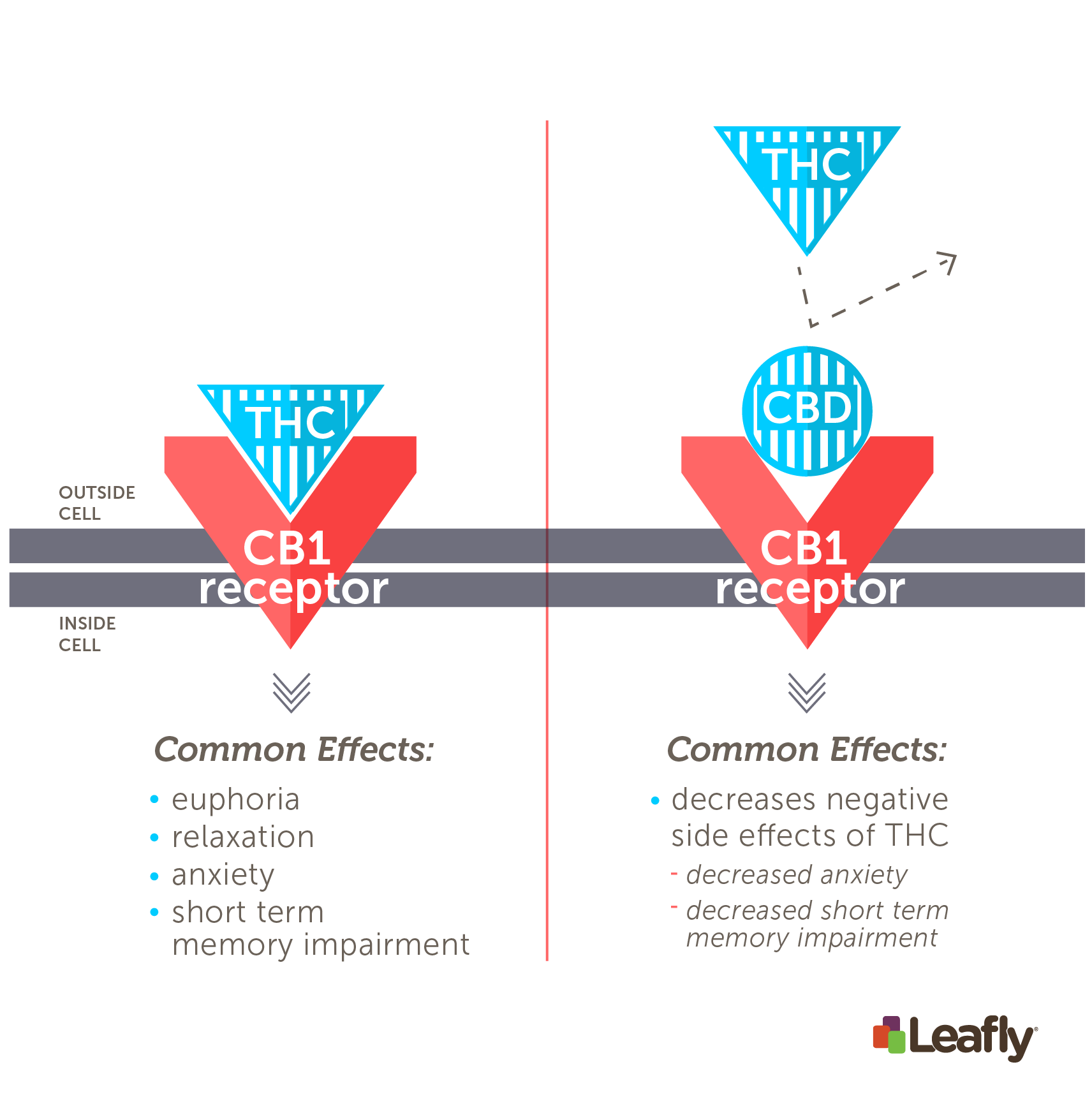
Left: THC directly stimulates the CB1 receptor. This interaction underlies the major psychoactive effects of Cannabis consumption. Right: CBD reduces, or "antagonizes," THC's ability to stimulate CB1 receptors. This can decrease some of THC's effects, especially negative effects like anxiety and short-term memory impairment.
Left: THC directly stimulates the CB1 receptor. This interaction underlies the major psychoactive effects of Cannabis consumption. Right: CBD reduces, or “antagonizes,” THC’s ability to stimulate CB1 receptors. This can decrease some of THC’s effects, especially negative effects like anxiety and short-term memory impairment.
How does that work in real life? Let’s say you vaporize cannabis flower with 24 percent THC. If that flower has 0.2 percent CBD, the THC is going to excite your CB1 receptors with almost no interference from CBD. You may feel extremely high, and you might also experience some of the less desirable effects of THC, such as a heightened feeling of paranoia. If you consume cannabis with 24 percent THC and 6 percent CBD, though, the CBD should have a dampening effect on the THC. You’ll still feel high, but perhaps not stupefyingly so—and the CBD should help keep the paranoia in check.
This difference has had profound political implications. As the founders of Project CBD have noted,  some have mistakenly labeled THC the “bad cannabinoid” and CBD the “good cannabinoid.” Legislators have passed many “CBD-only” laws in Southern states in an effort to allow patients access to this potent cannabinoid while prohibiting its euphoric sibling. But the pioneering cannabis researcher Raphael Mechoulam has often spoken of the “entourage effect,” the idea that cannabinoids and terpenes may work better together than in isolation. The GW Pharma product Sativex, for example, is a drug approved outside the U.S. for treatment of MS-related muscle spasticity. Sativex contains with a nearly 1:1 CBD-to-THC ratio.
As researchers learn more about CBD and the role of other cannabinoids and compounds in the treatment of conditions like MS, we may be able to more accurately dose CBD in combination with other cannabis-derived compounds.
Source: https://www.leafly.com/news/science-tech/cbd-vs-thc-cbd-not-intoxicating

Saturday, August 18, 2018

The Facts on Chlorpyrifos

The Facts on Chlorpyrifos

Both the EPA and its critics say science is on their side in the debate over whether the agricultural insecticide should be banned.

Summary

When the Environmental Protection Agency decided to not ban chlorpyrifos, an insecticide widely used in agriculture, both the EPA and its critics claimed “sound” or “solid” science supported their positions. Research does suggest chlorpyrifos impacts human health, but that research has some limitations. 
The EPA, under the Obama administration, proposed to ban chlorpyrifos in November 2015. But EPA Administrator Scott Pruitt reversed that decision last month, arguing he was relying on “sound science.”
Pruitt, March 29: We need to provide regulatory certainty to the thousands of American farms that rely on chlorpyrifos, while still protecting human health and the environment. By reversing the previous Administration’s steps to ban one of the most widely used pesticides in the world, we are returning to using sound science in decision-making – rather than predetermined results.
Sheryl Kunickis, the director of the Office of Pest Management Policy at the U.S. Department of Agriculture, backed Pruitt’s decision, stating it was “grounded in evidence and science.”
But Jim Jones, assistant administrator at the EPA until January, told the New York Timesthat Pruitt’s decision ignored “science that is pretty solid.” The Times added that Jones — who held various positions at the agency between 1997 and 2017, including director of the EPA’s Office of Pesticides Programs — said that “he believed the ruling would put farm workers and exposed children at unnecessary risk.”
Some studies do suggest that chlorpyrifos exposure can lead to developmental issues in children, for example, but they’re correlational studies, meaning they don’t provide causal links. However, research in rodents has found causal links between chlorpyrifos and developmental issues.
Other studies in human populations have failed to find correlations between chlorpyrifos and development issues in children, but that research may be suffering from what scientists call “confounding variables,” or unrelated factors that may be affecting the study’s results.
In other words, some research does suggest chlorpyrifos poses a threat to human health, but the question is whether or not it’s enough to warrant a complete ban of the insecticide.
We take no position on the EPA’s decisions. But we can outline the strengths and limitations of the research that has been done on chlorpyrifos.

Analysis

Some Background on Chlorpyrifos

Chlorpyrifos was first registered as an insecticide in 1965. According to the EPA, it’s the “most used conventional insecticide” in the U.S. with roughly 6 million pounds used on around 10 million acres between 2009 and 2013.
It’s used on nearly 50 different crops with soybeans, corn, alfalfa, oranges and almonds topping the list in terms of pounds of chlorpyrifos applied. Farmers also applied chlorpyrifos to over 30 percent of their apple, asparagus, walnut, onion, grape, broccoli, cherry and cauliflower crops.
People can be exposed to chlorpyrifos by ingesting food containing the insecticide, according to the National Institutes of Health. But chlorpyrifos does degrade over time into a substance that doesn’t pose health risks — about 15 days when exposed to sunlight and “much slower” without light, says the NIH.
People can also be exposed to the insecticide by inhaling it, especially from indoor air, and through the skin. While chlorpyrifos “has rarely been found in drinking water and outdoor air,” it “can be carried long distances” in the air, adds the NIH. The EPA also notes the possibility of exposure from treated golf courses.
Chlorpyrifos is called a “broad-spectrum” insecticide because it can kill a wide variety of insects. But its potential impact goes beyond insects.
The insecticide is “toxic” to birds and “extremely toxic” to fish, according to the National Institutes of Health. It’s also “extremely toxic” to non-target insects such as bees.
Chlorpyrifos affects all of the above animals, along with humans and other mammals, in a similar way — by leading to the overstimulation of the nervous system.
In fact, chlorpyrifos targets the same chemical pathway in the body as nerve agents such as sarin gas. Both chlorpyrifos and sarin belong to a class of chemicals called organophosphates, several of which have already been banned by the EPA.
At high doses, nerve agents, chlorpyrifos and other organophosphates impact humans similarly, namely by causing a whole host of symptoms, including headache, nausea, dizziness and confusion. At very high doses, organophosphates can cause vomiting, abdominal pain and diarrhea. And at ever higher doses, such as from spills or accidents, they can lead to death.
To be clear, even though chlorpyrifos and sarin affect the same chemical pathways in the body, chlorpyrifos is way less toxic than sarin.
Scientists quantify a chemical’s toxicity using a metric called the median lethal dose, or the LD50. This is the amount of the chemical needed to kill 50 percent of a study population.
The LD50 of chlorpyrifos via oral exposure is estimated to be 92 to 276 milligrams per kilogram of body weight, while the LD50 for sarin is 0.071 to 0.285 mg per kg.
More generally, there is a “wide range of toxicity” among organophosphates, explains the EPA. However, since all organophosphates target the same chemical pathway, exposure to multiple types of the chemical “may lead to serious additive toxicity,” the agency adds.
Farm workers and other workers who handle the chlorpyrifos and other organophosphates on a day-to-day basis are at the “highest risk of exposure,” says the NIH. When the insecticide is sprayed in homes and gardens for pest control, residents are also at a “higher risk of exposure,” the NIH adds.
For this reason and others, the EPA banned chlorpyrifos’ use for residential purposes in 2000, except in select cases, including when contained in ant and roach bait products.
The EPA continued to restrict the use of chlorpyrifos between 2000 and 2012.
For example, the agency banned its use on some crops, such as tomatoes, and limited its use on other crops, including apples, grapes and citrus. The EPA also curbed the insecticide’s use by reducing the rate at which it can be applied and banned its use in certain areas near residential and public spaces.
In 2016, the U.K. decided to ban all uses of chlorpyrifos, except for on brassica seedlings using a specific method. Brassica is a group of crops, including broccoli, cabbage and rape, the last of which is often used to make oil.

Enough Evidence for a Total Ban?

The debate over whether or not to outright ban chlorpyrifos primarily hinged on the effect that exposure has on developing children rather than farm workers and other adults. Like adults, children can be exposed to chlorpyrifos from food, treated golf courses and other sources. 
In September 2007, the Pesticide Action Network North America and the Natural Resources Defense Council petitioned the EPA to outright ban chlorpyrifos for multiple reasons, a number of which pertained to the impact the insecticide has on the development of children.
For example, the petitioners argued the EPA “failed” to take into consideration data that demonstrates “long-lasting effects” on children “from early life exposure” and “disregarded data” that showed there is “no evidence of a safe level of exposure” for fetuses and children.
In November 2015, the EPA proposed to completely ban chlorpyrifos use because it was “unable to conclude that the risk from aggregate exposure from the use of chlorpyrifos meets the safety standard.”
In other words, in its proposal to ban the insecticide, the EPA under the Obama administration followed the precautionary principle, which can be roughly defined as erring on the side of caution in the face of uncertainty.
In November 2016, the EPA reassessed its proposal to ban the insecticide after taking into consideration recommendations made by the agency’s Science Advisory Panel. The panel rejected the EPA’s methodology in quantifying the risk posed by chlorpyrifos.
However, using a different methodology suggested by the panel, the EPA still concluded that, while “uncertainties” remain, a number of studies provide “sufficient evidence” that children experience neurodevelopment effects even at low levels of chlorpyrifos exposure. For this reason, the EPA retained its decision to completely ban chlorpyrifos.
In its denial of the environmental groups’ petition, the EPA under Pruitt’s direction claimed that the impact of low levels of chlorpyrifos exposure on the neurodevelopment of children was a “novel, highly complex and unresolved scientific issue.” But unlike the EPA under Obama, the Pruitt’s EPA decided that it wouldn’t outright ban chlorpyrifos “without first attempting to come to a clearer scientific resolution” on the matter, a task it’s set to complete by 2022.
So what do studies say about chlorpyrifos and its effect on children and fetuses?
Some of the strongest research suggesting that chlorpyrifos does adversely affect children and fetuses comes from the Columbia Center for Children’s Environmental Health at Columbia University. In its November 2016 report on the insecticide, the EPA paid particular attention to studies headed by Virginia Rauh, the deputy director of the Columbia Center.
All of Rauh and her colleagues’ studies relied on blood samples collected from the umbilical cords of mothers right after giving birth that measured the levels of chlorpyrifos directly.
Rauh and her colleagues’ studies were somewhat unique in this way, as other epidemiological studies, which the EPA also used in its 2016 analysis, measured chlorpyrifos metabolites in the urine of expecting mothers, rather than the insecticide directly.
Why is an indirect measure of chlorpyrifos potentially problematic?
It’s possible for individuals to have high levels of chlorpyrifos metabolites in their urine, but have low or no exposure to chlorpyrifos itself. This is because chlorpyrifos degrades in the environment over time, so individuals might be ingesting the degraded substances — the metabolites — directly, say as residue on fruits. And the metabolites themselves don’t pose health risks.
In one study, published in the journal Pediatrics in December 2006, Rauh’s group looked at what effect prenatal exposure to chlorpyrifos has on the cognitive and motor development of children.
The researchers found that 3-year-olds “highly exposed” to chlorpyrifos prenatally scored, on average, 6.5 points lower on a motor development test compared with children who had “low exposure” to the insecticide. They also found that the highly exposed children scored 3.3 points lower on a cognitive development test, on average, though they had less confidence in this second finding. These tests have “moderate predictive power for subsequent intelligence and school performance,” the researchers write.
Also, 3-year-olds exposed to high levels of chlorpyrifos prenatally were “significantly more likely to score in the clinical range” for attention deficit hyperactivity disorder problems and pervasive developmental disorder problems, a category of disordersunder which autism falls, the researchers found.
The group does point out, however, that its study cannot account for chlorpyrifos exposure that children may have encountered after birth, since they only sampled umbilical cord blood at delivery.
In an April 2011 study published in the journal Environmental Health Perspectives, Rauh and others also looked at the effect prenatal chlorpyrifos exposure may have had on the intelligence and memory of 7-year-olds.
They found that the more exposure to the insecticide the umbilical cord blood showed at delivery, the lower the child’s IQ and working memory. Working memory “assesses children’s ability to memorize new information, hold it in short-term memory, concentrate, and manipulate information,” the researchers explain.
In another study, Rauh and colleagues evaluated whether or not children with high exposure to chlorpyrifos experienced tremor in their arms, which is a neurological issue.
The researchers first asked children age 9 to 13 to draw a spiral on a piece of paper. A neurologist specializing in movement disorders, who was blind to the children’s prenatal chlorpyrifos levels, then evaluated these drawings for signs of tremor.
Published in NeuroToxicology in December 2015, the study found that up to 39.5 percent of the high exposure group showed signs of mild to moderate tremor, compared with up to 22.8 percent in the low exposure group.
In one more study, Rauh and others looked at what effect prenatal exposure to chlorpyrifos might have on brain structure.
Published in Proceedings of the National Academies of Sciences in May 2012, the study found “significant abnormalities” in the morphology of brains of children who were exposed to higher levels of chlorpyrifos prenatally. The researchers add that their “findings are consistent with the effects of early developmental exposure to [chlorpyrifos] in animal models.”
In fact, the “effects of low-level organophosphate exposures on brain development in animal models” is what “triggered” the study of these chemicals’ effects on children in the first place, they write.
While suggestive, Rauh and her groups’ studies all had sample sizes below 300 children, which means that the studies may not apply to the broader public. The larger the sample size of a study, the more confident scientists are in concluding that their results correspond to the population as a whole.
However, an additional study, which the EPA also took into account in its 2016 review, included 970 participants and looked at children’s prenatal pesticide exposure more generally.
Conducted by Irva Hertz-Picciotto, an environmental epidemiologist at the University of California, Davis, and others, the study found that children age 2 to 5 were 60 percent more likely to have autism spectrum disorder, also a developmental disorder, compared with normally developing children, when organophosphates were applied within 1.25 kilometers of their homes while their mothers were pregnant.
For chlorpyrifos in particular, the researchers found that every 100 pounds of the insecticide applied within 1.5 kilometers of pregnant mothers’ homes increased the chance of their child developing autism spectrum disorder by 14 percent.
In its 2016 review, the EPA did note that some studies didn’t find an association between organophosphates and developmental issues in children, specifically one that took place in China and another that took place in Canada. Both of these studies measured children’s chlorpyrifos metabolites (that is, not chlorpyrifos levels directly) at one time only, which both sets of authors admit limits their findings.
In fact, the Chinese study, conducted by Shen Xiaoming, a doctor at Shanghai Jiao Tong University, and others, concludes that their “results should be interpreted with caution, and more studies of children living in China are warranted.”
There are still other studies that have looked at the relationship between chlorpyrifos, and organophosphates generally, and developmental issues in children, but we chose to concentrate on the research that the EPA paid particular attention to in proposing to ban the insecticide.
Based on the available research, there is evidence to suggest that chlorpyrifos negatively impacts the development of children. But that research does have some limitations, and whether it is sufficient evidence is debatable.
Source: https://www.factcheck.org/2017/04/the-facts-on-chlorpyrifos/

Cancer Killing Ratio - 100:1 of Vitamin C and K3 (Apatone)

Cancer Killing Ratio…How 100:1 of Vitamin C and K3 (Apatone) is Proving Warburg and Pauling Right!

Cancer is defined by cell cycle deregulation and uncontrolled growth. It is the second leading cause Nobel Prize Winner Otto Warburg and Linus Paulingof death in the world. In the United States alone there were 1,658,370 new cancer cases diagnosed and 589,430 cancer deaths and an estimated 750,000 deaths in Europe.
We are fighting a losing battle.
But we now have a new hope the combination of intravenous Vitamin C and K3 in 100:1 ratio known as Apatone. This specific combination causes a form of cell necrosis called autoschizis…it is KILLING cancer. Researchers started experimenting with a combination of vitamin C and Vitamin K3 (CK3) and watched as cancer cells…it killed them.
The Science
Before we can get into how the specific combination of Vitamin CK3 kills cancer, we must first get a better understanding of cancer cells.
From a biochemical point of view, cancer cells have some remarkable features:
They are deficient in DNase activity
They have low activities of antioxidant enzymes
They show high rates of glycolysis
And most of cancer cells accumulate Vitamin C
The inhibition of both alkaline DNase and acid DNase has been reported in non-necrotic cancer cells at early stages of experimental carcinogenesis. On the other hand, the reactivation of these enzymes has also been seen in the early stages of spontaneous and/or induced tumor cell death. Therefore, the use of compounds able to activate such endonucleases opens the possibility of a new therapeutic approach for cancer treatment…Vitamins C and K3 reactivate acid and alkaline DNases!
The big question is, can that combination work with cancer?
It is well known that vitamin C is cytotoxic against malignant melanoma cells, human leukaemia cells, neuroblastoma cells, tumour ascites cells, acute lymphoblastic leukaemia, and epidermoid carcinoma. It is also well know that vitamin K3 is cytotoxic against tumors of breast, stomach, lung, colon, nasopharyngeal, cervix, liver, leukaemia, and lymphoma cell lines.
What The Researchers Did
Researchers combined vitamins C and K3 at ratio of 100:1 after in vivo administration in tumor-bearing mice produced and found the following:
Cancer growth inhibition in transplant-able liver tumor (TLT)-bearing mice with an increase in life span (ILS) of 45.8%. Neither vitamin C nor vitamin K3 administered alone has any significant effect on the life span of TLT-bearing animals. It must be in the 100:1 ratio.
Selective potentiation of tumor chemotherapy. For instance, while cyclophosphamide alone, at a single sub-therapeutic dose of 80 mg kg1 body weight increased the life span by 23%, its association with CK3, increased the life span by 59.5%
Sensitization of tumors resistant to some drugs. The pretreatment of TLT-bearing mice with CK3 before injection of Oncovin increases the life span by 97.3%.
Additionally examinations of CK3-treated mice did not indicate any sign of toxicity in normal organ and tissues.
But How Does The CK3 Kill The Cancer Cells?
Both morphological examination and flow cytometry analysis allow us to see whether cells are dying by necrosis (triggered cell death) or apoptosis (normal cell death).
This is important because we need to know if the cancer cells are dying because they are being “triggered” to so or if it’s just part of their normal cell cycle.
On the basis of these parameters, cancer cells treated by CK3 die principally by cell necrosis, but interestingly enough share some characteristics of both necrosis and apoptosis
The cell shrinks in size until about only 1/3 its original size and only the nucleus and organelles remain surrounded by a tiny ribbon of cytoplasm. If apoptosis is a quiet cell suicide in which the cell curls up and dies, autoschizis (necrosis) is a bit more violent; the cell slashes itself open violently spilling out its insides.
Studies have looked at autoschizis in experiments with:
Ovarian cancer cells
Liver tumors
Bladder tumors
Oral squamous cell and salivary gland tumors,
And Leukemia.
Pretreatment with this vitamin C/K combination appears to potentiate the effect of chemotherapy and radiation. It also appears to be nontoxic, leaving normal cells unaffected.
Beating Cancer As a Whole
Here at CHIPSA Hospital we utilize intravenous Vitamin CK3 as part of our integrative approach to treating cancer and autoimmune disease. Here are some of the protocols we utilize:
Coley’s FluidVallovaxApatone (IV & Oral Vitamin CK3)Insulin Potentiate TherapyGerson TherapyCryoablationHyperbaric OxygenOzone Therapy
If you notice the last treatment we mentioned was hyperbaric oxygen and ozone therapy. You see, in the studies the damage Apatone did to cancer cells was limited to the amount of oxygen saturation that was in the sample.
At CHIPSA we use Ozone, Hyperbaric Oxygen and Apatone synergistically to make sure that the body has maximum exposure to oxygen. Patients can even request to take their Apatone IV into the hyperbaric oxygen chamber to get a flood of oxygen while the drip is going on.
This is how we can align Linus Pauling and Otto Warburg. The 100:1 ratio of vitamin C and K3 can allow 400%+ more C into the cancer cell and the combination of ozone and hyperbaric oxygen floods the cancer cells with oxygen thus giving the patient the best chance for success.
We feel that combining Vitamin CK3 (Apatone) with some of our proven immune boosting protocols and our 37 years of research into immune function may allow for some groundbreaking cancer treatments and get us closer to an answer.
If you or someone you love would like to see how or if you can utilize Vitamin CK3 for cancer give us a call at 1-855-624-4772. We will schedule you a free 30 minute appointment to talk to one of our doctors
Source: https://chipsahospital.org/cancer-killing-ratiohow-1001-of-vitamin-c-and-k3-apatone-is-proving-warbug-and-pauling-right/

Auschwitz Chemistry

Auschwitz Chemistry: How Science Proves The ‘Final Solution’ Was Systematically Gassing Lice Infested Clothing To Save Lives

By John Wear
Above: “Gassing Clothing”. Left: Healthy inmates at work sterilizing clothing. Right: Healthy prisoners at Auschwitz working in one of the larger clothing disinfestation chambers in the camp.
Above: The Auschwitz camp employed a number of delousing stations, which used steam and Zyklon-B to kill lice in prisoner clothing. This picture shows autoclave number 2, seen from the “dirty” clothing side. Infected clothing was put on hangers attached to a trolley and pushed inside the chamber. Dirty clothes were put on hangers on a trolley which was pushed into the chamber on two short rails. The disinfection stations were constructed with double doors so that the infected and cleaned clothes would not be mixed together. This picture was taken while the camp was operational.
The Chemistry of Auschwitz/Birkenau
Defenders of the Holocaust story have attempted to discredit scientific reports which disprove the existence of homicidal gas chambers at German camps during World War II. For example, Deborah Lipstadt’s defense attorney, Richard Rampton, referred in court to The Leuchter Report as “…a piece of so-called research which is not worth the paper it is written on…”[1]
Dr. Richard Green states about Germar Rudolf:
Owing to the fact that he actually has some understanding of chemistry, many of his deceptions are more sophisticated than other Holocaust deniers…Ultimately, he engages in the same deceptions and specious arguments as [Fred] Leuchter and [Walter] Lüftl , but the case he makes for those deceptions and arguments involves more difficult chemistry.”[2]
This article will discuss attempts by chemists to discredit scientific reports which disprove the existence of homicidal gas chambers at Auschwitz/Birkenau during World War II.
Historical Background
In 1988, the Canadian government put Ernst Zündel on trial a second time for the criminal offense of knowingly disseminating false news about “the Holocaust.” As part of his defense in this trial, Zündel commissioned the American gas-chamber expert Fred Leuchter to make a scientific examination of the alleged homicidal gas chambers at Auschwitz, Birkenau and Majdanek. The resulting Leuchter Report is the first scientific study of the alleged German homicidal gas chambers.[3]
In addition to reporting that the alleged homicidal gas chambers at Auschwitz, Birkenau and Majdanek were structurally unsuitable for gassing, Leuchter researched the chemical properties of the Zyklon B fumigant. Leuchter found that Zyklon B is a highly toxic compound that releases deadly hydrogen cyanide gas. The released hydrogen cyanide gas clings to surfaces and  reacts chemically with materials containing iron, forming ferrocyanide compounds that have a distinctive blue color called Prussian Blue. Since building materials normally contain a certain amount of rust (iron oxide, usually between one and four percent), repeated exposure to hydrogen cyanide gas would result in Prussian Blue staining on the walls of the alleged gas chambers.[4]
Leuchter took forensic samples from the alleged gas chambers at the visited sites and a control sample from the delousing facility at Birkenau. The samples were analyzed by an independent laboratory in the United States. The laboratory found no significant ferrocyanide compound traces in the samples taken from the alleged homicidal gas chambers, but the sample from a wall of the Birkenau delousing facility had heavy concentrations of the ferrocyanide compounds. Leuchter concluded that this result would be impossible if the alleged homicidal gas chambers had been repeatedly exposed to hydrogen cyanide gas.[5]
Germar Rudolf, a certified chemist, expanded on Leuchter’s work by writing the Rudolf Report in the spring of 1992. The Rudolf Report, which has been updated and revised several times, focused on engineering and chemical aspects of the alleged homicidal gas chambers at Auschwitz and Birkenau. Rudolf observed in his on-site examinations that all of the delousing facilities at Auschwitz, Birkenau, Stutthof and Majdanek have one thing in common: their walls are permeated with Prussian Blue. Not only the inner surfaces, but also the outside walls and the mortar between the bricks of the delousing facilities have Prussian Blue staining. Nothing of this sort can be observed in any of the alleged homicidal gas chambers at Auschwitz and Birkenau.
Rudolf also took samples from the alleged homicidal gas chambers and the delousing facilities at Auschwitz and Birkenau. Similar to Leuchter’s samples, the alleged homicidal gas chambers exhibit only insignificant traces of ferrocyanide residue on the same order of magnitude found in any other building. The samples from the delousing chambers, however, all showed very high ferrocyanide residues. Rudolf determined that, if mass execution gassings with hydrocyanic acid had taken place in the alleged homicidal gas chambers, the rooms in the alleged homicidal gas chambers would exhibit similar ferrocyanide residue as the delousing chambers. Therefore, Rudolf concluded that mass gassings with Zyklon B did not occur in the alleged homicidal gas chambers at Auschwitz and Birkenau.[6]
Kraków Institute of Forensic Research
The Kraków Institute of Forensic Research published results in 1994 that attempted to refute the Leuchter Report. The team from this forensic institute led by Dr. Jan Markiewicz claims not to have understood how it was possible for Prussian Blue to have formed in walls as a result of their being exposed to hydrogen cyanide gas. The researchers therefore excluded Prussian Blue and similar iron cyanide compounds from their analyses, resulting in much lower cyanide traces for the delousing chambers. Their analysis made it practically impossible to distinguish between rooms massively exposed to hydrogen cyanide and those which were not: all would have a cyanide residue of close to zero. The Kraków researchers concluded from their analysis that since the gas chambers and delousing facilities all had the same amount of cyanide residues, humans were gassed in the gas chambers.
Germar Rudolf gave the Kraków researchers irrefutable proof that Prussian Blue can be formed in walls exposed to hydrogen cyanide gas, citing a case document in expert literature.[7] The authors of the Kraków report refused to change their report and admit they made a mistake. Rudolf writes:
The only ‘scientific’ attempt to refute Frederick A. Leuchter’s most intriguing thesis turns out to be one of the biggest scientific frauds of the 20th century. How desperate must they be—those who try to defend the established version of the Holocaust, i.e., the alleged systematic extermination of Jews in homicidal ‘gas chambers’, that they resort to such obviously fraudulent methods?”[8]
British science historian Dr. Nicholas Kollerstrom also refuted the Kraków Institute of Forensic Research report, as succinctly summarized by the retired professor of the philosophy of science Dr. James H. Fetzer:
When the Auschwitz museum was confronted with the fact that the innocuous delousing chambers at Auschwitz have blue walls–due to being saturated with blue iron cyanide compounds–but the alleged homicidal gas chambers have not, they commissioned their own chemical research. Instead of testing wall samples for the chemicals that had caused the blue stains, the researchers they commissioned simply excluded those chemicals from their analysis by employing a procedure that could not detect them. They justified this measure with the claim that they did not understand exactly how these compounds could form and that they might therefore be mere artifacts. Researchers who don’t understand what they are investigating have no business becoming involved. In this case, however, it appears to be deliberate. They have deliberately ignored an obvious explanation–that Zyklon B was only used for delousing–which would have remedied their lack of comprehension. As a result of this failure to adhere to the principles of science, they produced a report of no scientific value, which they used to arrive at a predetermined conclusion.[9]
Dr. Arthur Robert Butz writes in regard to the Kraków Institute of Forensic Research report:
The argument, to the extent that it was intelligible enough to be summarized at all, was that they did not understand how the iron-cyanide compounds got to be there, so they decided to ignore them in reaching their conclusions. I don’t understand how the moon got there, so I will ignore all effects associated with it, such as tides. I hope I don’t drown.”[10]
Dr. James Roth
Dr. James Roth testified at the 1988 Ernst Zündel trial that he received samples from Fred Leuchter in his capacity as an Analytical Chemist at Alpha Analytical Laboratories. The purpose of the tests was to determine the total iron and cyanide content in the samples. Dr. Roth testified that the Prussian Blue produced by a reaction of the iron and hydrogen cyanide could penetrate deeply in porous materials such as brick and iron.[11]
Dr. Roth later changed his testimony in a documentary movie titled Mr. Deathproduced by Errol Morris. Dr. Roth states in this movie:
Cyanide is a surface reaction. It’s probably not going to penetrate more than 10 microns. Human hair is 100 microns in diameter. Crush this sample up, I have just diluted that sample 10,000; 100,000 times. If you’re going to go looking for it, you’re going to look on the surface only. There’s no reason to go deep, because it’s not going to be there.[12]
Dr. Nicholas Kollerstrom writes that Dr. Roth’s statements in Mr. Death are wrong:
The 1999 film about Leuchter features an interview with the chemist [Dr. James Roth] who had done the analysis of his wall-samples back in 1988. He had done this “blind,” i.e. with no knowledge of where they had come from, which was correct scientific procedure. During the second Zündel trial in Toronto in 1988 he testified under oath concerning the method used and what Leuchter had sent him. He said back then that hydrogen cyanide can easily penetrate into brick and mortar. But then, when he was interviewed again by Morris for his documentary, he suddenly stated that the results were quite meaningless, because the cyanide could only have soaked a few microns into the brickwork. Wow, that was quite a whopper. Mortar and brickwork are highly porous to hydrogen cyanide, obviously so because the delousing chambers were more or less equally blue inside and out, it had soaked right through. But you can watch him on video explaining this, as if he were confusing brick and mortar with rock. The latter will only absorb cyanide to a few microns of its surface.[13]
Germar Rudolf writes in regard to Dr. Roth’s statements in Mr. Death: “It can be shown that Prof. Dr. James Roth is wrong for the following reasons:
  1. It is a fact that the walls of the disinfestation chambers in Auschwitz, Birkenau, Stutthof, and Majdanek are saturated with cyanide compounds, and this not only superficially, but into the depth of the masonry, as I have demonstrated by taking samples from different depths of the wall. Compare in this regard my mortar and plaster Sample Pairs 9 & 11, 12 & 13, 19a & b…, which were each taken at the same spot but at different depths, as well as Sample 17, taken from below the overlying lime plaster (which is thus similar to 19b). These values prove that hydrogen cyanide can rather easily reach deep layers of plaster and mortar. But even the other samples taken from the surface prove that Prof. Roth’s allegation is wrong: Provided that most of the cyanide detectable today is present in the form of iron cyanide (Iron Blue and other cyanoferrates), as Prof. Roth assumes himself, his thesis would mean that 10% to 75% of the iron content of these samples are located in the upper 10 micrometers thin layer of the samples (0.010 mm), i.e., they are located in less than 1% of the entire sample mass. The rest of the samples, however, would have been massively deprived of iron. How this migration of a major portion of iron to a thin surface layer would have happened is inexplicable to me. Fact is that this simply could not happen.
  2. Furthermore, expert literature is detailed about the following:
    1. Hydrogen cyanide is an extremely mobile chemical compound with physical properties comparable to water…
    2. Water vapor can quite easily penetrate masonry material, and thus also hydrogen cyanide…
    3. Hydrogen cyanide can easily penetrate thick, porous layers like walls…
  3. In addition, it is generally known that cement and lime mortar are highly porous materials, comparable for instance to sponges. In such materials, there does not exist anything like a defined layer of 0.01 mm beyond which hydrogen cyanide could not diffuse, as there can also be no reason, why water could not penetrate a sponge deeper than a millimeter. Steam, for example, which behaves physically comparable to hydrogen cyanide, can very easily penetrate walls.
  4. Finally, the massive discolorations of the outside of the walls of the disinfestation chambers in Birkenau and Stutthof, as shown in this expert report, are clearly visible and conclusive evidence for the fact of how easily hydrogen cyanide and its soluble derivatives can and do penetrate such walls.
As a professor of analytical chemistry, Prof. Roth must know this, so one can only wonder why he spreads such outrageous nonsense. That Prof. Roth is indeed a competent chemist can be seen from what he said during his testimony under oath as an expert witness during the above mentioned Zündel trial..: ‘In porous materials such as brick or mortar, the Prussian blue [hydrogen cyanide] could go fairly deep as long as the surface stayed open, but as the Prussian blue formed, it was possible that it would seal the porous material and stop the penetration.’
…It is also revealing that Prof. Roth mentioned during this interview that, if he had known where Leuchter’s samples originated from, his analytical results would have been different. Does that mean that Prof. Roth manipulates his result according to whether or not he likes the origin of certain samples? Such an attitude is exactly the reason why one should never tell an ‘independent’ laboratory about the origin of the samples to be analyzed, simply because ‘independence’ is a very flexible term when it comes to controversial topics. What Prof. Dr. Roth has demonstrated here is only his lack of professional honesty.”[14]
Dr. Richard Green
Dr. Richard Green, who has a Ph.D. in Chemistry from Stanford University, agrees with Germar Rudolf that the Prussian Blue found in the delousing chambers is the result of gassings with hydrogen cyanide. However, Dr. Green offers a possible alternative explanation for why the outside walls of the delousing chambers having blue staining. Green writes: “…the discoloration on the outside of walls [of the delousing chambers], ought to make one consider what possible processes could have taken place outside of the delousing chambers. For example, is it possible that materials that had been soaked with aqueous solutions of HCN were leaned against the outside of the buildings? Not enough is known, but it is premature to conclude that the staining on the outside of buildings owes its origins to processes that took place within those buildings.”[15]
Dr. Green’s speculation is absurd. Why would the Germans lean materials that had been soaked with aqueous solutions of HCN against the outside walls of the delousing chambers? Dr. Green is desperate to find an alternative reason for the heavy blue staining on the outside walls of the delousing chambers.[16]
Germar Rudolf writes in regard to Dr. Green’s speculation:
One major rule of science is that it is impermissible to immunize a theory against refutation, here in particular by inventing untenable auxiliary hypotheses to shore up an otherwise shaky thesis…This is exactly what Dr. Green is doing: coming up with a ludicrous attempt at explaining a fact which does not fit into his theory. Yet instead of fixing his theory, he tries to bend reality.”[17]
Dr. Green also challenges the possibility of formation of any noticeable quantities of Prussian Blue in the alleged homicidal gas chambers. Dr. Green writes: “The difference in total cyanides (Prussian blue + non-Prussian blue) owes to the fact that Prussian blue formed efficiently in the case of the delousing chambers but not in the homicidal gas chambers, and Prussian blue once formed is likely to remain.”[18]
Dr. Green is not able to provide any convincing evidence why Prussian Blue would not form efficiently in the homicidal gas chambers. For example, Dr. Green states that masonry in the alleged homicidal gas chambers has a neutral pH value which does not allow for the formation of cyanide salts. Germar Rudolf writes: “But if that were true, how come huge amounts of cyanides did accumulate in the walls of the disinfestation chambers?”[19]
Rudolf has documented with expert literature on the chemistry of building materials that the cement mortars and concretes used in the alleged homicidal gas chambers are noticeably alkaline for many weeks, months, or even years. These walls would have been very much inclined to accumulate cyanide salts and to form Prussian Blue, even more so than the lime plaster of the disinfestation chambers.[20]
Conclusion
The alleged homicidal gas chambers at Auschwitz/Birkenau could not have been used to exterminate hundreds of thousands of people as described in pro-Holocaust literature for numerous reasons: 1) they did not have escape-proof doors and windows; 2) they did not have panic-proof equipment; 3) they did not have technically gastight doors and shutters; 4) they had no provision to quickly release and distribute the poison gas; and 5) they had no effective device to ventilate or otherwise render ineffective the poison gas after the execution.[21]
By contrast, Germany built highly sophisticated and expensive disinfestation facilities at Auschwitz/Birkenau to kill lice and save inmate lives. By one estimate, the SS at Auschwitz spent almost $1 billion in today’s values to bring the typhus epidemics raging there under control.[22] An enormous amount of information exists concerning these German delousing facilities[23], but no similar information exists regarding the alleged homicidal gas chambers at Auschwitz/Birkenau.[24]
The roof of the semi-underground Morgue #1 of Crematorium II at Birkenau, which is said to have been the building’s homicidal gas chamber, remains intact to some degree today. Contrary to eyewitness testimony, that roof has no Zyklon-B-introduction holes. This has been acknowledged by pro-Holocaust researcher Robert Jan van Pelt. Since it is impossible to close holes measuring 70 x 70 cm from a concrete roof without leaving clearly visible traces, it is certain that no Zyklon-B-introduction holes ever existed at Crematorium II. Consequently, Zyklon B could not have been introduced through the roof at this morgue as alleged by pro-Holocaust supporters.[25]
As documented in this article, chemists adhering to the orthodox Holocaust narrative have failed to explain why the walls of the delousing facilities at Auschwitz/ Birkenau are permeated with Prussian Blue, while nothing of this sort can be observed in any of the alleged homicidal gas chambers. The only reasonable explanation is that Zyklon B was never used in the alleged homicidal gas chambers at Auschwitz/Birkenau. Nicholas Kollerstrom writes:
…for any alleged human gas chamber found in a German World War II labour camp let us merely measure cyanide in the walls: if it’s not there, it didn’thappen.”[26]

Source: http://www.renegadetribune.com/auschwitz-chemistry-science-proves-final-solution-systematically-gassing-lice-infested-clothing-save-lives/