ALERT: Certified Organic Food Grown in U.S. Found
Contaminated with Glyphosate Herbicide

Think you can avoid glyphosate by buying organic? Think again. A new
investigation by Tropical Traditions reveals that many products in the organic
grain market in the U.S. contain glyphosate residue at levels almost the same
as conventional grains.
Brian
Shilhavy
Health Impact News Editor
Health Impact News Editor
With over
80% of the U.S. food supply now reportedly contaminated with the herbicide
glyphosate, many people are turning to USDA certified organic products to avoid
this toxic chemical. Current USDA NOP (National Organic Program) standards do
not allow the use of the herbicide glyphosate on organic crops.
However,
a new investigation by Tropical Traditions has revealed that the U.S. organic
grain market is contaminated with glyphosate.
Tropical
Traditions has sold organic grains for years. After reading new research about
the issue of “crop desiccation” done by using glyphosate on wheat and
other grains just prior to harvest, Tropical Traditions decided to first test
some commercial wheat products with wheat grown in Montana, North Dakota, and
Canada. They sent the commercial samples to a well-known and respected
laboratory to test for glyphosate.
All
tested positive for glyphosate residue. The range was from 0.07 mg/kg to 0.09
mg/kg. Keep in mind this is glyphosate found in non-GMO crops. For a GMO
crop such as GMO soybeans, which are sprayed heavily with glyphosate, the range
is typically between 3.3 and 5.7 mg/kg. (Source.)
Next, Tropical
Traditions tested the USDA certified organic grains from suppliers they had
been using, sourced mainly from western states such as Montana and Idaho.
Sadly, the presence of glyphosate residue was found in organic wheat and other
organic grains, including organic barley, oats, spelt, and einkorn. The range
was from 0.03 to 0.06 mg/kg, just slightly lower than the conventional grains
that were tested.
The only
organic grains that tested clean were organic rye and organic millet. There was
also one variety of organic wheat from small-scale farmers in Wisconsin that
tested clean from glyphosate.
Why Should We be Concerned about Glyphosate?
Glyphosate
is in 80% of our food supply in the U.S., and some scientists believe
it may well be the most toxic chemical ever approved for commercial use.
Glyphosate is now linked to kidney disease, antibiotic resistant
bacteria, inflammatory bowel disease, obesity, depression, ADHD, autism,
Alzheimer’s disease, Parkinson’s disease, ALS, multiple sclerosis, cancer, cachexia,
infertility, and developmental malformations. It destroys the microbiome of
humans and plants, which is the root cause of many modern diseases.
To learn
more about the dangers of glyphosate, see:
The Glyphosate Grain Problem
Since
commercial wheat and other grains today are NOT GMO plants, a direct spraying
of an herbicide containing glyphosate would kill them. So how are these grains
ending up with glyphosate residues in them?
Dr. Don
Huber, Professor Emeritus of Plant Pathology at Purdue University,
explains why:
There are
two reasons that a farmer wants to [use glyphosate on non-GMO crops]. It is for
late season weed control in situations where he has patches of green weeds in
the field that came up late. [This is commonly done with wheat and barley.] It
is a little slower to harvest when weeds are present.
The other
reason involves late season snow. In the northern region such as in the
Dakotas, in certain parts of Montana, and in the Prairies of Canada, there is a
very short growing season. If it snows on the crop at harvest then
you may lose the crop, because you can’t get back into the field to do the
harvest.
In these
regions, 70% of the wheat and barley are desiccated with glyphosate before
harvest. [This kills the plant so that it will wilt and dry]. Farmers don’t
want to take a risk in losing their entire wheat and barley crop, so they will
take a cut in yield and quality by using glyphosate a few weeks before harvest,
and then harvest the crop early.
Farmers
don’t realize how much they are contaminating that food or feed product when
they do this. They will accept the cut [in quality and quantity of the crop],
because that can buy them a week advantage in harvest. It’s really more done
for ease and planning. However, it is just the dumbest thing you could ever do
from a health and safety standpoint.
In fact,
beer brewers are having a problem with glyphosate. A few years ago, when one of
my colleagues wanted to get more Abraxis test strips for testing materials for
glyphosate residue, he was told that they had a 3 month backlog. He asked, what
was causing this? He was told that every load of malt barley coming out of
North Dakota has to be tested, because the glyphosate levels were so high that
it kills the yeast in the brew mix. (Source.)
Anthony
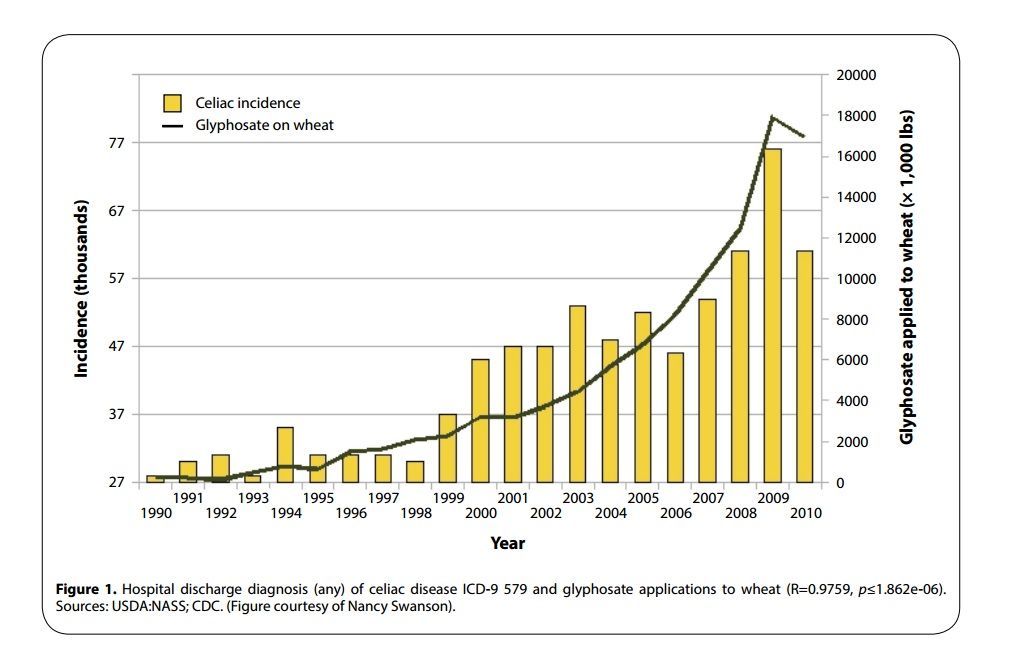
Samsel and Stephanie Seneff published as study titled: Glyphosate,
pathways to modern diseases II: Celiac sprue and gluten intolerance
in Interdiscip Toxicol. 2013; Vol.
6 (4): 159–184. They produced the following chart showing a
correlation between glyphosate use on wheat and Celiac disease:
USDA Organic Standards Allow for Pesticide Residues

Image
from Cornucopia.org.
The USDA
organic standards change so much that it is hard to keep up with what the
latest standards are. For example, the EPA just increased the limit of
glyphosate allowed in food in 2013, despite a loud public outcry. (See: EPA Raised Residue Limits of
Monsanto’s Glyphosate Herbicide). Tropical Traditions has learned
that the USDA has now allowed a certain amount of pesticide and herbicide
residue, including glyphosate, in USDA certified organic products as well.
So it
was not too surprising to learn that the levels of glyphosate found
in organic grain products were within the limits allowed by the USDA for
organic certification, which is based on a percentage of the EPA allowable limits
for pesticides and herbicides. The organic standards for pesticide residue can be found here.
The EPA
establishes the maximum allowed levels of pesticides, or EPA tolerances, which
may be present on foods. Although most EPA -registered pesticides are
prohibited in organic production, there can be inadvertent or indirect
contact from neighboring conventional farms or shared handling facilities.
As long as the operator hasn’t directly applied prohibited pesticides and has
documented efforts to minimize exposure to them, the USDA organic
regulations allow for residues of prohibited pesticides at or below 5
percent of the EPA tolerance.
Since the
EPA standards for glyphosate are already very high, it was not surprising to
find out that the levels of glyphosate residue Tropical Traditions was
finding in USDA certified organic grains was well within their limits. If
both the EPA standards and USDA organic standards were too low for pesticide
residue, probably more than 90% of the U.S. food supply would not be eligible
for sale. It would be too contaminated.
How is Glyphosate Residue Getting into Organically
Grown Crops?

This is
the big question that Tropical Traditions is researching now, as they work
together with organic grain mills and suppliers to try to determine how this
has happened. There are several possibilities.
The most
alarming possibility is that glyphosate might be falling on crops through
rainwater or irrigation. Some studies have actually shown that this is the
case, particularly in the Mississippi River Basin.
This is quite alarming, because it means all crops are suspect, not just
grains.
Herbicide
and pesticide drift is also a possibility. Many organic grains are grown in the
same area where conventional grains are grown, and where desiccating with
glyphosate is practiced. This is probably done by crop duster aircraft, and the
herbicide is drifting. Other crops (besides grains) that Dr. Don Huber has
stated use the practice of desiccating with glyphosate include: dry beans
(chickpea, lupin, and faba), canola, field pea, flax, lentil, and soybeans.
Organic
varieties of these crops might be in danger of containing
glyphosate residue. Tropical Traditions has already removed products
from its product line associated with these crops, pending further
investigation, and verification by laboratory analysis that they are
glyphosate-free. We are implementing our own Glyphosate-tested program that we will soon
be applying to all foods that are threatened with glyphosate contamination, and
seeking out farmers and suppliers committed to meeting our standard of ZERO
percent glyphosate residue.
In
Tropical Traditions’ own testing of organic grains so far, they found that
barley has among the highest levels of glyphosate of the organic
crops, and this corresponds to conventional crops where the EPA has raised the
limits of glyphosate in barley to a higher level than other grains. Beer
drinkers beware! Not even organic beer is safe if it is produced in the U.S.
Epidemic Digestive Health Problems in U.S. – A CALL
TO ACTION!
We are
seeing unprecedented health issues in the U.S. today related to digestive
health. Gluten intolerance diseases such as Celiac are probably just the tip of
the iceberg. While the medical system wants to blame these conditions on
genetics or food allergies, the truth is probably far simpler: our food has
become contaminated and toxic, thanks to the chemical industry.
The EPA
and USDA have protected the Biotech industry and their cocktail of chemicals at
the expense of the health of our nation. Nobody chooses to eat GMO food or food
contaminated with herbicides like glyphosate. These policies which have raised
the limits and allowed new chemicals to enter the market with no independent
research have betrayed the American consumer.
Action is
needed to stem the tide of the U.S. federal government agencies that allow
these chemicals to contaminate our food supply, and protect the companies who
are earning billions of dollars in producing GMO seeds and toxic herbicides and
pesticides.
If you
live in a state that has a ballot initiative on Tuesday to label GMO products,
please turn out to vote to have such measures passed. They are on the ballet in
two states:


|
Oregon
Right to Know Campaign
|
Colorado Right to Know Campaign
|
If these
ballet measures pass will it force companies to start labeling products as GMO?
Probably not. They will fight it out in the courts. But it will put a scare
into the Biotech and Big Processed Food
companies, knowing that consumers are waking up to this issue, and demanding
GMO-free uncontaminated products.
[UPDATE:
Both ballot measures failed, proving that consumers still do not understand the
severity of this issue.]
Secondly,
the power to change the system relies not on politicians, but upon YOU, the
American consumer. Americans are among the least knowledgeable people in the
world in understanding the production of food. We also spend the lowest
percentage of our income on food compared to any other wealthy
country. For more on this issue, please see: YOU the Taxpayer are Funding the Agri
Business Takeover of our Food Supply. You cannot fight this issue if
you don’t know what the true problems are.
The
American consumer is still the most powerful force in the U.S. to affect
change. But it will not be easy. The federal government’s assault on
small-scale family farmers who desire to market products directly from the farm
to the consumer is well documented here at Health Impact News. Billions of
dollars are at stake, and a willing consumer is required for the system to
continue as it is, with cheap subsidized mass-produced food full of toxins. You
have a choice to NOT be part of that system, but it will take a lot of work.
Tropical
Traditions and their new yet-to-be fully developed Healthy Traditions network
will do its part to identify healthy food, including their new
Glyphosate-tested verification program.
    |
Tropical
Traditions and the Healthy Traditions network will be working hard
together with health-conscious producers and suppliers to provide nutritious
uncontaminated food as an alternative to commodity food that is mass produced.
About the
Author
Brian Shilhavy
is the Senior Editor of Health Impact News, and the owner and founder of
Tropical Traditions, Inc.
- See
more at:
http://healthimpactnews.com/2014/alert-certified-organic-food-grown-in-u-s-found-contaminated-with-glyphosate-herbicide/#sthash.tZ6bUUic.dpuf


No comments:
Post a Comment