Tuesday, September 8, 2015

Jealous Knife


Jealous Knife

Evil has so managed to perfume our senses
Kept us on guard with little or few defenses
Could it be that we have forsaken all the good we have come to know
For this is not how each and every soul is intended to grow

We have been rendered numb by a continuum of unspeakable atrocities
Dangerously egged on by an unholy religiosity
We take pleasure in destroying all the things that sustain our fragile life
Methodically slicing away at God’s creation with a jealous knife

How can you feel no sorrow for the forsaken child
Or the disappearing forests harbouring our kinship with those in the wild
How can we not protect the beauty of Mother Earth
Or the great waters through which a spirit is given birth

Thank you,
Joseph Pede

Monday, September 7, 2015

Global I.Q. Scores

The notion that Jews are intellectuals is completely false - their entire history is one big fabrication (Albert Einsten is one perfect example of a fraud, and the Holocaust is a perfect example of a hoax). During my years at the University of Toronto I witnessed Jews substitute individuals with more intellect to write their exams. In fact, many Jewish doctors, dentists, lawyers and other professionals who graduated from the University of Toronto during that time had actually failed, but because the professional boards were controlled by Jews, students who actually deserved accreditation never received it, but flunky Jews did.

As you can see, from an I.Q. perspective they don't even make the cut.


The intelligence scores came from work carried out earlier this decade by Richard Lynn, a British psychologist, 
and Tatu Vanhanen, a Finnish political scientist, who analysed IQ studies from 113 countries, and from subsequent 
work by Jelte Wicherts, a Dutch psychologist.

Countries are ranked highest to lowest national IQ score. 
Source: http://www.photius.com/rankings/national_iq_scores_country_ranks.html
Rank
--------
Country
-----------------------
%
-------------
1 Singapore 108
2 South Korea 106
3 Japan 105
4 Italy 102
5 Iceland 101
5 Mongolia 101
6 Switzerland 101
7 Austria 100
7 China 100
7 Luxembourg 100
7 Netherlands 100
7 Norway 100
7 United Kingdom 100
8 Belgium 99
8 Canada 99
8 Estonia 99
8 Finland 99
8 Germany 99
8 New Zealand 99
8 Poland 99
8 Sweden 99
9 Andorra 98
9 Australia 98
9 Czech Republic 98
9 Denmark 98
9 France 98
9 Hungary 98
9 Latvia 98
9 Spain 98
9 United States 98
10 Belarus 97
10 Malta 97
10 Russia 97
10 Ukraine 97
11 Moldova 96
11 Slovakia 96
11 Slovenia 96
11 Uruguay 96
12 Israel 95
12 Portugal 95
13 Armenia 94
13 Georgia 94
13 Kazakhstan 94
13 Romania 94
13 Vietnam 94
14 Argentina 93
14 Bulgaria 93
15 Greece 92
15 Ireland 92
15 Malaysia 92
16 Brunei 91
16 Cambodia 91
16 Cyprus 91
16 FYROM 91
16 Lithuania 91
16 Sierra Leone 91
16 Thailand 91
17 Albania 90
17 Bosnia and Herzegovina 90
17 Chile 90
17 Croatia 90
17 Kyrgyzstan 90
17 Turkey 90
18 Cook Islands 89
18 Costa Rica 89
18 Laos 89
18 Mauritius 89
18 Serbia 89
18 Suriname 89
19 Ecuador 88
19 Mexico 88
19 Samoa 88
20 Azerbaijan 87
20 Bolivia 87
20 Brazil 87
20 Guyana 87
20 Indonesia 87
20 Iraq 87
20 Myanmar (Burma) 87
20 Tajikistan 87
20 Turkmenistan 87
20 Uzbekistan 87
21 Kuwait 86
21 Philippines 86
21 Seychelles 86
21 Tonga 86
22 Cuba 85
22 Eritrea 85
22 Fiji 85
22 Kiribati 85
22 Peru 85
22 Trinidad and Tobago 85
22 Yemen 85
23 Afghanistan 84
23 Bahamas, The 84
23 Belize 84
23 Colombia 84
23 Iran 84
23 Jordan 84
23 Marshall Islands 84
23 Micronesia, Federated States of 84
23 Morocco 84
23 Nigeria 84
23 Pakistan 84
23 Panama 84
23 Paraguay 84
23 Saudi Arabia 84
23 Solomon Islands 84
23 Uganda 84
23 United Arab Emirates 84
23 Vanuatu 84
23 Venezuela 84
24 Algeria 83
24 Bahrain 83
24 Libya 83
24 Oman 83
24 Papua New Guinea 83
24 Syria 83
24 Tunisia 83
25 Bangladesh 82
25 Dominican Republic 82
25 India 82
25 Lebanon 82
25 Madagascar 82
25 Zimbabwe 82
26 Egypt 81
26 Honduras 81
26 Maldives 81
26 Nicaragua 81
27 Barbados 80
27 Bhutan 80
27 El Salvador 80
27 Kenya 80
28 Guatemala 79
28 Sri Lanka 79
28 Zambia 79
29 Congo, Democratic Republic of the 78
29 Nepal 78
29 Qatar 78
30 Comoros 77
30 South Africa 77
31 Cape Verde 76
31 Congo, Republic of the 76
31 Mauritania 76
31 Senegal 76
32 Mali 74
32 Namibia 74
33 Ghana 73
34 Tanzania 72
35 Central African Republic 71
35 Grenada 71
35 Jamaica 71
35 Saint Vincent and the Grenadines 71
35 Sudan 71
36 Antigua and Barbuda 70
36 Benin 70
36 Botswana 70
36 Rwanda 70
36 Togo 70
37 Burundi 69
37 Cote d'Ivoire 69
37 Ethiopia 69
37 Malawi 69
37 Niger 69
38 Angola 68
38 Burkina Faso 68
38 Chad 68
38 Djibouti 68
38 Somalia 68
38 Swaziland 68
39 Dominica 67
39 Guinea 67
39 Guinea-Bissau 67
39 Haiti 67
39 Lesotho 67
39 Liberia 67
39 Saint Kitts and Nevis 67
39 Sao Tome and Principe 67
40 Gambia, The 66
41 Cameroon 64
41 Gabon 64
41 Mozambique 64
42 Saint Lucia 62
43 Equatorial Guinea 59

North Korea N/A             


Devil's Breath

‘Devil’s breath’ drug that turns victims into zombies comes to Britain

 Â© Dibyangshu Sarkar
 
‘Devil’s breath,’ a powdered drug that turns victims into unresponsive zombies for up to 24 hours, is reportedly on its way to British streets.

Criminals use the drug to immobilize victims, steal their valuables and assault them while they are dazed.

Offenders blow the dangerous powder into their victim’s face, leaving them paralyzed and helpless. The substance derives from a South American plant, and the potent chemical is scopolamine, which can be powderized or turned into an essence.

Warning social media users about the drug, horror writer S.E. Rise tweeted: “Pls if anyone stops you in the parking lot of a mall, Walmart or the home of depot and ask if you’re interested in some perfume and gives you paper to smell, please don’t it’s a new scam.

“You’ll pass out so they can kidnap, rob or do worse things to you. Please forward to all friends and family,” the writer said.

Describing the drugs’ effects, French police sources said affected victims fall into a “hypnotic state under the total sway of their handlers” after the powder is blown in their face.

According to the Daily Mirror, the ‘Devils breath gang’ has been known to get drugged victims to take them to their homes and locate their valuables.

Speaking to the MailOnline, a police source said: “They got the victims to take them to their home, where they asked them to put all their jewelry and money into a bag and hand it over to them.”

Up to 20 people in Paris have been scammed by the gang using the drug, the paper claims.
Two Chinese women and a European man who belong to the gang have been arrested, but authorities still fear the trio are part of a bigger network operating across the US and parts of Europe, including the UK.

Some 50,000 people a year have allegedly fallen victim to the Devil’s Breath gang in Columbia.
Gang members are also using the drug to rape victims by slipping it into their drinks.

Source: https://www.rt.com/uk/314660-powder-drug-zombies-gang/

DCA - Cancer Cure

"Proof That The Cancer Industry Doesn't Want a Cure

A safe and effective cure for cancer has been discovered with a drug that was once used for unusual metabolic problems. Yet, the cancer industry shows no interest with following up on dichloroacetate (DCA) research from University of Alberta in Edmonton, Canada, reported in 2007. That’s because DCA is no longer patented. (1)That research also confirmed cancer as a metabolic malfunction, not a weird mutation of cells often explained away as a genetic issue. But the medical mafia doesn’t want you to hear about it. But it confirms what most alternative cancer therapists already know.
Since Nixon declared the “war on cancer” in the 1970s, the cancer industry has succeeded with raising money for researching very expensive chemo substances at $50,000 to $100,000 per round or more for toxic therapies that rarely work. (2)Chemo drugs usually lead to demanding more business with drugs to ease terrible side effects (http://www.naturalnews.com/034761_cancer_drugs_toxicity_Voraxaze.html).

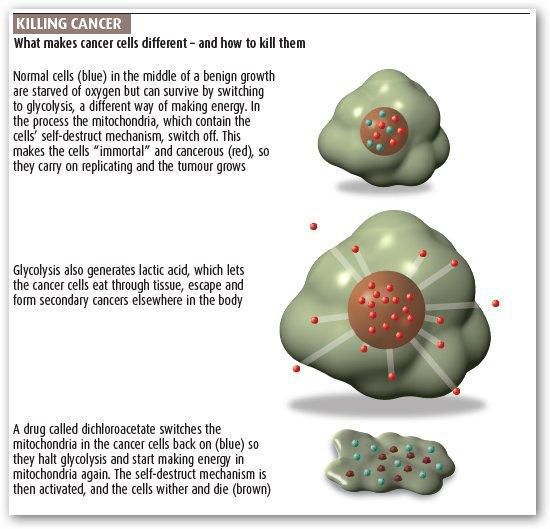
Meanwhile, more are getting cancer and more are dying from it, mostly because of the toxic treatments.Explaining DCA research results Evangelos Michelakis and the Alberta University research team tested DCA on human cancer cells outside the body and in cancerous mice with profound success. DCA was once used for unusual metabolic disorders. The worst side effects, which rarely occur, include some numbness and an affected gait.The mice were fed DCA in water, and in weeks they had remarkable tumor shrinkage. This indicates DCA can be taken orally. DCA works by restoring the cells’ mitochondria. Michelakis and his team had discovered that the mitochondria in cancer cells are not permanently damaged and irreparable. This is what mainstream medicine thinks.With mitochondria malfunctioning, cancer cells use glucose fermentation for survival energy.

This fermentation occurs when glycolysis (glucose conversion) occurs in an anaerobic cellular environment, which can be created by benign tumor masses, toxins, and low pH levels.DCA restores mitochondria in cells to make them function properly. Another function of normal mitochondria is signaling apoptosis, or cellular self destruction. Normal cells die and become replaced constantly. But with cancer cells, the apoptosis signal is nullified, making cancer cells “immortal.” (3)The Alberta University researchers also realized that glycolysis fermentation in cancer cells produces lactic acid. The lactic acid breaks down the collagen holding those cells together in a tumor. This allows cancer cells to easily break away from a tumor shrinking with mainstream therapies.The researchers reasoned this is why cancer metastasizes or spreads to different parts of the body or reappears after remission from chemo.Tragic hypocrisyAlternative cancer therapies have little or no problem with metastatic cancer or even cancer reoccurring after remission. Most alternative cancers simply cure cancers completely.DCA offers the cancer industry an opportunity to come up with a pharmaceutical cure that is much cheaper and safer than their current standard of care. Yet the cancer industry is ignoring this opportunity. Instead, DCA is a homeless orphan begging for research funds to avoid legal issues with off label use on cancer. (4)"


https://www.youtube.com/watch?v=fQwwGPiyW9M


READ MORE: http://www.disclose.tv/news/proof_that_the_cancer_industry_doesnt_want_a_cure/122059?utm_content=buffer92d48&utm_medium=social&utm_source=facebook.com&utm_campaign=buffer

Sunday, September 6, 2015

How Covert Agents Infiltrate The Internet To Manipulate, Deceive, And Destroy Reputations

How Covert Agents Infiltrate The Internet To Manipulate, Deceive, And Destroy Reputations

“Whatever else is true, no government should be able to engage in these tactics: what justification is there for having government agencies target people – who have been charged with no crime – for reputation-destruction, infiltrate online political communities, and develop techniques for manipulating online discourse? But to allow those actions with no public knowledge or accountability is particularly unjustifiable.”  – extracted from the article
Although this article is dated ….it’s still very relevant today, maybe even more so.  
As we see this current regime going further down the rabbit hole each day, we must stay on top of their roguishness.

People need to see this outline in order to comprehend our enemies’ matrix possibilities.

The Intercept – by Glenn Greenwald

One of the many pressing stories that remains to be told from the Snowden archive is how western intelligence agencies are attempting to manipulate and control online discourse with extreme tactics of deception and reputation-destruction. It’s time to tell a chunk of that story, complete with the relevant documents.

Over the last several weeks, I worked with NBC News to publish a series ofarticles about “dirty trick” tactics used by GCHQ’s previously secret unit, JTRIG (Joint Threat Research Intelligence Group). These were based on four classified GCHQ documents presented to the NSA and the other three partners in the English-speaking “Five Eyes” alliance. Today, we at the Intercept are publishing another new JTRIG document, in full, entitled “The Art of Deception: Training for Online Covert Operations.”

By publishing these stories one by one, our NBC reporting highlighted some of the key, discrete revelations: the monitoring of YouTube and Blogger, the targeting of Anonymous with the very same DDoS attacks they accuse “hacktivists” of using, the use of “honey traps” (luring people into compromising situations using sex) and destructive viruses. But, here, I want to focus and elaborate on the overarching point revealed by all of these documents: namely, that these agencies are attempting to control, infiltrate, manipulate, and warp online discourse, and in doing so, are compromising the integrity of the internet itself.

Among the core self-identified purposes of JTRIG are two tactics: (1) to inject all sorts of false material onto the internet in order to destroy the reputation of its targets; and (2) to use social sciences and other techniques to manipulate online discourse and activism to generate outcomes it considers desirable. To see how extremist these programs are, just consider the tactics they boast of using to achieve those ends: “false flag operations” (posting material to the internet and falsely attributing it to someone else), fake victim blog posts (pretending to be a victim of the individual whose reputation they want to destroy), and posting “negative information” on various forums. Here is one illustrative list of tactics from the latest GCHQ document we’re publishing today:
Other tactics aimed at individuals are listed here, under the revealing title “discredit a target”:
Then there are the tactics used to destroy companies the agency targets:
GCHQ describes the purpose of JTRIG in starkly clear terms: “using online techniques to make something happen in the real or cyber world,” including “information ops (influence or disruption).”
Critically, the “targets” for this deceit and reputation-destruction extend far beyond the customary roster of normal spycraft: hostile nations and their leaders, military agencies, and intelligence services. In fact, the discussion of many of these techniques occurs in the context of using them in lieu of “traditional law enforcement” against people suspected (but not charged or convicted) of ordinary crimes or, more broadly still, “hacktivism”, meaning those who use online protest activity for political ends.

The title page of one of these documents reflects the agency’s own awareness that it is “pushing the boundaries” by using “cyber offensive” techniques against people who have nothing to do with terrorism or national security threats, and indeed, centrally involves law enforcement agents who investigate ordinary crimes:
No matter your views on Anonymous, “hacktivists” or garden-variety criminals, it is not difficult to see how dangerous it is to have secret government agencies being able to target any individuals they want – who have never been charged with, let alone convicted of, any crimes – with these sorts of online, deception-based tactics of reputation destruction and disruption. There is a strong argument to make, as Jay Leiderman demonstrated in the Guardian in the context of the Paypal 14 hacktivist persecution, that the “denial of service” tactics used by hacktivists result in (at most) trivial damage (far less than the cyber-warfare tactics favored by the US and UK) and are far more akin to the type of political protest protected by the First Amendment.

The broader point is that, far beyond hacktivists, these surveillance agencies have vested themselves with the power to deliberately ruin people’s reputations and disrupt their online political activity even though they’ve been charged with no crimes, and even though their actions have no conceivable connection to terrorism or even national security threats. As Anonymous expert Gabriella Coleman of McGill University told me, “targeting Anonymous and hacktivists amounts to targeting citizens for expressing their political beliefs, resulting in the stifling of legitimate dissent.” Pointing to this study she published, Professor Coleman vehemently contested the assertion that “there is anything terrorist/violent in their actions.”

Government plans to monitor and influence internet communications, and covertly infiltrate online communities in order to sow dissension and disseminate false information, have long been the source of speculation. Harvard Law Professor Cass Sunstein, a close Obama adviser and the White House’s former head of the Office of Information and Regulatory Affairs, wrote a controversial paper in 2008 proposing that the US government employ teams of covert agents and pseudo-”independent” advocates to “cognitively infiltrate” online groups and websites, as well as other activist groups.

Sunstein also proposed sending covert agents into “chat rooms, online social networks, or even real-space groups” which spread what he views as false and damaging “conspiracy theories” about the government. Ironically, the very same Sunstein was recently named by Obama to serve as a member of the NSA review panel created by the White House, one that – while disputing key NSA claims – proceeded to propose many cosmetic reforms to the agency’s powers (most of which were ignored by the President who appointed them).

But these GCHQ documents are the first to prove that a major western government is using some of the most controversial techniques to disseminate deception online and harm the reputations of targets. Under the tactics they use, the state is deliberately spreading lies on the internet about whichever individuals it targets, including the use of what GCHQ itself calls “false flag operations” and emails to people’s families and friends. Who would possibly trust a government to exercise these powers at all, let alone do so in secret, with virtually no oversight, and outside of any cognizable legal framework?

Then there is the use of psychology and other social sciences to not only understand, but shape and control, how online activism and discourse unfolds. Today’s newly published document touts the work of GCHQ’s “Human Science Operations Cell,” devoted to “online human intelligence” and “strategic influence and disruption”:
Under the title “Online Covert Action”, the document details a variety of means to engage in “influence and info ops” as well as “disruption and computer net attack,” while dissecting how human beings can be manipulated using “leaders,” “trust,” “obedience” and “compliance”:
The documents lay out theories of how humans interact with one another, particularly online, and then attempt to identify ways to influence the outcomes – or “game” it:
We submitted numerous questions to GCHQ, including: (1) Does GCHQ in fact engage in “false flag operations” where material is posted to the Internet and falsely attributed to someone else?; (2) Does GCHQ engage in efforts to influence or manipulate political discourse online?; and (3) Does GCHQ’s mandate include targeting common criminals (such as boiler room operators), or only foreign threats?
As usual, they ignored those questions and opted instead to send their vague and nonresponsive boilerplate: “It is a longstanding policy that we do not comment on intelligence matters. Furthermore, all of GCHQ’s work is carried out in accordance with a strict legal and policy framework which ensures that our activities are authorised, necessary and proportionate, and that there is rigorous oversight, including from the Secretary of State, the Interception and Intelligence Services Commissioners and the Parliamentary Intelligence and Security Committee. All our operational processes rigorously support this position.”

These agencies’ refusal to “comment on intelligence matters” – meaning: talk at all about anything and everything they do – is precisely why whistleblowing is so urgent, the journalism that supports it so clearly in the public interest, and the increasingly unhinged attacks by these agencies so easy to understand. Claims that government agencies are infiltrating online communities and engaging in “false flag operations” to discredit targets are often dismissed as conspiracy theories, but these documents leave no doubt they are doing precisely that.

Whatever else is true, no government should be able to engage in these tactics: what justification is there for having government agencies target people – who have been charged with no crime – for reputation-destruction, infiltrate online political communities, and develop techniques for manipulating online discourse? But to allow those actions with no public knowledge or accountability is particularly unjustifiable.

Source: http://www.fromthetrenchesworldreport.com/how-covert-agents-infiltrate-the-internet-to-manipulate-deceive-and-destroy-reputations-2/141258#more-141258