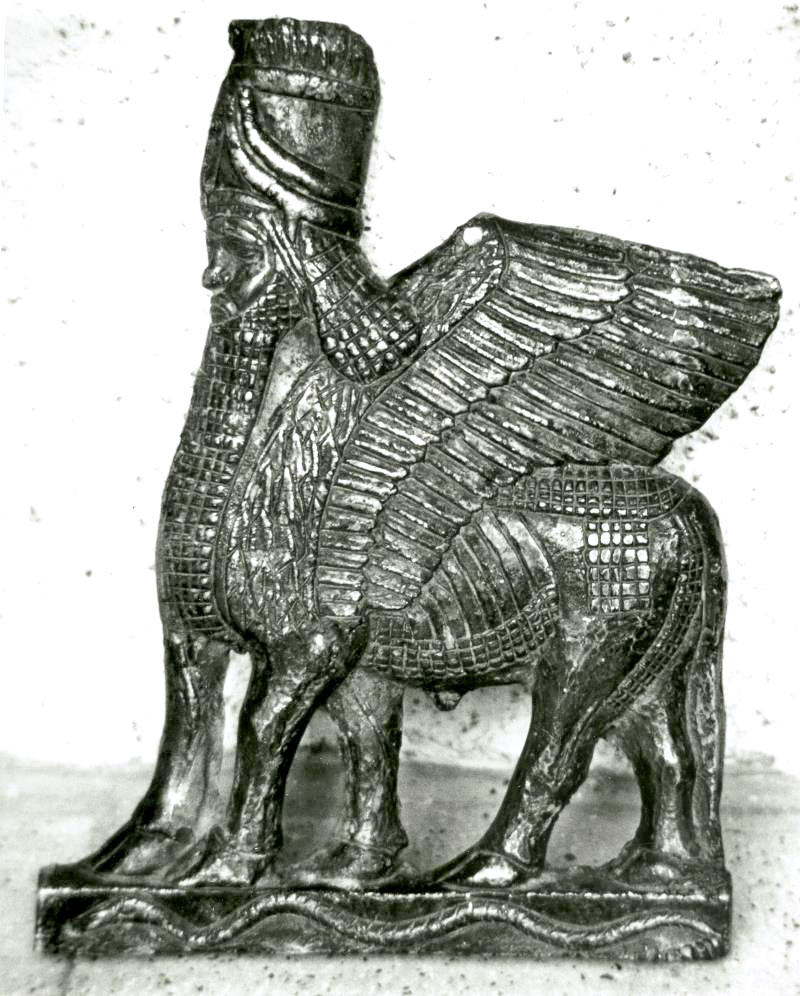
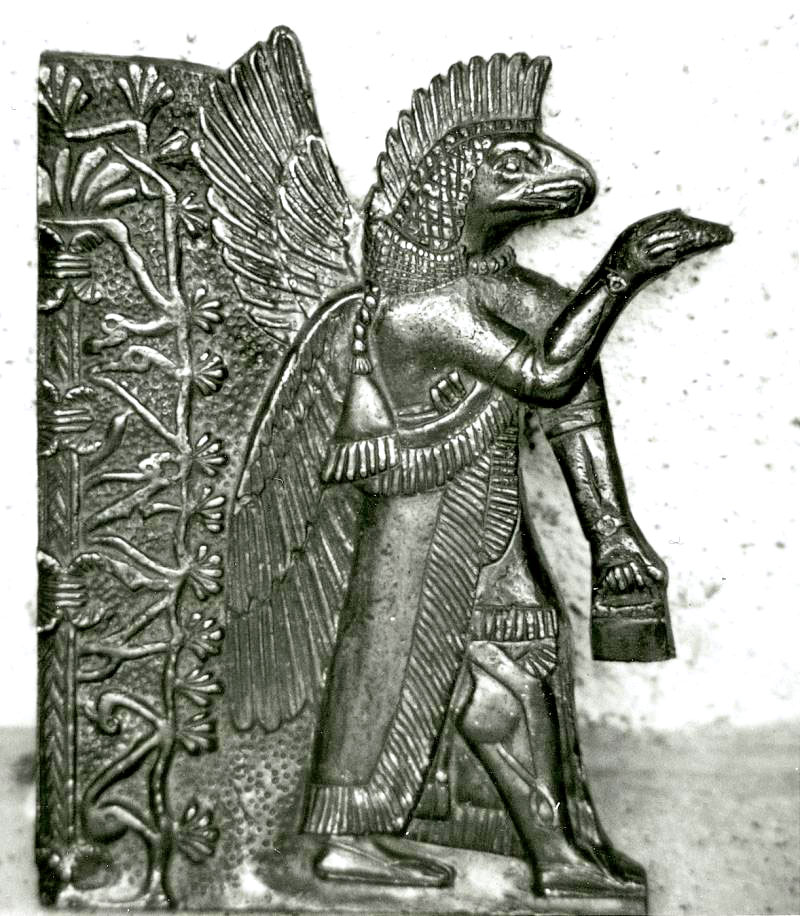
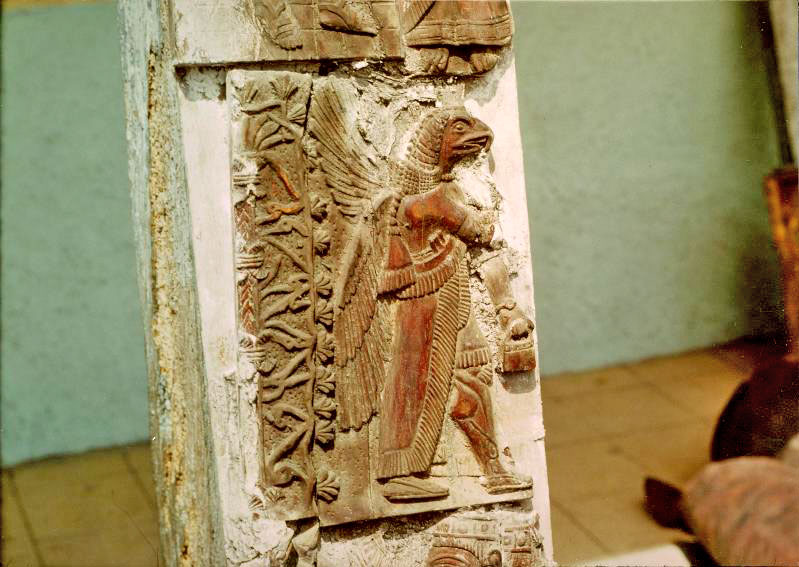
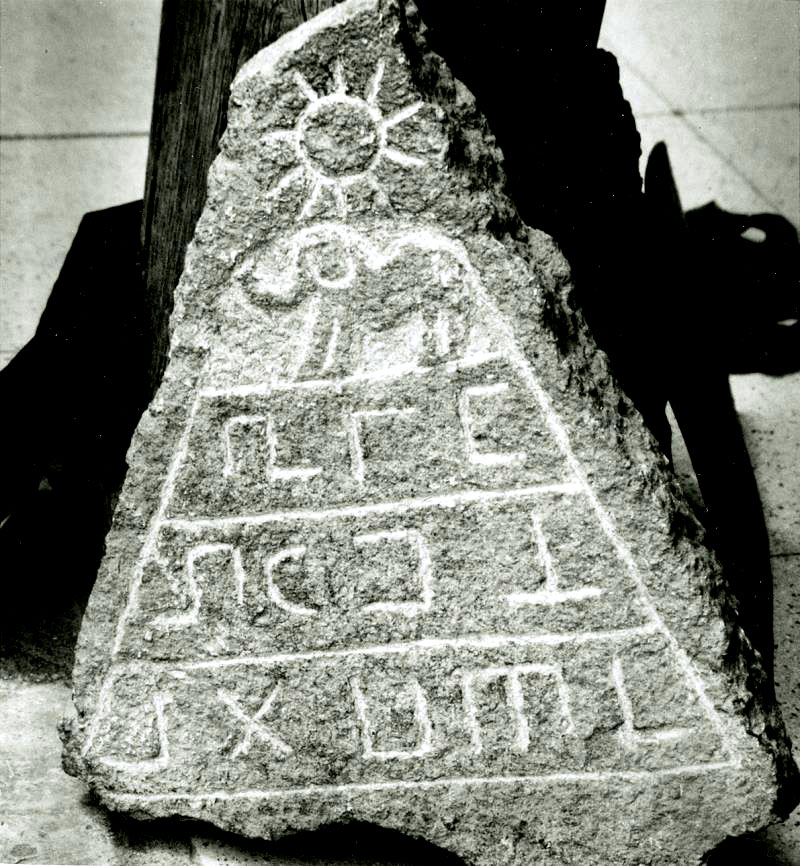
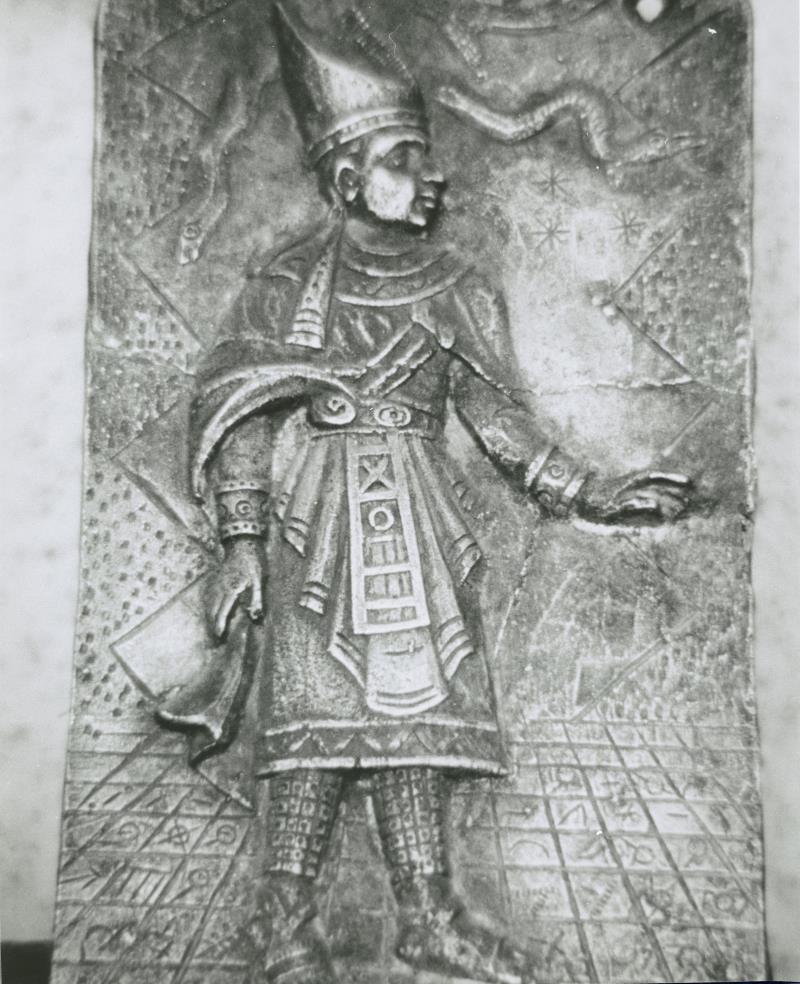
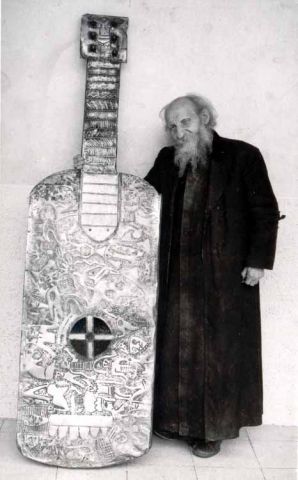
In the World Explorers Club magazine, David Hatcher Childress has added a photographic section on Father Crespi at the end of the 'Metal Library of Atlantis' article.
The enigmatic Crespi plate. Magyar? Sanskrit? Pali?
Father Crespi
Salesian Padre Carlos Crespi Croci, born in Italy in 1891, dedicated his life to Ecuador from 1923 to 1982.
Educator, anthropologist, botanist, artist, explorer, cinematographer, humanitarian and musician, his unfathomable wealth of talents and benevolence served and illuminated rich and poor alike, in recognition of which an impressive sculpture to his memory was erected in Cuenca, his adopted city, by an adoring populace.
After meeting Padre Crespi (see photo) in 1975-76, presbyterian-raised Stan Hall declared to a friend,
‘If ever I felt I'd been in the presence of a Saint it was Padre Crespi!’
Hall with Padre Crespi,
Cuenca 1976
A Tribute to Padre Crespi - Born a Saint The film excerpt below is from ‘Los Invencibles Shuar del Alto Amazons’ shot in 1927 by Salesian PadreCarlos Crespi, the first film of Shuar community life and culture ever made.
The Shuar-Achuar population of Ecuador numbers 70,000 over 400 communities. They are called ‘Invincibles’ because neither Incas nor Conquistadores could dominate them.
In the 1990s Stan Hall, an ‘Honorario Vitalicio’ and International Representative of the Shuar Federation, mediated the release of an Ecuadorian Atomic Energy delegation taken prisoner because it arrived in a Shuar community unannounced. The only words the Shuar associated with Atomic Energy were ‘Hiroshima’ and ‘Nagasaki’.
After consulting specialized geologists Hall convinced Shuar and Achuar representatives in Quito that uranium deposits in their territory were negligible and of no commercial value.
from FOK! Website Many may not be familiar with what we call the Crespi Collection, but it was/is one of the more amazing collection of artifacts from South & Central America that has every been brought together.
Father Carlos Crespi was a Silesian-monk who lived in Ecuador. He did missionary work among the Indian population in remote valleys during his lifetime.
Crespi received or bought many artifacts from the indigenous people in Ecuador.
When questioned, they told him they had found them in subterranean cave systems in the jungles. As time progressed, many of these relics were brought together and kept in the courtyard of the church Maria Auxiliadora.
Unfortunately, many of the artifacts were destroyed in a fire in 1962 or later when the church was restored. Also, many were lost or wound up with treasure hunters. After Father Crespi passed away, the remaining artifacts of the original collection were removed and made inaccessible to the public. Some may still be stored in the cellar archive of the church Maria Auxiliadora.
The age and origin of these items is still unknown today. Father Crespi never tried to classify them. The picture motifs are strange, their meaning not understood. These objects show the pictures of an unknown culture.
Were they left by unknown civilizations?
The most well known pieces are tablets made of silver, gold foil or other alloys with unknown letters and mysterious symbols.
Priests Discover Golden Library Built by Giants Inside of a Cave in Ecuador?
About two years ago we brought up the fact that in Ecuador a priest made one of the most incredible discoveries of the 21st century, to say the least. But because it didn’t get all that much attention, we figured it’d be about time we give it some more exposure.
So, the discovery was made by a man that goes by the name of Crespi.
He’s been working as a priest for most of his life now and despite the fact that he’s never been all that much of a believer in the extraterrestrial factor he couldn’t help but think about it as he saw the discovery with his own two eyes.
So, what exactly did he see? He stumbled across a massive metallic alien library which was packed full of sheets of gold, platinum, and other such precious metals.
Inside he also uncovered several artefacts that became known as Cueva de Los Tayos.
The Ecuadorian authorities wouldn’t confirm the existence of any of them, but the proof is definitely out there ready to be explored by anyone who’s willing to look for it.
Photograph of Father Crespi with some local children
It is said that many important individuals including Neil Armstrong himself visited the cave on multiple occasions to essentially discover the true origin of all of humanity.
The caves are said to go on forever and ever, to the point where it becomes impossible to read every book in the library within the span of one’s lifetime.
Fact Check & Truth
IN 1976, A MAJOR EXPEDITION entered the Cueva de Los Tayos in search of artificial tunnels, lost gold, strange sculptures, and a “metallic library,” supposedly left by a lost civilization aided by extraterrestrials. Among the group was the astronaut Neil Armstrong.
For as long as anyone can remember, the indigenous Shuar people of Ecuador have been entering a vast cave system on the jungle-covered eastern foothills of the Andes. They descend, using ladders made of vines, through one of three vertiginous entrances, the largest of which is a 213-foot-deep (65-meter) shaft that leads into a network of tunnels and chambers stretching, as far as we know, for at least 2.85 miles. The largest chamber measures 295 feet by 787 feet.
For the Shuar, these caves have long been a centre for spiritual and ceremonial practices, home to powerful spirits as well as tarantulas, scorpions, spiders, and rainbow boas. They are also home to nocturnal oilbirds, known locally as tayos, hence the name of the cave. The tayos are a favoured food of the Shuar, another reason why they brave the depths of the cave system.
In their role as guardians of the cave system, the Shuar had been left in relative peace over the last century or two, apart from an occasional gold prospector snooping around in the 1950s and ‘60s. Until that was, a certain Erich von Däniken decided to get involved.
The Swiss author captured the global imagination in 1968 with the publication of his book Chariots of the Gods? which was in large part responsible for the current plague of ancient astronaut theories and all that malarkey. Then, three years later, he published The Gold of the Gods, unleashing a little-known theory about the Cueva de Los Tayos upon his eager readership.
In The Gold of the Gods, von Däniken recounted the claims of János Juan Móricz, an explorer who claimed to have entered the caves in 1969. Inside the cave, he asserted, he had discovered a treasure trove of gold, strange artefacts and sculptures, and a “metallic library” containing lost information preserved on metal tablets. And the caves themselves were surely artificial, he claimed, created by some advanced intelligence now lost to history.
This was red meat for von Däniken, of course, and tied in very nicely with his spate of lucrative books promoting his theories of lost civilizations, ancient astronauts, and the like (or, as Carl Sagan put it, von Däniken’s theory that “our ancestors were dummies”).
It also inspired the first major scientific expedition to Cueva de Los Tayos. The 1976 expedition was led by Stan Hall, a Scottish civil engineer who had read von Däniken’s work. It quickly grew to become one of the largest cave expeditions of its time, with more than 100 people involved. These included British and Ecuadorian government officials, leading scientists and speleologists, British special forces, professional cavers, and none other than astronaut Neil Armstrong, who served as the expedition’s Honorary President.
The expedition was a success, at least in its less fanciful ambitions. The extensive network of caves was mapped far more thoroughly than ever before. Zoological and botanical findings were recorded. And archaeological discoveries were made. But no gold was found, no otherworldly artefacts discovered, and there was no sign of a metallic library. The cave system, too, appeared to be the result of natural forces rather than any kind of advanced engineering.
Interest in the Cueva de Los Tayos never again reached the heights of the 1976 expedition, but numerous research expeditions have since taken place. One of the more recent expeditions was that of Josh Gates and his team for the fourth season of the television series Expedition Unknown. Gates entered the cave system with Shuar guides and Eileen Hall, the daughter of the late Stan Hall from the 1976 expedition. And while expeditions such as these have resulted in fascinating zoological and geological discoveries, there’s still no sign of gold, aliens, or a library.
Cancer Cure Suppressed for 80 Years: Finally Admitting Royal Rife Was Right
(Melissa Dykes) A person does not hear sound only through the ears; he hears sound through every pore of his body. It permeates the entire being, and according to its particular influence either slows or quickens the rhythm of the blood circulation; it either wakens or soothes the nervous system. It arouses a person to greater passions or it calms him by bringing him peace. According to the sound and its influence a certain effect is produced. Sound becomes visible in the form of radiance. This shows that the same energy which goes into the form of sound before being visible is absorbed by the physical body. In that way the physical body recuperates and becomes charged with new magnetism. — Sufi musician, mystic, and healer Hazrat Inayat Khan
Our reality is such that frequencies have a much more profound effect on us than we’ve been previously led to believe. This reality can no longer be ignored.
As technologically advanced as we are constantly told we are these days, there are some technologies just now being presented to the public as “new” when they are not new at all but have simply been widely suppressed for decades. Things like the “new” digital neuro headbandsthat pulse specific electromagnetic frequencies into a person’s head to “transition” his or her moods, for example.
It has also come out in recent years that frequencies can cure diseases, including cancer. Professor and researcher Anthony Holland even gave a Tedx talk on “Shattering Cancer with Resonant Frequencies” a few years back, discussing the ability to destroy cancer cells and deadly super bugs like MRSA with oscillating pulsed electrical fields… not that you probably heard about it on the nightly news or anything.
https://www.youtube.com/watch?v=1w0_kazbb_U As someone pointed out in the comments, phrases like, “They hadn’t seen anything quite like it. Seems to be a new phenomenon,” (emphasis mine), made viewers who know about the organized suppression of such technologies since at least the 1930s want to slam their own heads into a wall.
Meet Dr. Royal Raymond Rife
Dr. Rife
Dr. Rife has been referred to by those who personally knew and worked with him as a genius. A scientist and inventor, starting in the 1920s, Rife began building a large and complex microscope capable of magnifying objects 31,000 times (compared with maybe 1700 times available on standard microscopes in the 1930s and 40s). By 1940 Rife had a two-foot high device weighing in at 200 pounds which included some 5,682 parts that enabled Rife to see viruses and bacteria in a way no other scientists had.
Because these organisms were so tiny, Rife designed a method of staining them with light.Through this work, Rife came to understand that all living things, including bacteria and viruses, have their own frequency or oscillation pattern.
Just like a specific musical note can shatter a wine glass if sung at the resonant frequency of the glass, it was found frequencies could also be used to destroy pathogens.
As he continued to isolate viruses and bacteria and locate their frequencies for destruction, Rife claimed he discovered the virus responsible for cancer.
Using resonance, or what he termed the “Mortal Oscillatory Rate” of the virus, he killed it. Over and over and over.
Rife completed hundreds of experiments on tumors in rats purposefully infected with this isolated cancer virus before ever using his cancer-killing frequencies on people. In 1934, he tested out his device out on 16 terminally ill cancer patients. Out of 16, all but two of them were considered officially cured in just three months. Of his treatment Rife would later write, “With the frequency instrument treatment, no tissue is destroyed, no pain is felt, no noise is audible, and no sensation is noticed. A tube lights up and 3 minutes later the treatment is completed. The virus or bacteria is destroyed and the body then recovers itself naturally from the toxic effect of the virus or bacteria. Several diseases may be treated simultaneously.”
An LA Times article described the method for the public in June 1940.
“For organisms too small to be stained, an ingenious illuminating system is used. This system utilizes Rife’s theory that organisms respond to certain wavelengths, a theory he carries to finality by bombarding disease germs with radio waves which are ‘tuned’ to those of the minute man-killers. And the virus he says occurs in cancer has, Rife insists, disintegrated under such radio waves.”
Rife was hailed in the scientific and medical communities for his discoveries. By 1937, Rife had established a company called Beam Ray with several colleagues, and 14 of his machines were manufactured.
So what happened? Why aren’t these machines in every hospital and cancer treatment center in the world today?
Simply put, the only cancer Rife couldn’t seem to kill was greed.
How the Cure for Cancer Got Suppressed
Morris Fishbein
Powerful opposition with vested interests in allopathic (pharmaceutical and surgery-based) medicine and the still infant cancer “treatment” called chemotherapy, and medical professionals linked to the Rockefeller Foundation (with its deeply entrenched eugenics-based population control agenda) would make sure Rife’s machines would never be available to the public at large.
One such stooge was Dr. Morris Fishbein, head for a time of the American Medical Association (AMA) and described by Bob Wallace on LewRockwell.com as a “shakedown artist” hellbent on destroying naturopathic medical inventors he couldn’t buy out:
“Fishbein sent an attorney to make a token attempt to buy out Rife. Rife refused. Although no one knows the exact terms of the offer, it was probably similar to the one Fishbein made to Harry Hoxsey for his herbal cancer remedy (which Fishbein, in court, had to admit worked on skin cancer).
Fishbein and his associates would receive all profits for nine years and Hoxsey would receive nothing. Then, if they were satisfied that it worked, Hoxsey would begin to receive 10% of the profits. When Hoxsey refused, Fishbein used his political connections to have Hoxsey arrested 125 times in a period of 16 months. The charges (based on practicing without a license) were always thrown out of court, but Fishbein harassed Hoxsey for 25 years. The only good thing that came out of it is that the scandal forced Fishbein to resign.
Fishbein then offered Phil Hoyland, an investor in Beam Ray and an electrical engineer who had helped build the frequency instruments, legal assistance in an attempt to steal the company from Rife and the other investors. A lawsuit ensued.”
That lawsuit was the beginning of the end of Rife and his machines. Unable to withstand the attacks on his character and life’s work in court, Rife crumbled and turned to alcoholism (despite the fact that he ultimately won his case). The legal costs bankrupted him, and his Beam Ray company went out of business.
Fishbein continued to wield the power of the AMA to halt any further proper scientific investigations into Rife’s claims or his machine. The doctors that had previously supported Rife and his work suddenly fell silent. Arthur Kendall, one of Rife’s partners, suddenly retired to Mexico with a “gift” of a quarter of a million dollars. Other doctors were given large grants and AMA honors to shut their mouths and go back to prescribing pharmaceuticals. Major medical journals, predominantly funded by Big Pharma advertising revenues, refused to publish anyone’s work involving Rife’s theories or his machines.
Rife’s lab was also broken into, and documentation of his work including photographs and even pieces of his microscopes were stolen and vandalized. Then, in what would be too much coincidence for even a Hollywood movie, the multi-million dollar Burnett Lab was torched and destroyed just as its scientists were about to corroborate Rife’s findings.
The burned Burnett Lab
Police illegally confiscated the rest of Rife’s research… and that was it. Fishbein would go down in history with a prestigious write up a medical career on “exposing quacks” (or, alternatively, financial “enemies” of Big Pharma’s chemical and surgery-based medicine model).
It wasn’t just Fishbein. There was a coordinated effort to ensure other doctors didn’t even attempt to follow in Rife’s footsteps.
Dr. Cornelius P. Rhoads, an oncologist, Rockefeller Institute alum and head of the chemical warfare service during the last two years of WWII, spent two decades from 1939-1959 as the head of Memorial Sloan Kettering — the nation’s premier chemotherapy advocate where Rhoads helped shape the newly emerging “treatment” of cancer with chemotherapy. He, too, prevented other doctors from even attempting to replicate Rife’s work, pulling strings to get research funding canceled for those who dared to try.
Rhoads not only prevented Dr. Irene Diller from announcing the discovery of the cancer micro-organism to the New York Academy of Sciences in 1950, but he got Dr. Caspe slapped with a nasty IRS investigation and her laboratory funds canceled after she announced a similar discovery in Rome three years later.
Rhoads, it should be pointed out, would also go down in history as a potential murderer.
In the 1930s, when Rhoads was down in Puerto Rico for the Rockefeller’s Anemia Commission, after a drunken night where he returned to find his car had been vandalized, he wrote a disgusting, racist confession of both murder and attempted murder by injecting people with cancer to a colleague:
“They [Puerto Ricans] are beyond doubt the dirtiest, laziest, most degenerate and thievish race of men ever inhabiting this sphere. It makes you sick to inhabit the same island with them. They are even lower than Italians. What the island needs is not public health work but a tidal wave or something to totally exterminate the population. It might then be livable. I have done my best to further the process of extermination by killing off 8 and transplanting cancer into several more. The latter has not resulted in any fatalities so far… The matter of consideration for the patients’ welfare plays no role here — in fact all physicians take delight in the abuse and torture of the unfortunate subjects.”
At least 13 people died under Rhoads’ “care” in Puerto Rico.
The Rockefeller public relations firm came out later to say Rhoads was simply writing a “fantastic and playful” letter for his own amusement, a satire piece. Token investigations, including one initiated by the Rockefeller Institute, claimed there was no evidence Rhoads had abused or neglected his patients. Interesting wording.
As far as history is concerned, you can believe Rhoads’ letter hasn’t been featured too prominently in his otherwise illustrious biography as a pioneer of chemotherapy.
And Today?
How many people have needlessly died from cancer that could have quickly, painlessly, and inexpensively been cured by Rife technology in the years since his research was suppressed? It’s a horrifying thought.
My mother almost died from cancer. They gave her grueling chemotherapy treatments including one she later found out wasn’t even for the cancer type she had been diagnosed with. When all was said and done, and her immune system had been utterly destroyed but her cancer went into remission, the doctors told her it would probably come back in five to ten years.
That. Is NOT. A cure.
The reason the average person still believes dangerous and toxic chemotherapy actually “cures” cancer today is linked to the same greedy force behind why the majority of people still fuel their cars with gasoline despite the fact that much more efficient, inexpensive, and environmentally sound alternatives have existed for decades but have also been suppressed until recently.
Greed, however, can’t keep the truth hidden from humanity forever… especially those truths which are so fundamentally obvious.
It’s 2017. How many years have people been dutifully donating money to cancer research and “running for the cure” without so much as a peep from the allopathic medical system about the cause?
Albeit quietly, we now have researchers coming out of the woodwork to verify the power of resonant frequencies to kill viruses and bacteria and to cure even life-threatening diseases, including cancer. Two doctors in 2014 published a paper in Global Advances in Health and Medicine titled “Life Rhythm as a Symphony of Oscillatory Patterns: Electromagnetic Energy and Sound Vibration Modulates Gene Expression for Biological Signaling and Healing”. In it, they concluded:
Hence, not only chemicals and physical energies like EMFs and sound vibrations, but even our emotions, thoughts, beliefs, and the way we develop our intentions and life rhythms can deeply transform our gene expression patterning at the cellular level. This finding may disclose unexpected chances to develop self-healing processes based on further utilization of this remarkable human potential…
The paradigm emerging here moves from a purely biochemical viewpoint, based solely upon physical concepts of energy and momentum transfer and their implications for biochemistry, to a holistic, information-based paradigm. Much as a whisper might carry more gravitas than shouted words, science may now be uncovering the basic principles of a more subtle informational biology in which specific signaling behaviors can carry the power for healing.
The power of healing.
After 70+ years, we all know how well the Big Pharma model of filling ourselves up with chemicals and ripping out our vital organs has served us… These aren’t “cures”. That system doesn’t heal.
It’s only a matter of time before the medical and scientific communities will be forced to admit Rife was right or risk losing the last few shreds of credibility they have in a world where its become all too obvious we’ve been purposefully held hostage in a technology bubble… to our own detriment.
Kerymeion or 'Stone of Light', bearing face of Jesus. Discovered in Egypt in 1798, a century before the face 'appeared' in the first photograph taken at the Shroud of Turin.
"Some of the biggest men in the United States, in the field of commerce and manufacture, are afraid of something. They know that there is a power somewhere so organized, so subtle, so watchful, so interlocked, so complete, so pervasive, that they had better not speak above their breath when they speak in condemnation of it."–Woodrow Wilson
"The real rulers in Washington are invisible and exercise power from behind the scenes." –U.S. Supreme Court Justice Felix Frankfurter
On January 20, 2001, President George W. Bush during his first inaugural address faced the obelisk known as the Washington Monument and twice referred to an angel that "rides in the whirlwind and directs this storm." His reference was credited to Virginia statesman John Page who wrote to Thomas Jefferson after the Declaration of Independence was signed, saying, "We know the race is not to the swift nor the battle to the strong. Do you not think an angel rides in the whirlwind and directs this storm?’’
Five weeks after the inaugural, on Wednesday, February 28, Congressman Major R. Owens of New York stood before the House of Representatives and prayed to the "Angel in the Whirlwind." He asked the spiritual force to guide the futureand fate of the United States.[1] Twenty-eight weeks later (for a total of 33 weeks from the inaugural—a number invaluable to mysticism and occult franternities), nineteen Islamic terrorists attacked the United States, hijacking four commercial airliners and crashing two of them into the Twin Towers of the World Trade Center in New York City, a third into the Pentagon, and a fourth, which had been directed toward Washington, DC crashed near Shanksville, Pennsylvania.
What happened that day resulted in nearly 3000 immediate deaths, at least two-dozen missing persons, and the stage being set for changes to the existing world order.
When Bush was giving his second inaugural speech four years later, he again offered cryptic commentary, saying, "For a half century, America defended our own freedom by standing watch on distant borders. After the shipwreck of communism came years of relative quiet, years of repose, years of sabbatical - and then there came a day of fire...." A few paragraphs following, Bush added, "By our efforts, we have lit a fire as well - a fire in the minds of men.
It warms those who feel its power, it burns those who fight its progress, and one day this untamed fire of freedom will reach the darkest corners of our world."
The phrase, "a fire in the minds of men," is from Fyodor Dostoyevsky’s nineteenth century book, The Possessed (The Devils), a novel set in pre-revolutionary Russia where civil resistance is seen championed by nihilist Sergei Nechaev who tries to ignite a revolution of such destructive power that society will be completely destroyed. The fact that a United States president would quote this phrase in an official speech of record was astonishing to many analysts, given that The Possessed is about violent government crackdown on dissent that sparks civil unrest and revolution marked by public violence.[2]Fire in the Minds of Men is also the title that historian James H. Billington chose for his famous book on the history of revolutions, including the origin of occult Freemasonry and its influence in the American Revolution. In his closing comments, Bush himself tied the inaugural crypticisms to the Masonic involvement in the American Revolution, saying, "When our Founders declared a new order of the ages… they were acting on an ancient hope that is meant to be fulfilled." The phrase "a new order of the ages" is taken from the Masonically designed Great Seal ("Novus Ordo Seclorum") and Bush further acknowledged that the secret society members were acting on an "ancient" hope that is "meant to be fulfilled."
To the illumined elite and a handful of historians and scholars, the inaugural addresses by the president were important editions in a larger series of carefully crafted speeches in which line-by-line analysis of his public references uncovered what appeared to be coded language designed to convey shrouded messages at regular interval to select members of his global audience. Biblical scholar Bruce Lincoln’s examination of a speech delivered by Bush to the nation on October 7, 2001, announcing the U.S. attack on Afghanistan [3]repeat verified this practice, producing redundant hidden references from Apocalyptic books of the Bible concerning the End Times. Lincoln concluded that the word crafting was a strategy of "double coding" to secretly appeal to people who saw Bush as divinely called to stand up to the enemies of God in an unfolding event in the Middle East, which they believed was foretold in the books of Revelation, Isaiah and other ancient texts. In this instance, Lincoln concluded that Bush was mirroring the dualistic conflict Osama bin Laden had used in speeches to pit his worldview against the West as a struggle between good vs evil and thus to appeal to religious sentiments and traditions. U.S. officials were clearly uncomfortable with anything that allowed bin Laden to be cast in a sympathetic light through propaganda and the transmission of veiled messages, therefore according to Lincoln, Bush joined Osama in constructing public perception of "a Manichaean struggle, where Sons of Light confront Sons of Darkness, and all must enlist on one side or another, without possibility of neutrality, hesitation, or middle ground."[4]
In American Dynasty, Kevin Phillips confirmed this practice of message-coding by Bush, pointing out the ever-present references in the president’s speeches to words such as "evil" and "evil ones."[5]At the top of Phillip’s list is reference again to the use of the metaphysical phrase "whirlwind," which Phillips interprets as "a medium for the voice of God in the Books of Job and Ezekiel." From an esoteric point of view, Phillips was either unaware of or unwilling to discuss the deeper contemporary meaning of this language and its importance to secret societies. But such phrasing in the president’s public speeches assuredly did not go unnoticed by the appropriate members of his audience. Lincoln comes closest to acknowledging this when he writes: "Enlisting the specialized reading/listening and hermeneutical skills they cultivate, he encouraged them to probe beneath the surface of his text. There, sotto voce ["under voice"], he told them he understands and sympathizes with their views, even if requirements of his office constrain him from giving full-throated voice…."[6]
Of course Bush was not the first president to use the language of the divine to cast himself as "defender of the faith" in order to win support for public policy. Who can forget Ronald Reagan’s view of the Soviet Union as the "Evil Empire" and his feeling that war in the Middle East might draw "Gog" into nuclear war and fulfill biblical prophecy. In his 1984 debate with Walter Mondale, Reagan admitted, "No one knows whether those prophecies mean that Armageddon is a thousand years away or the day after tomorrow."
Yet few would argue that with George W. Bush the language of godlike appointment went disturbingly deeper. Even members of his own Methodist denomination saw a change in him after he took office. He seemed to them to have become a man on a mission; somebody who believed he was "chosen" by God to initiate a prophetic "master plan." And until the 2006 mid term elections unseated Republican control of congress and effectively stopped the juggernaut of his administration’s changes to domestic and foreign policy, the presidency of Bush was believably on a path toward an Apocalyptic vision led by inspiration from the Angel in the Whirlwind. Whether the president fully understood the ramifications of his words and actions, he and others around him had: 1) acknowledged; 2) prayed to; and 3) welcomed supernatural agents to guide and influence the future machine of national sovereignty in a way oddly familiar to end times prophecy and Dostoyevsky’s novel.
Though we allow that the president might have been unaware of parts of his abstruse actions because he was not the author of his speeches in the conventional sense and members of his staff with input from unnamed guides crafted most of these words, Bush nevertheless delivered these speeches after reviewing them, contemplating them, practicing them and making personal margin notes. More importantly, "he spoke in his official capacity as head of state, representing the state and beyond that the nation," notes Lincoln. So whether Bush was aware of his actions or was puppeted by dominionist allegiances that he and his father had nurtured (or at a deeper level spoke for fraternal societies), occultists in and behind government knew exactly what they were doing. Their choice of words and actions—from the president’s speeches to the council he received from members of an elite, top secret cell of spiritual authorities in Washington (note: this is not a reference to the Christian groups or Faith Councils that meet with US presidents)—reveal subtle but informing truths: words were placed in the president’s mouth to be spoken in mystic harmony of a sacred craft, an otherworldly discourse, which the men behind the president, the ‘voices behind the voice,’ believed would invoke the arrival of a spiritual ‘Kingdom on Earth’ led by an embodied theocratic representative if these words were uttered at the right moment in history and from chosen men of God. For this "Angel in the Whirlwind," wrote Christopher Findlay, "also carries unsettling connotations of a day of vengeance and judgment… a notion that appeals to… the apocalyptic frame of mind… reminiscnet of Winthrop’s ‘shining city on a hill’ image, coupled with the fear of being expelled from this earthly paradise if the new society should fail to fulfill its role in the divine plan."[7]
Later, when some in the public were taking courage that the midterms backlash of November 2006 had sufficiently restrained the administration’s dreams of playing a vital role in initiating Armageddon, behind the scenes in Washington DC this influential group of powerful men retained faith in their paranormal forces. Setting their eyes on the timeframe 2009-2012, they were not for the moment concerned if congress or even the executive branch changed hands now and again. They had received what they wanted—official invitation to supernaturalism by the nation’s leaders and, for sufficient time, conformity by the majority of uninitiated Americans. An Angel from the Whirlwind spread its powerful wings, and a new epoch in American history was ushered in; a time when the government of the U.S. was intentionally brought under influence to dark angelic power.
The statement above may seem daring. But the connection between the president’s speeches, signals to ‘the family’ of spiritual advisors as well as to the leaders of The Craft (discussed later), the Bush administration’s subsequent actions, coalescence of congress and for a while the majority of Americans, set in motion the rules for cosmic game play as defined in the sacred texts of all major religions, including the Bible. Invitation to angels by elected officials combined with passive civilian conformity is key to opening doorways for supernatural agents to engage social governance. This is a classic tenant of demonology. Spirits go where they are invited, whether to possess an individual or to take dominion over a region. One could contend therefore that starting in 2001, the United States became so disposed in following and not challenging unprecedented changes to longstanding U.S. policies including the Christian rules for just war, that a powerful force known to the Illuminati as the "Moriah Conquering Wind," a.k.a. "the Angel in the Whirlwind" accepted the administration’s invitation and enthroned itself in the nation’s capital. Immediately after, it cast it’s eyes on the ancient home of the Bab-Illi, Babylon, where the coveted ‘Gate of the Illi’ had opened once before.
Despite a series of ever-changing explanations as to why George W. Bush was stubbornly resolved in taking the U.S. into Iraq/Babylon, the home of the ‘Etemenanki’ (House of the Foundation of Heaven and Earth, the ‘Tower of Babel’) even though Iraq was not connected to the events of September 11, 2001, years later if you asked a room of 20 analysts to define what was the true nature behind the U.S. entering that war, you would probably receive 20 different answers.
Some say it was strategic placement of U.S. military resources against what the administration saw as a growing threat from Islamic radicals. Some say it was an effort to seize and maintain control of Iraqi oil reserves. Others contend that 9/11 was itself either a convenient or orchestrated event (false flag) allowing the Bush administration to extend a global domination project. Still others believe something unusual connected to biblical sites in Babylon had been uncovered during Saddam Hussein’s reconstruction of the ancient city, and that the administration went there to capture it. But according to the British press, Bush let his real reasons slip during a meeting with Palestinian leaders in June 2003 when he admitted that he had committed the United States to enter Babylon because, "God told me to invade Iraq."[8]
Did a voice from God instruct the leader of the world’s most powerful nation to begin what quickly resulted in, at least on the surface, a debacle? One disturbing possibility is that the president was delusional. On the other hand, if God did tell Bush to invade Iraq, given other ‘signs of the times,’ we tune our ears to the prophets who foretold an end-of-days event when Babylon would be overthrown by a foreign invader, followed by the release of apocalyptic forces—powers known by the prophets as the descendants of fallen angels who went into Hell "in full battle dress."[9]When the prophet Jeremiah prophesied the future of Babylon, he specifically foresaw the catalyst for its destruction as happening when the God of the Angel-Armies (LORD of hosts) sends a warning that "evil" (Ra) is to be unleashed upon the nations of the world by "a great Whirlwind" that is raised up from the coasts of the earth (Jeremiah 25:32). The people of earth are afterward viewed as hopeless and in need of a savior.
Forebodingly, the end of Bush’s second term witnessed such civil clamor for renewed "hope" amidst widespread messianic fervor surrounding the election of America’s current president, Barack Hussein Obama. Bush’s Angel in the Whirlwind administration was indeed prophetic in that it accomplished exactly what elite occultists wanted: a fire burning in the minds of men, fanned by multinational chaos and desperation, resulting in universal entreaty for an inspirational and political demigod—a savior—to arise on the global scene promising a New World Order.