The Film the Israel Lobby Does Not Want You to See
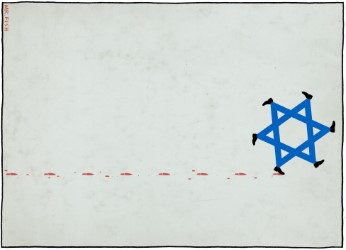
“The Lobby,” the four-part Al-Jazeera documentary that was blocked under heavy Israeli pressure shortly before its release, has been leaked online by the Chicago-based website Electronic Intifada, the French website Orient XXI and the Lebanese newspaper Al-Akhbar.
The series is an inside look over five months by an undercover reporter, armed with a hidden camera, at how the government and intelligence agencies of Israel work with U.S. domestic Jewish groups such as the American Israel Public Affairs Committee (AIPAC), The Israel Project and StandWithUs to spy on, smear and attack critics, especially American university students who support the boycott, divestment and sanctions (BDS) movement. It shows how the Israel lobby uses huge cash donations, often far above the U.S. legal limit, and flies hundreds of members of Congress to Israel for lavish and unpaid vacations at Israeli seaside resorts, bribing the American lawmakers to do Israel’s bidding, including providing military aid such as the $38 billion (over 10 years) that was approved by Congress in 2016. It uncovers Israel’s sleazy character assassination of academics, activists and journalists, its well-funded fake grassroots activism, its manipulation of press coverage, and its ham-fisted attempts to destroy marriages, personal relationships and careers. The film highlights the efforts to discredit liberal Jews and Jewish organizations as tools of radical jihadists, referring, for example, to Jewish Voice for Peace as “Jewish Voice for Hamas” and claiming that many members of the organization are not actually Jewish. Israel recruits black South Africans into an Israeli front group called Stop Stealing My Apartheid, in a desperate effort to counter the reality of the apartheid state that Israel has constructed. The series documents Israel’s repeated and multifaceted interference in the internal affairs of the United States, including elections; efforts to discredit progressive groups such as Black Lives Matter that express sympathy for the Palestinians; and routine employment of Americans to spy on other Americans. Israel’s behavior is unethical and perhaps illegal. But don’t expect anyone in the establishment or either of the two ruling political parties to do anything about it. It is abundantly clear by the end of the series that they have been intimidated, discredited or bought off.
“Imagine if China was doing this, if Iran was doing this, if Russia was doing this?” Ali Abunimah, the author of “The Battle for Justice in Palestine” and co-founder of The Electronic Intifada, says in the film. “There would be uproar. You would have Congress going off to them. You would have hearings.”
Those of us who denounce and expose the Israeli crimes committed against Palestinians are intimately familiar with the sordid and nefarious tactics of the Israel lobby. The power of the film series is that in dealing with the reporter—a young Oxford postgraduate, James Anthony Kleinfeld, who goes by the name Tony in the film and poses as a pro-Israel student—major figures within the Israel lobby candidly explain and expose their massive covert campaign in the United States. There is no plausible deniability. And this is why Israel worked so hard to stop the film from being broadcast.
Clayton Swisher, who directed the series, wrote in the liberal Jewish newspaper The Forward that leaders from the Israel lobby met with the state of Qatar’s registered agent and lobbyist, a former aide to U.S. Sen. Ted Cruz named Nick Muzin, to “see if he could use his ties with the Qataris to stop the airing.” Qatar funds Al-Jazeera. Muzin told the Israeli newspaper Haaretz that “he was discussing the issue with the Qataris and didn’t think the film would broadcast in the near future.” An anonymous source told Haaretz that “the Qatari emir himself helped make the decision” to spike the film.
Saudi Arabia, Egypt, Bahrain and the United Arab Emirates severed ties with Qatar in June 2017 and imposed a land, sea and air blockade on the Persian Gulf state. They accuse Doha of supporting terrorism and radical Islamist groups, including the Muslim Brotherhood. The four states have issued a list of demands for re-establishing ties that include Qatar’s shutting down Al-Jazeera, along with severing relations with Iran. Qatar has appealed to the United States to intercede and has, as part of this effort, reached out to the powerful Israel lobby in the United States for support. American Jewish leaders, including the former Harvard law professor Alan Dershowitz, have met with the Qatari emir, Tamim bin Hamad Al Thani, and have discussed with him what they describe as the network’s “anti-Semitism.” It is widely believed the series was sacrificed by Qatar in an effort to placate the Israel lobby and get its support for an end to the sanctions, although the blockade remains in force.
Episode 1
The series exposes how Israeli intelligence services monitor American critics of Israel and feeds real-time information about them to American Jewish organizations.
“We are for example in the process of creating a comprehensive picture of the campuses,” Brig. Gen. Sima Vaknin-Gil, director general of Israel’s Ministry of Strategic Affairs, tells a gathering of pro-Israel activists in the film. “If you want to defeat a phenomenon you must have the upper hand in terms of information and knowledge.”
The Israeli government operates Israel Cyber Shield, a civil intelligence unit that collects and analyzes BDS activities and coordinates attacks against the BDS movement.
“We are giving them data—for example, one day Sima’s deputy is sending me a photo. Just a photo on Whatsapp,” Sagi Balasha, who was CEO of the Israeli-American Council from 2011 to 2015, says when speaking on an Israeli-American Council panel. “It’s written ‘Boycott Israel’ on the billboard.”
He shows a picture of a roadside billboard that reads: “BOYCOTT ISRAEL UNTIL PALESTINIANS HAVE EQUAL RIGHTS. StopFundingApartheid.org.”
“In a few hours our systems and analysts could find the exact organization, people, and even their names, and where they live,” says Balasha, who now works with cyber-intelligence organizations that target BDS activists. “We gave it back to the ministry, and I have no idea what they did with this. But the fact is, three days later there were no billboards.”“We use all sorts of technology,” Jacob Baime, the executive director of the Israel on Campus Coalition, says in the film. “We use corporate-level, enterprise-grade social media intelligence software. Almost all of this happens on social media, so we have custom algorithms and formulae that acquire this stuff immediately.”“Generally, within about 30 seconds or less of one of these things popping up on campus, whether it’s a Facebook event, whether it’s the right kind of mention on Twitter, the system picks it up,” says Baime. “It goes into a queue and alerts our researchers and they evaluate it. They tag it, and if it rises to a certain level, we issue early-warning alerts to our partners.”
Those recruited by the Israel lobby, including the undercover Al-Jazeera reporter in the documentary, are sent to training sessions such as Fuel the Truth. The film records a session in which trainees watch a video of Palestinian children as the narrator says, “Children are taught in UNRWA [United Nations Relief and Works Agency for Palestine Refugees] Palestinian schools to hate Jews.” The trainees are told that scenes of devastation in Gaza are, in fact, misrepresented images disseminated by critics from Syria or Iraq. They are instructed in role-playing workshops how to brand all those who criticize Israeli policies as anti-Semites, members of a hate group or self-hating Jews.
The reporter is placed in the so-called war room run by The Israel Project, known as TIP, which monitors American media for stories on Israel and the Palestinians. The goal is “neutralizing undesired narratives.”
“We develop relationships … ,” David Hazony, the managing director of The Israel Project, says about how to influence journalists. “A lot of alcohol to get them to trust us. We’re basically messaging on the following—BDS is essentially a kind of a hate group targeting Israel. They’re anti-peace. We try not to even use the terms because it builds their brand. We just refer to boycotters. The goal is to actually make things happen. And to figure out what are the means of communication to do that.”
The BDS movement, which I support, was formed in 2005. It is an attempt by Palestinian civil rights groups to build a nonviolent international movement to boycott Israel, divest from Israeli companies and eventually impose sanctions—as was done against apartheid South Africa—until basic Palestinian rights under international law are achieved. While the movement has not gained traction financially in the United States, with most colleges and universities refusing to divest, it has been very effective at illuminating the injustices committed against Palestinians by Israel and severely eroded Israel’s credibility and support in the U.S. This ongoing shift in public opinion terrifies Israel, which has poured tremendous resources into crushing the BDS movement.
“Government ministers attacked me in person,” Omar Barghouti, the co-founder of the BDS movement, says in the film. “One of them threatening BDS leaders with targeted civil assassination. Others threatened to revoke my permanent residency [in Israel], along other threats.”“We suffered from intense denial-of-service attacks, hacking attacks on our website,” Barghouti says. “Israel decided to go on cyber warfare against BDS. Publicly, they said, ‘We shall spy on BDS individuals and networks, especially in the West.’ We have not heard a peep from any Western government complaining that Israel is admitting that it will spy on your citizens. Imagine Iran saying it will spy on British or American citizens. Just imagine what could happen.”“So, like nobody really knows what we’re doing,” says Julia Reifkind, who was director of community affairs at the Israeli Embassy in Washington. “But mainly it’s been a lot of research, like monitoring BDS things and reporting it back to the Ministry of Foreign Affairs. Like making sure everyone knows what’s going on. They need a lot of research done and stuff like that. When they talk about it in the Knesset, we’ve usually contributed to what the background information is. I’m not going to campuses. It’s more about connecting organizations and I guess campuses, providing resources and strategy if students need it.”“I write a report and give it to my boss, who translates it,” Reifkind says. “It’s really weird. We don’t talk to them on the phone or email. There’s a special server that’s really secure that I don’t have access to because I’m an American. You have to have clearance to access the server. It’s called Cables. It’s not even the same [word translated] in Hebrew, it’s like literally ‘Cables.’ I’ve seen it. It looks really bizarre. So, I write reports that my boss translates into the cables and sends them. Then they’ll send something back. Then he’ll translate it and tell me what I need to do.”
“Is the Israeli Embassy trying to leverage faculty?” Tony, the undercover reporter, asks her.
“Yeah,” she says. “We are working with several faculty advocacy groups that kind of train faculty, and so we are helping them a little bit with funding, connections, bringing them to speak, having them to speak to diplomats and people at the MFA [Ministry of Foreign Affairs] that need this information. So, I want to be that resource to show students what we’re doing, to see what you’re doing, here’s some information if you need anything at all. We can connect you. Just kind of be that person there for you.”
Reifkind was president of the pro-Israel group at the University of California at Davis and worked closely with the Israel lobby to attempt to crush the BDS movement on campus, especially after Students for Justice in Palestine (SJP) brought a divestment motion to the student senate.
“We knew they were going to win because the entire student senate was all pro-BDS,” she says. “They ran for that purpose and won for that purpose. We have been pushed out of student government for months.”
Reifkind and a few supporters went to the senate meeting where the vote was scheduled.
“We have been ignored and disrespected year after year, but we have never been silenced,” she tells the student gathering. “We are a beacon of peace and inclusion on a campus plagued by anti-Semitism.”“The intolerance that spawned this [divestment] resolution is the same kind of intolerance that spawned anti-Semitic movements throughout history,” she shouts.
She and her handful of supporters walk out, an action they had agreed on in advance and then carefully filmed.
The passing of the BDS motion at UC Davis set the gears of the Israel lobby and the Israeli government in motion.
“That day all of us released like 50 op-eds in major news sources so that when people made a hashtag, like a whole thing trending, so when people opened their Facebooks it wouldn’t be them celebrating their victory,” Reifkind says in the film. “It would be us sharing our stories. Once it blew up, then random people like The Huffington Post contacted me and was like, “Do you have anything to say?” And I was like, ‘Conveniently, I wrote an op-ed two weeks ago just in case.’ ”
Israel and its surrogates in the United States used their considerable resources to carry out vicious and anonymous personal attacks against the campus BDS activists at UC Davis, calling them “terrorists” and “Hamas sympathizers” who support Sharia on campus. The lobby also skillfully framed the narrative in the national media, claiming falsely that the pro-Israel students were forced out of the meeting room.
“Pro-Israel students were taunted by pro-Hamas students after an anti-Israel vote passed on campus,” says an announcer on Fox News as a caption underneath video reads, “RUNNING RAMPANT: UC Davis Plagued by Anti-Semitic Feelings.” “And right after the vote passed, a student senator posted this on Facebook, ‘Hamas and Sharia law have taken over UC Davis. Brb [be right back] crying over the resilience.’ ”
Shortly after the vote, Jewish students said they found two swastikas painted on their fraternity house in Davis. The media, tipped off, was at the fraternity house almost immediately. The BDS activists were blamed for the graffiti.
The film shows a CBS 13 news clip.
Television reporter: “Pro-Israel students said they feared recent events would lead to this.”
UC Davis male student: “This has been sort of a bad week to be Jewish on campus.”
Television reporter: “After years of heated meetings, the student body passed a resolution Thursday, urging UC Davis to end any affiliation with companies that support Israel.”
Episode 2
Another UC Davis male student, speaking in front of one of the swastikas: “So, this is not out of the blue. We’re pretty sure this is directly related.”
“StandWithUs helped us a little bit in terms of actual research on the speech,” Reifkind says in referring to her comments before the student senate. “They gave us some legal research type stuff. I’m always biased and want to work with AIPAC. They kind of helped, more like mold support. And David Projecthelped us a little bit. It was more help like gaining contacts in the media world. I guess we needed money to pay for someone to film the speech. We had a Davis Faculty for Israel group, and they were hugely helpful to us. Some of them were retired lawyers, they’d write legal documents for us. They knew the administration. They were tenured. They had pull.”“After looking back on everything, I feel a little creepy because of what happened after the vote,” says Marcelle Obeid, the president of Students for Justice in Palestine at UC Davis. “People who were affiliated with the [pro-Palestinian] group were just smeared and had to deal with these very personal crises—the world calling us terrorists, the world thinking that we were this spiteful hate group. It’s pretty unequivocal how organized they were, how brutal and ruthless that narrative was, and how it affected us.”
The Electronic Intifada’s Abunimah says,
“There’s an intensive effort by Israel and pro-Israel groups to get governments, universities, legislative bodies to adopt a definition of anti-Semitism that includes criticism of Israel and its state ideology, Zionism.”“They have created this perverse definition of anti-Semitism where calling for everyone in Palestine and Israel to have equal rights is somehow an attack on Jews,” he says. “They’re trying to get this pushed into official definitions. This has been a key goal of the Brandeis Center so they can go after people who are advocating for equality and bring them up on charges that they’re actually anti-Semitic bigots.”
Kenneth Marcus, founding president of the Louis D. Brandeis Center for Human Rights Under Law, confirms this stance in the film and is shown saying:
“You have to show that they’re racist hate groups, that they are using intimidation to get funded, and to consistently portray them that way.”
But despite its campaign, Israel is acutely aware that it is losing the public relations war, especially among the young.
“The polling isn’t good,” David Brog, executive director of the Maccabee Task Force, which combats BDS on American campuses, says in the film. “And all of you probably know that if you look at the polls, the younger you get on the demographic scales, the lower support for Israel is. … It seems to be achieving its goals. I think it threatens future American support for Israel. Younger people are leaving college less sympathetic to Israel than when they entered.”
And many of these young people are Jewish, finding their identity and meaning in values that Israel refuses to uphold.
“The work that Jewish Voice for Peace does is grounded in Jewish tradition, the most basic Jewish and human values that every single person has inherent worth and dignity and should be treated with respect,” Rabbi Joseph Berman says in the film. “We then see what’s happening to Palestinians, the occupation, the displacement, the inequality, and say we need to end these things.”
But while Israel may be losing in the court of public opinion, it tightly embraces elected officials in the United States, where legalized bribery is institutionalized.
“Does the war of ideas matter?” asks Eric Gallagher, who was a director at AIPAC from 2010 to 2015. “I don’t know. I don’t know. I know that getting $38 billion in security aid to Israel matters, which is what AIPAC just did. That’s what I’m proud to have been a part of for so long. My job was basically to convince students that participating in the war of ideas on campuses is actually a distraction. You can hold up signs and have rallies on campus, but the Congress gets $3.1 billion a year for Israel. Everything AIPAC does is focused on influencing Congress. Congress is where you have leverage. So, you can’t influence the president of the United States directly, but the Congress can.”“What the lobby is all about is to make sure that Israel gets special treatment from the United States, forever,” John Mearsheimer, professor of political science at the University of Chicago and co-author of “The Israel Lobby and U.S. Foreign Policy,” says in the film.
Mearsheimer says,
“What AIPAC does is it makes sure that money is funneled your way if you’re seen as pro-Israel, and it will go to significant lengths to make sure that you stay in office if you continue to be staunchly pro-Israel.”“What happens is Jeff [Talpins] meets with congressmen in the backroom, tells them exactly what his goals are,” David Ochs, founder of HaLev, says of the pro-Israeli hedge fund manager Jeff Talpins and how politicians receive sums of as much as $200,000 from the Israel lobby. “And by the way, Jeff Talpins is worth $250 million. Basically, they hand an envelope with 20 credit cards and say, ‘You can swipe each of these credit card for $1,000 each.’ ”“If you wander off the reservation and become critical of Israel, you not only will not get money, AIPAC will go to great lengths to find someone who will run against you,” Mearsheimer says. “And support that person very generously. The end result is you’re likely to lose your seat in Congress.”
“They have questionnaires,” recalls former U.S. Rep. Jim Moran, a Democrat from northern Virginia who was in the House from 1991 to 2015. Moran, who opposed the 2002 congressional resolution to invade Iraq, became a target for the Israel lobby, which pushed hard for the war. “Anyone running for Congress is required [by the lobby] to fill out a questionnaire. And they [AIPAC] evaluate the depth of your commitment to Israel on the basis of [those questions]. And then you have an interview with local people. If you get AIPAC support, then more often than not you’re going to win.”
“There was a conservative rabbi in my district who was assigned to me, I assume, by AIPAC,” Moran says. “He warned me that if I voiced my views about the Israeli lobby that my career would be over, and implied that it would be done through the Post. Sure enough, The Washington Post editorialized brutally. Everyone ganged up.”
There is a screen shot of a Washington Post headline: “Sorry, Mr. Moran, You’re Not Fit For Public Office.”
Character assassination is a common tactic used by the Israel lobby against its critics. Bill Mullen, a professor of American studies at Purdue University, has been a campaigner for the BDS movement for years. His wife was sent a link to a website containing a letter addressed to her.
“It was a Sunday,” he says. “I was in the kitchen. My partner was in the living room with my daughter. Came in with her laptop and said, ‘You’ve got to see this.’ This letter, reported to be by a former student, said she had been sexually harassed by me. She had found other students at Purdue who have had the same experience. And she was writing this letter to tell their story. Within a very short time, within about 48 hours, we were able to establish that these multiple sites that were attacking me had been taken out [created] almost at the same time. And that they were clearly the work of the same people. One of the accounts said, in the process of supposedly putting my hand on her, I invited her to a Palestine organizational meeting. Well, I thought, ‘You’re sort of putting your cards on the table there,’ whoever you are.”“With the anti-Israel people, what we found has been most effective, in the last year, you do the opposition research,” says Baime, the Israel on Campus Coalition official. “Put up an anonymous website. Then put up targeted Facebook ads. Every few hours you drip out a new piece of opposition research, it’s psychological warfare. It drives them crazy. They either shut down or they spend time investigating it and responding to it, which is time they can’t spend attacking Israel. That’s incredibly effective.”“It was really an attempt, by people who didn’t know us, ‘Maybe I can destroy this marriage at the very least,’ ” Purdue’s Mullen says. “ ‘Maybe I can cause them horrendous, personal suffering.’ The same letter purporting to me harassment, sent to my wife, used the name of our daughter. I think that was the worst moment. We thought, ‘These people will do anything. They’re capable of doing anything.’ ”
Perhaps the film’s greatest investigative coup is the unwitting disclosure by Eric Gallagher at The Israel Project that the hedge fund manager Adam Milstein is “the guy who funds” the anonymous Canary Mission website. The website provides the names, backgrounds and photos of students, professors, invited speakers and organizations that are allegedly tied to terrorism and anti-Semitism through their support for Palestinian rights.
“There’s a guy named who you might want to meet,” Gallagher says to Tony about Adam Milstein. “He’s a convicted felon. That’s a bad way to describe him. He’s a real estate mogul. When I was working with him at AIPAC, I was literally emailing back and forth with him while he was in jail. He’s loaded. He’s close to half a billion dollars.”
Milstein was convicted of tax evasion and sent to prison for three months in 2009. The Israeli-American Council, which he leads, funds numerous pro-Israel organizations: Milstein also sits on the boards of AIPAC, StandWithUs and the Israel on Campus Coalition. He is close to billionaire casino magnate Sheldon Adelson, the wealthiest donor to the pro-Israel lobby and the largest donor to the Trump campaign.
The promotional video for the Canary Mission, played in the film, says: “A few years later, these individuals are applying for jobs in your companies … ensure that today’s radicals are not tomorrow’s employees.”
“It was shattering to me because I had to look for a job, I had to start my life,” Obeid from UC Davis says. “And now I had this website smearing my name before I even got a chance to make a name for myself.”“Somebody did contact my employer and asked for me to be fired based on my pro-Palestine activism,” says Summer Award, who campaigned at the University of Tennessee for Palestinian equal rights. “They said if they continued to employ me, their values are anti-Semitic. It can be really scary at first. I was mostly harassed via Twitter. They were tweeting me every two or three days. They take screen shots, even way back to my Facebook pictures that don’t even look like me anymore. Just digging and digging through my online presence.”
Israel’s moral bankruptcy is powerfully exposed in one of the last scenes in the film. Tony joins an “astroturf” protest organized by the Hoover Institution. Those in the protest have been paid to travel on a bus to George Mason University to disrupt a conference of Students for Justice in Palestine. They are coached by Lerman Mazar, the StandWithUs director of legal affairs, in what to shout.
“If you do happen to speak with any reporters just stay on message,” Mazar tells her lackluster protesters. “And what is the message? SJP is a ….”
“Hate group,” the protesters answer feebly.
*
Note to readers: please click the share buttons above. Forward this article to your email lists. Crosspost on your blog site, internet forums. etc.
Chris Hedges is a Truthdig columnist, a Pulitzer Prize-winning journalist, a New York Times best-selling author, a professor in the college degree program offered to New Jersey state prisoners by Rutgers University, and an ordained Presbyterian minister.
Source: https://www.globalresearch.ca/the-film-the-israel-lobby-does-not-want-you-to-see/5661958