Wednesday, November 16, 2016

Warp Drive a Reality? --"Can Defy Newtonian Physics to Travel to the Stars in Weeks or Months"

NASA Leaks: Warp Drive a Reality? --"Can Defy Newtonian Physics to Travel to the Stars in Weeks or Months"


Enterprise_nasa_old

A recently leaked, unpublished paper from NASA reveals that NASA has made a functioning Radio Frequency Resonant Cavity Thruster, otherwise known as electromagnetic propulsion drive or EM Drive or Warp Drive – a space engine with fuel-free propulsion system. The EM Drive uses magnetic waves to create thrust by bouncing microwave photons within a closed cone-shaped metal vessel shown below. The motion causes the pointed end of the drive to generate thrust and propel it in the opposite direction. The microwaves gather electricity via solar power and it does not require a propellant.

Critics remain skeptical about the idea saying that the engine violates basic Newton's Third Law of Motion, which states that for every action there is an equal and opposite reaction.
According to state-of-the art theory, a warp drive could cut the travel time between stars from tens of thousands of years to weeks or months, of transporting humans to Mars in 10 weeks, fly to the Moon in four hours, and travel to Pluto in only 18 months - all without the need for a propellant.
As detailed in the paper, NASA physicists led by Harold “Sonny” White and Paul March were able to generate thrust in a “tapered RF test article” (EmDrive prototype) during a series of tests at NASA’s Eagleworks Labs at Johnson Space Center in the fall of 2015.

1038890039

In short, the NASA engineers are trying to determine whether faster-than-light travel — warp drive — might someday be possible. The team is attempting to slightly warp the trajectory of a photon, changing the distance it travels in a certain area, and then observing the change with a device called an interferometer.
“Space has been expanding since the Big Bang 13.7 billion years ago,” White told the New York Times in 2013. “And we know that when you look at some of the cosmology models, there were early periods of the universe where there was explosive inflation, where two points would’ve went receding away from each other at very rapid speeds. Nature can do it,” he added. “So the question is, can we do it?”


As detailed in the leaked paper, the NASA EmDrive test consists of a closed copper cone, that is bombarded with microwaves. The researchers powered it with 40, 60, and 80 watts and found that it generated up to 58, 128, and 119 micronewtons of thrust, respectively. Given that this “anomaly” was still observed by White and his colleagues after accounting for error, this suggests that the results of the experiment show an EmDrive is possible.
Based on the released paper, the researchers estimated that their contraption would be capable of generating approximately 1.2 millinewtons of thrust per kilowatt in a vacuum were they to scale up the power input. To put this in perspective, the Hall thruster—one of the most powerful in development and powered by ejecting plasma—generates about 60 millinewtons of thrust per kilowatt. While the level of thrust to power is significantly smaller than ion thrusters, the researchers said it is twice as powerful as the thrust of light sails - currently the most popular form of zero-propellant propulsion, which uses beams of sunlight to propel it forward.
“The issue involved here is whether the experiment is seeing something real or not,” Jim Woodward, a physicist at California State-Fullerton, told Motherboard. “I know Paul does clean work and to be honest, I suspect there may really be something there. But the result they're seeing can't actually be explained in terms of the theory they're proposing. So the question is: what is causing it?”
As Newton showed in the 18th Century, if you want to propel a rocket through space, you’re going to have to eject some material in the opposite direction of the rocket’s travel. But an EmDrive appears to generate a reaction without any action.
“Absent a convincing physical explanation that doesn't fly in the face of well-known principles of physics, you should hold in abeyance any judgment as to whether or not the NASA results are real,” said Woodward. “This stuff is much harder to do and get right than almost anybody who has not actually been in the trenches doing it really appreciates. The odds against anything being real in this business are very high.”
A number of theories have been floated attempting to explain this ostensible violation of the bedrock of physics. White has been a proponent of the quantum vacuum explanation, which posits that the EmDrive is able to generate thrust by acting on virtual particle pairs that are generated by fluctuations in the quantum vacuum (in this theory, these vacuum fluctuations are created by the electromagnetic field generated by the EmDrive). In essence, the microwaves would be ‘pushing off’ of these virtual particles within the EmDrive cavity to generate the thrust that has been observed by White and his colleagues in EmDrive experiments.
Another leading explanation is that the EmDrive’s thrust is generated by radiation pressure, a position held by its inventor Roger Shawyer. On this view, when the microwave radiation enters the copper cavity, the radiation pushes against the walls of the EmDrive and generates thrust.
Yet, according to Woodward, both of these theories are unlikely to be correct for the simple reason that physics doesn’t allow them. But since the EM Drive involves electromagnetic microwave cavities, it does not have a reaction mass.
In 1994, a Mexican physicist, Miguel Alcubierre, theorized that faster-than-light speeds were possible in a way that did not contradict Einstein by harnessing the expansion and contraction of space itself. Under Dr. Alcubierre’s hypothesis, a ship still couldn’t exceed light speed in a local region of space. But a theoretical propulsion system he sketched out manipulated space-time by generating a so-called “warp bubble” that would expand space on one side of a spacecraft and contract it on another.
An Alcubierre Warp Drive stretches spacetime in a wave causing the fabric of space ahead of a spacecraft to contract and the space behind it to expand. The ship can ride the wave to accelerate to high speeds and time travel. The Alcubierre drive, also known as the Alcubierre metric or Warp Drive, is a mathematical model of a spacetime exhibiting features reminiscent of the fictional "warp drive" from Star Trek, which can travel "faster than light/"
“In this way, the spaceship will be pushed away from the Earth and pulled towards a distant star by space-time itself,” Dr. Alcubierre wrote. Dr. White, the NYT reports, has likened it to stepping onto a moving walkway at an airport.
Alcubierre’s theory, however, depended on large amounts of a little understood or observed type of “exotic matter” that violates typical physical laws.
In general relativity, one often first specifies a plausible distribution of matter and energy, and then finds the geometry of the spacetime associated with it; but it is also possible to run the Einstein field equations in the other direction, first specifying a metric and then finding the energy-momentum tensor associated with it, and this is what Alcubierre did in building his metric. This practice means that the solution can violate various energy conditions and require exotic matter. The need for exotic matter leads to questions about whether it is actually possible to find a way to distribute the matter in an initial spacetime which lacks a "warp bubble" in such a way that the bubble will be created at a later time.
Yet another problem according to Serguei Krasnikov is that it would be impossible to generate the bubble without being able to force the exotic matter to move at locally FTL speeds, which would require the existence of tachyons. Some methods have been suggested which would avoid the problem of tachyonic motion, but would probably generate a naked singularity at the front of the bubble.
White believes that advances he and others have made render warp speed less implausible. Among other things, he has redesigned the theoretical warp-traveling spacecraft — and in particular a ring around it that is key to its propulsion system — in a way that he believes will greatly reduce the energy requirements. But ”We’re not bolting this to a spacecraft,” he said of the technology.
Richard Obousy, a physicist who is president of Icarus Interstellar, a nonprofit group composed of volunteers collaborating on starship design, said “it is not airy-fairy, pie in the sky. We tend to overestimate what we can do on short time scales, but I think we massively underestimate what we can do on longer time scales.”
White likened his experiments to the early stages of the WW11 Manhattan Project, which were aimed at creating a very small nuclear reaction merely as proof that it could be done.
“Routine travel among the stars is impossible without new discoveries regarding the fabric of space and time, or capability to manipulate it for our needs,” says Neil deGrasse Tyson, astrophysicist at the American Museum of Natural History, said “By my read, the idea of a functioning warp drive remains far-fetched, but the real take-away is that people are thinking about it — reminding us all that the urge to explore continues to run deep in our species.”
Still, one of the most dubious is Dr. Alcubierre himself. He listed a number of concerns, starting with the vast amounts of exotic matter that would be needed. “The warp drive on this ground alone is impossible,” he said. “At speeds larger than the speed of light, the front of the warp bubble cannot be reached by any signal from within the ship,” he said. “This does not just mean we can’t turn it off; it is much worse. It means we can’t even turn it on in the first place.”
Source: http://www.dailygalaxy.com/my_weblog/2016/11/nasa-leaks-warp-drive-a-reality-can-defy-newtonian-physics-to-travel-to-the-stars-in-weeks-or-months.html

Julian Assange — ‘Google is Not What it Seems’ — They ‘Do Things the CIA Cannot’

Julian Assange — ‘Google is Not What it Seems’ — They ‘Do Things the CIA Cannot’


Julian Assange cautioned all of us a while back, in the vein of revelations similar to those provided by Edward Snowden, that Google — the insidious search engine with a reputation for powering humanity’s research — plays the dark hand role in furthering U.S. imperialism and foreign policy agendas.

Now, as the Wikileaks founder faces days of questioning by a Swedish special prosecutor over rape allegations inside his Ecuadorian Embassy haven in London today — and particularly in wake of the presidential election — Assange’s warning Google “is not what it seems” must be revisited.

Under intense scrutiny by the U.S. State Department for several controversial Wikileaks’ publications of leaked documents in 2011, Assange first met Google Executive Chairman, then-CEO, Eric Schmidt, who approached the political refugee under the premise of a new book. 
Schmidt, whose worth Forbes estimates exceeds $11 billion, partnered with Council on Foreign Relations and State Department veteran, Jared Cohen, for the work, tentatively titled The Empire of the Mind — and asked Assange for an interview.

Later acknowledging naïvte in agreeing to meet the pair of tech heavyweights, Assange found afterward how enmeshed in and integral to U.S. global agendas Schmidt and Cohen had become.
In fact, both have exhibited quite the fascination with technology’s role in burgeoning revolutions — including, but not-at-all limited to, the Arab Spring. Schmidt created a position for  Cohen in 2009, originally called Google Ideas, now Google Jigsaw, and the two began weaving the company’s importance to the United States into narratives in articles, political donations, and through Cohen’s former roles at the State Department.

That same year, Schmidt and Cohen co-authored an article for the CFR journal Foreign Affairs, which, seven years hence, appears a rather prescient discussion of Google’s self-importance in governmental affairs. Under the subheading “COALITIONS OF THE CONNECTED,” they wrote [all emphasis added]:

“In an era when the power of the individual and the group grows daily, those governments that ride the technological wave will clearly be best positioned to assert their influence and bring others into their orbits. And those that do not will find themselves at odds with their citizens.

“Democratic states that have built coalitions of their militaries have the capacity to do the same with their connection technologies. […] they offer a new way to exercise the duty to protect citizens around the world who are abused by their governments or barred from voicing their opinions.”

Perhaps appearing laudable on its surface — at least to some degree — as Assange pointed out, there is a self-mischaracterization by the American and other Western governments and inaccurately-monikered ‘non-governmental organizations’ that their interests in other nations’ affairs are innately good.


This cult of government and non-government insiders have a firm belief their goals should be the unassailable, unquestionable motivator for American imperialism — whatever the U.S. thinks best as a “benevolent superpower,” so should the rest of the ‘non-evil’ world.

“They will tell you that open-mindedness is a virtue, but all perspectives that challenge the exceptionalist drive at the heart of American foreign policy will remain invisible to them,” Assange wrote in When Google Met Wikileaks. “This is the impenetrable banality of ‘don’t be evil.’ They believe that they are doing good. And that is a problem.”

Cohen, an Adjunct Senior Fellow at the notorious Council on Foreign Relations, lists his expertise in “terrorism; radicalization; impact of connection technologies on 21st century statecraft; Iran,” and has worked for both Condoleezza Rice and Hillary Clinton at the Department of State. Fortune, calling Cohen a “fascinating fellow,” noted that, in his book Children of Jihad, the young diplomat and technology enthusiast “advocates for the use of technology for social upheaval in the Middle East and elsewhere.”

Under the auspices of discussing technological aspects at Wikileaks’ disposal for the upcoming book, Schmidt; Cohen; Lisa Shields, a CFR vice president at the time; and Scott Malcomson — who would shortly afterward be appointed Rice’s lead speech advisor for her role as the U.S. ambassador to the United Nations — descended on Assange’s safe haven in Norfolk, outside London.

It wasn’t until weeks and months after this gathering Assange fully realized how closely Google operates in tandem with the government of the United States — and how perilous the innocent mask of its public intentions truly is in light of such cooperation.

Ironically enough, in Wikileaks’ publishing three years later of the Global Intelligence Files — internal emails from private security firm, Stratfor — Cohen’s and Google’s true depth of influence became strikingly apparent. Assange wrote:

“Cohen’s directorate appeared to cross over from public relations and ‘corporate responsibility’ work into active corporate intervention in foreign affairs at a level that is normally reserved for states. Jared Cohen could be wryly named Google’s ‘director of regime change.’ According to the emails, he was trying to plant his fingerprints on some of the major historical events in the contemporary Middle East. He could be placed in Egypt during the revolution, meeting with Wael Ghonim, the Google employee whose arrest and imprisonment hours later would make him a PR-friendly symbol of the uprising in the Western press. Meetings had been planned in Palestine and Turkey, both of which—claimed Stratfor emails—were killed by the senior Google leadership as too risky. Only a few months before he met with me, Cohen was planning a trip to the edge of Iran in Azerbaijan to ‘engage the Iranian communities closer to the border,’ as part of Google Ideas’ project on repressive societies.”
However, most significantly, Stratfor vice president for intelligence Fred Burton, also a former official with the State Department, wrote in one of those emails:

“Google is getting WH [White House] and State Dept support and air cover. In reality they are doing things the CIA cannot do . . . [Cohen] is going to get himself kidnapped or killed. Might be the best thing to happen to expose Google’s covert role in foaming up-risings, to be blunt. The US Gov’t can then disavow knowledge and Google is left holding the shit-bag.”

Of course, the massive company — its various facets now under the umbrella of Alphabet, Inc. — has never been fully absent government involvement. Research for what would become ultimately become Google had been undertaken by company founders Larry Page and Sergey Brin in cooperation with the Defense Advanced Research Projects Agency (DARPA) — the strictly secretive technological testing and planning arm for the Department of Defense.

Indeed Google’s continued coziness with the diplomacy, military, and intelligence wings of the United States government should not be, though perpetually are, ignored.

Political establishment bulldogs on both sides of the aisle and their cheerleader corporate media presstitutes will continue for months or years to debate the failed presidential bid of Hillary Clinton and the apparently-shocking rise and election of Donald Trump, but technology played a starring role in those events. Several reports last year cautioned Google’s algorithms could swing the election — and not only the American election, but national elections around the globe.

“We estimate, based on win margins in national elections around the world,” said Robert Epstein, a psychologist with the American Institute for Behavioral Research and Technology and author of one of the studies, “that Google could determine the outcome of upwards of 25 percent of all national elections.”

Considering lines between the tech giant and the government have essentially been abandoned, this revelation puts power and influence into acute, if not terrifying, perspective.

Google’s ties with the Pentagon and intelligence communities never ceased. Revealed by a Freedom of Information Act request cited by Assange, Google founder Brin, together with Schmidt, corresponded casually by email with National Security Agency chief Gen. Keith Alexander in 2012, discussing a program called the “Enduring Society Framework.” Alexander wrote to Brin:

“Your insights as a key member of the Defense Industrial Base are valuable to ensure ESF’s efforts have measurable impact.”

According to the Department of Homeland Security, the Defense Industrial Base is “the worldwide industrial complex that enables research and development, as well as design, production, delivery, and maintenance of military weapons systems, subsystems, and components or parts, to meet U.S. military requirements .”

It also provides “products and services that are essential to mobilize, deploy, and sustain military operations.”

Although Schmidt and Cohen ultimately watered down their book title The Empire of the Mind into the more palatable and less blatantly imperialistic, The New Digital Age: Reshaping the Future of People, Nations, and Business, its message amounted to self-congratulatory justification for broader foreign policy goals. Nefarious warmonger Henry Kissinger, for one, praised the work, which included telling lines by the Google execs, such as:

“What Lockheed Martin was to the twentieth century, technology and cyber-security companies will be to the twenty-first.”

So ubiquitous has Google become, its presence — like similarly U.S. government-connected Facebook — is nearly indispensable in the daily lives of hundreds of millions worldwide.
However well-known is the government intelligence framework in such platforms, it would be ill-advised to ignore the far darker Machiavellian aspects of private corporate technology’s intersection with global political agendas — and the force that coalition wields around the planet.

Whether or not the American establishment’s empire suffered a blow in the election of Donald Trump will be a debatable point for some time, but it’s a veritable guarantee its cogs — seeing themselves as the planet’s saviors — have planned in advance for just such an occasion.

“If the future of the internet is to be Google,” Assange noted, “that should be of serious concern to people all over the world—in Latin America, East and Southeast Asia, the Indian subcontinent, the Middle East, sub-Saharan Africa, the former Soviet Union, and even in Europe—for whom the internet embodies the promise of an alternative to US cultural, economic, and strategic hegemony.”

Empire will remain empire until its dying breath — particularly if it functions under the obstinate belief it, alone, can save the world. Julian Assange should be praised for the transparency and insight he and Wikileaks have readily given the world, instead of excoriated and blamed for faults which lie in the establishment framework — it is this political, intelligence, and military web deserving of a pointed finger.

Read more at http://thefreethoughtproject.com/julian-assange-google-cia/#Kk2bcpgLLRmsWiOB.99

Source: http://thefreethoughtproject.com/julian-assange-google-cia/?utm_source=The+Rutherford+Institute&utm_campaign=0db751ccfd-EMAIL_CAMPAIGN_2016_11_15&utm_medium=email&utm_term=0_575dd19741-0db751ccfd-41953685

Escape Google - 12 Search Engine Alternatives

Escape Google With These 12 Search Engine Alternatives

Monopoly Pieces
Important note! There is now an updated version of this post for 2016: 14 search engine alternatives to Google.
As concerns over the de facto monopoly status of Google continue to grow, I’m reminded of the great philosopher Herman Cain and his infamous line “blame yourself”. As long as “Google” is a generic phrase for Internet search, their dominant position is assured. That said, you can do something about it.
There are plenty of Google alternatives and many of these players offer a better search experience, depending on your needs. Here are 12 alternatives to escape your reliance on Google for all things search.

Step 1: Bing

If you’re a digital marketer using advanced search operators, then use Bing for these queries.
Bing Search
LinkFromDomain: There are any number of tools that can give you inbound link data. There’s only one place to go for outbound link information – Bing.
Feed: Finds RSS or Atom feeds pertaining to the term you specify.
Contains: Returns search results that have links to the file types that you specify.
Near: Useful for spotting patterns. For example, [food near:10 bar] specifies the distance between terms so that documents that contain instances of the specified terms within X words of each other (in the example 10) are returned first in search results.

Step 2: Blekko

If you hate spam and love slashtags, then use Blekko.
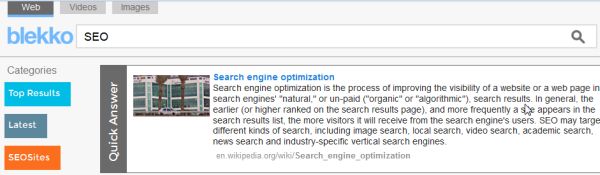
Blekko search
Blekko uses an initiative called slashtags – a text tag preceded by a “/” slash character, which may be used for custom and categorized searches. It also utilizes a unique user interface serving up results by category.

Step 3: Boardreader

If you’re looking for a simple way to search forums and boards, then Boardreader is for you.
Boardreader Search
Boardreader serves up information contained in web forums and message boards. Multiple message boards can be searched simultaneously, allowing users to share information.

Step 4: BuzzSumo

If you need to analyze what content performs best for a topic or competitor, you need BuzzSumo.
BuzzSumo search
Enter your keyword and go! This identifies the most shared links on social networks, as well as influencers for specific topics. It’s one of my personal favorites.

Step 5: CC Search

If you’re looking for media in the public domain, then you need CC Search.
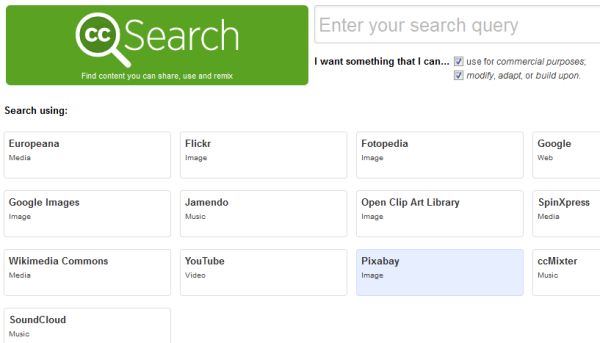
CC search
CC Search is a search aggregator offering access to search results provided by a number of independent organizations. Don’t assume the results displayed are under a creative commons license – always verify it, as sponsored results are served up, as well.

Step 6: CrunchBase

If you’re looking for information about people and startups, then CrunchBase is the place to look.
CrunchBase search
CrunchBase offers an unparalleled dataset of startup activity. More than 500,000 profiles of people and companies are maintained there by thousands of contributors.

Step 7: DuckDuckGo

If you’re concerned about search privacy, then use DuckDuckGo
DuckDuckGo search
If your search history isn’t something that you would be proud to share with grandma or the NSA, then anonymous search engine DuckDuckGo is for you. Personalized results? Fugetaboutit!

Step 8: Quantcast

If you need demographic and traffic stats, then you need Quantcast.
Quantcast search
Free and accurate audience insights for more than 100 million web properties. Find detailed demographic, geographic, and lifestyle information.

Step 9: SocialMention

If you need real-time social media search and analysis, then SocialMention is worth a look.
SocialMention search

Step 10: Technorati

If you need real-time search for user-generated media, then look no further than Technorati.
Technorati search
Technorati uses tags that authors have included on their websites. These tags categorize search results, with the most recent results appearing at the top.

11. Topsy

If you need to search and analyze the social web, especially Twitter, then you should try Topsy.
Topsy search
Social media analytics: Search by time and place, set alerts, and analyze sentiment for every tweet ever made. Discover how often a term is tweeted. Find an influential person on a specific subject.

12. Wolfram|Alpha

If you need access to the world’s facts and data, then WolframAlpha is the place to look.
WolframAlpha search
A computational knowledge engine that answers factual queries by computing the answer from externally sourced “curated data.”

Bottom Line

Google isn’t the only game in town and isn’t even the best alternative for many specific tasks and needs.
What is your favorite non-Google search tool?
Source: https://searchenginewatch.com/sew/how-to/2343048/escape-google-with-these-12-search-engine-alternatives

Tuesday, November 15, 2016

Who Owns the Media?

Who Owns the Media?

Massive corporations dominate the U.S. media landscape. Through a history of mergers and acquisitions, these companies have concentrated their control over what we see, hear and read. In many cases, these companies control everything from initial production to final distribution. In the interactive charts below we reveal who owns what.
FILTER MEDIA MARKET
  • TV and Radio
  •  
  • Cable and Telecommunications
  •  
  • Internet & Print
  • TV and Radio
    2011 Revenue: $6.2 billion
    Company Overview: These private equity firms own Clear Channel, the largest radio station owner in the country. Approximately half of the company's revenue is generated from radio broadcasting. The remaining half comes from advertising companies and other investments.
    Radio: 866 radio stations and Premiere Radio Networks (a national radio network that produces, distributes or represents approximately 90 syndicated radio programs, serves nearly 5,800 radio station affiliates and has over 213 million weekly listeners. Programs include the Rush Limbaugh Show, Glenn Beck and the Sean Hannity Show); Fox Sports Radio; Fox News Radio; Australian Radio Network
    Other: Katz Media (radio advertising broker); American Outdoor Advertising
  • Cable and Telecommunications
    Access to high-speed Internet service — also known as broadband — has become a basic public necessity, just like water or electricity.
    Yet despite its importance, broadband access in the United States is far from universal. Millions of Americans still stand on the wrong side of the "digital divide," unable to tap into the political, economic and social resources of the Web. Meanwhile, cable and phone companies — which hold virtual monopolies over the infrastructure of the Internet — often refuse to build out high-speed broadband to regions that need it most, and actively seek to block communities from seeking their own broadband solutions.
    Take Action to stop their shenanigans.
  • Print
    Consolidation has contributed to tough times for the newspaper industry. When the industry was swimming in profits in the 1990s, big media companies used 14–27 percent profit margins to buy up other properties rather than invest in the quality of their existing products or innovate for the future. Now they want to make it possible for a given company to own a newspaper and a broadcast station in the same market.
    Take Action to save the print industry from itself.
  • Internet
    Giant companies like Apple, Facebook and Google are slowly reconstituting the Internet's walled gardens of old. As these companies try to steer us to their increasingly closed versions of the Internet — and to marketers who benefit from mining our personal information — we must fight for policies that protect our rights as Internet users.
    Take Action to stand up for your online rights.
  • Source: http://www.freepress.net/ownership/chart